 My IB
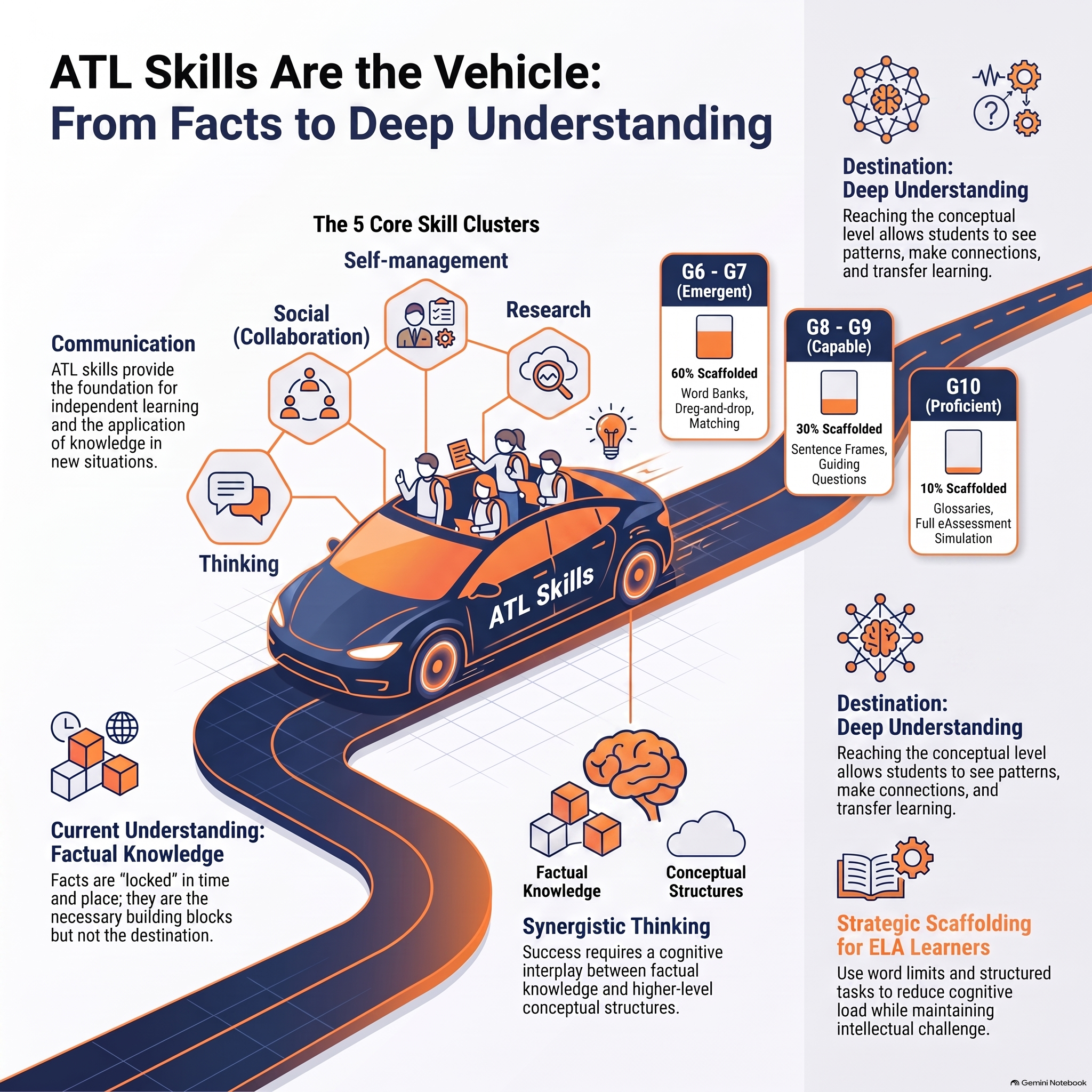
My IB A beautifully designed conceptual pathway is useless if students lack the tools to navigate it. Approaches to Learning (ATL) Skills are the critical bridge between the written and assessed curriculum — if the Unit Plan provides the destination, ATL Skills provide the vehicle to get there.
Why This Matters
Educational purpose: cultivating self-regulated learners
ATL development is about cognitive, affective, and metacognitive skills. Self-regulated learners set their own goals, ask probing questions, generate their own motivation, monitor progress, and reflect on mistakes to adapt strategies.
The common misconception: "they learn by osmosis"
Assigning group work does not teach collaboration any more than throwing a child in a pool teaches the butterfly stroke. Without explicit instruction on delegating tasks or resolving conflicts, students rely on existing, often flawed, habits.
What happens if this is ignored?
Students fail the final task not from lacking factual understanding, but from lacking the specific skill required; teachers end up doing the cognitive heavy lifting; and students fail to transfer strategies to new situations.
Core Concepts
1. The structure of ATL in the MYP
Five Categories span the whole IB continuum: Communication, Social, Self-management, Research, and Thinking. The MYP expands these into 10 developmentally appropriate Clusters (e.g., Thinking splits into Critical thinking, Creative thinking, Transfer). Within each cluster sit Specific Skills — actionable statements you select for your planner, not just the broad category.
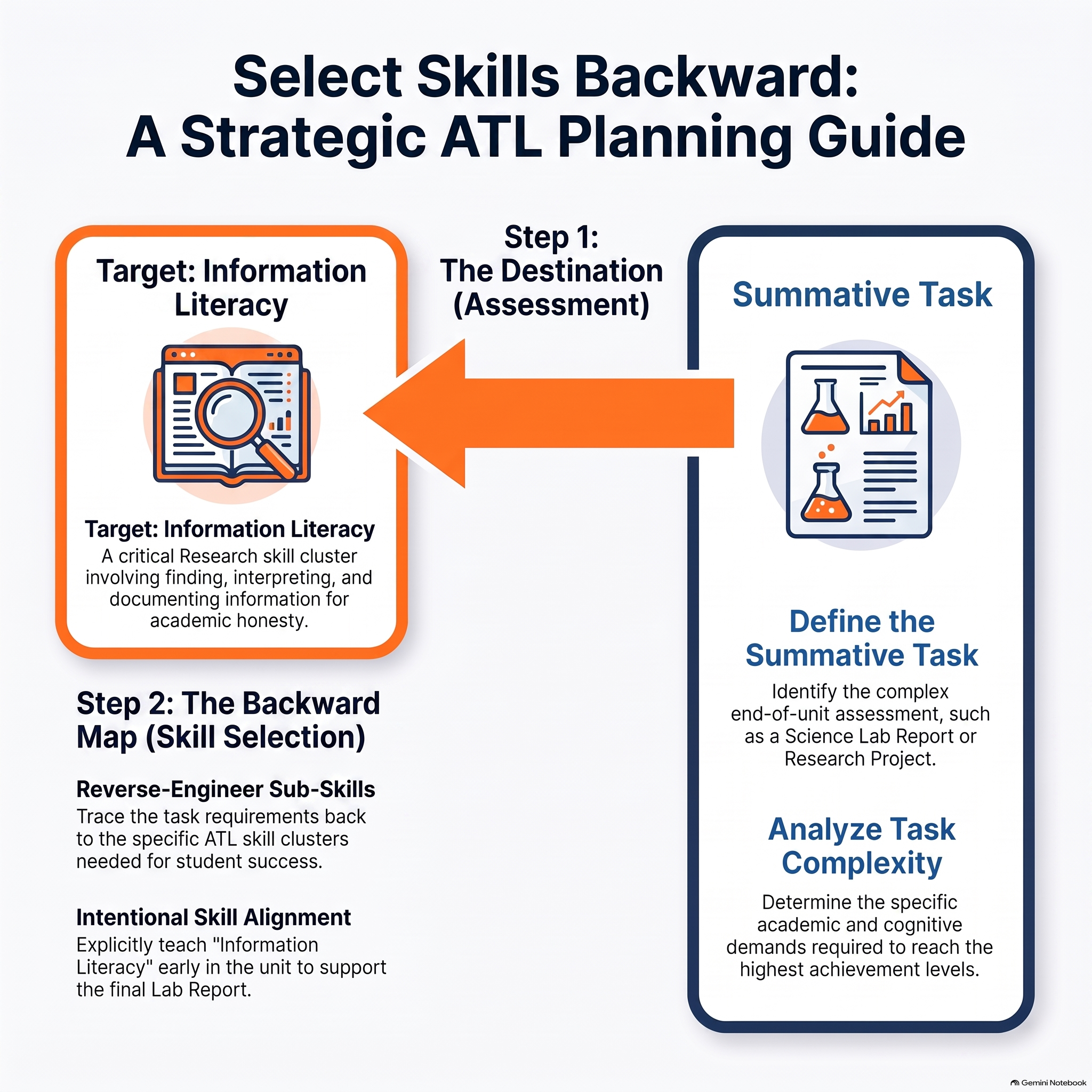
2. Backward design: selecting skills with purpose
Look at the final assessment and ask: "What specific skills will my students need to master to succeed?" If a Science lab report is the summative and students consistently struggle with data tables, the targeted skill must be an Information Literacy skill on processing and recording data. Quality over quantity — deeply teaching one or two skills beats superficially listing ten.
3. The 7-step model for explicit teaching
1) Decide the specific skill needed. 2) Make it explicit — describe it, show high/low proficiency examples. 3) Self-Assess current competence. 4) Analyze class results for deficiencies. 5) Direct instruction — a mini-lesson teaching the steps. 6) Practice in subject-content exercises. 7) Re-assess proficiency before the summative task.
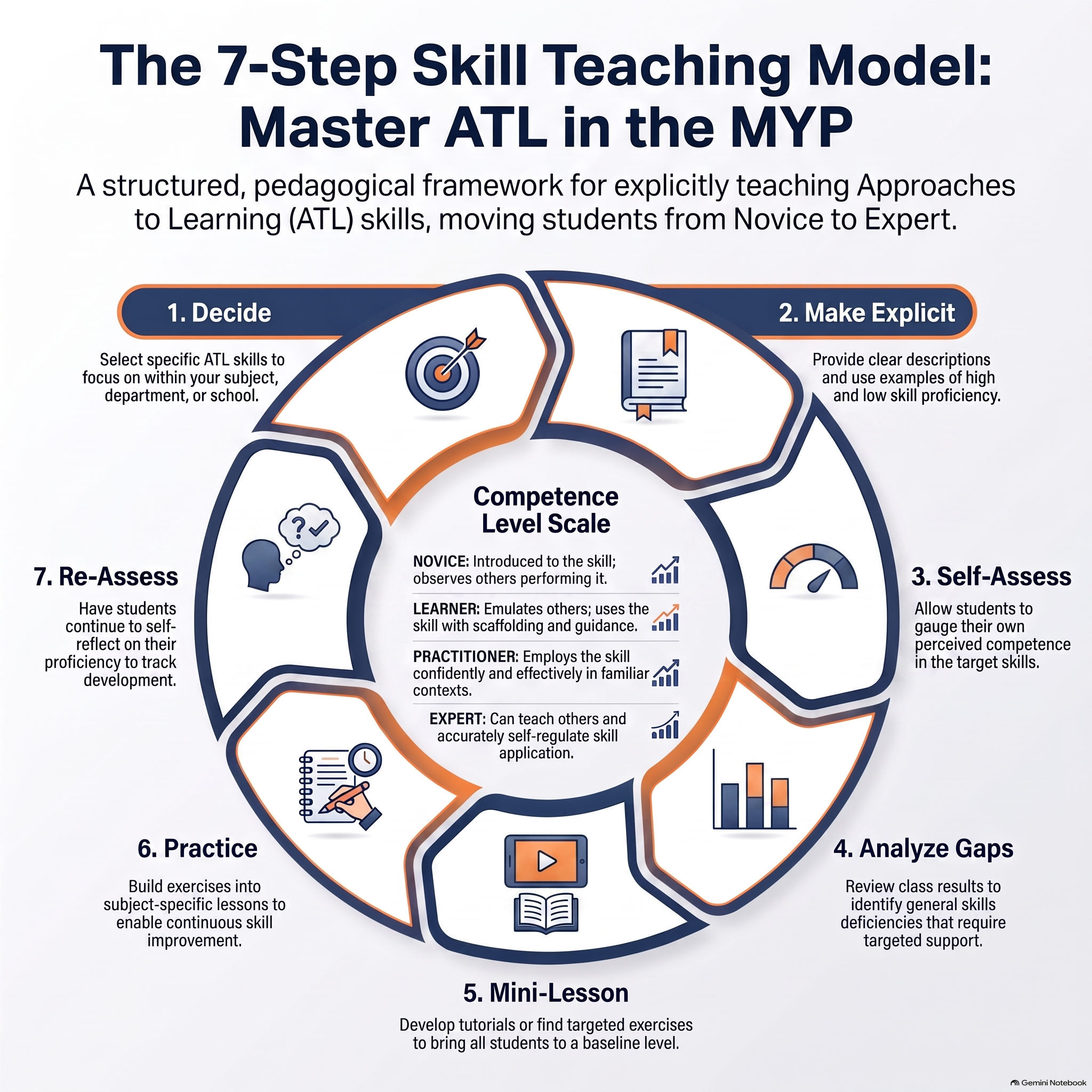
4. Tracking proficiency: the ATL continuum
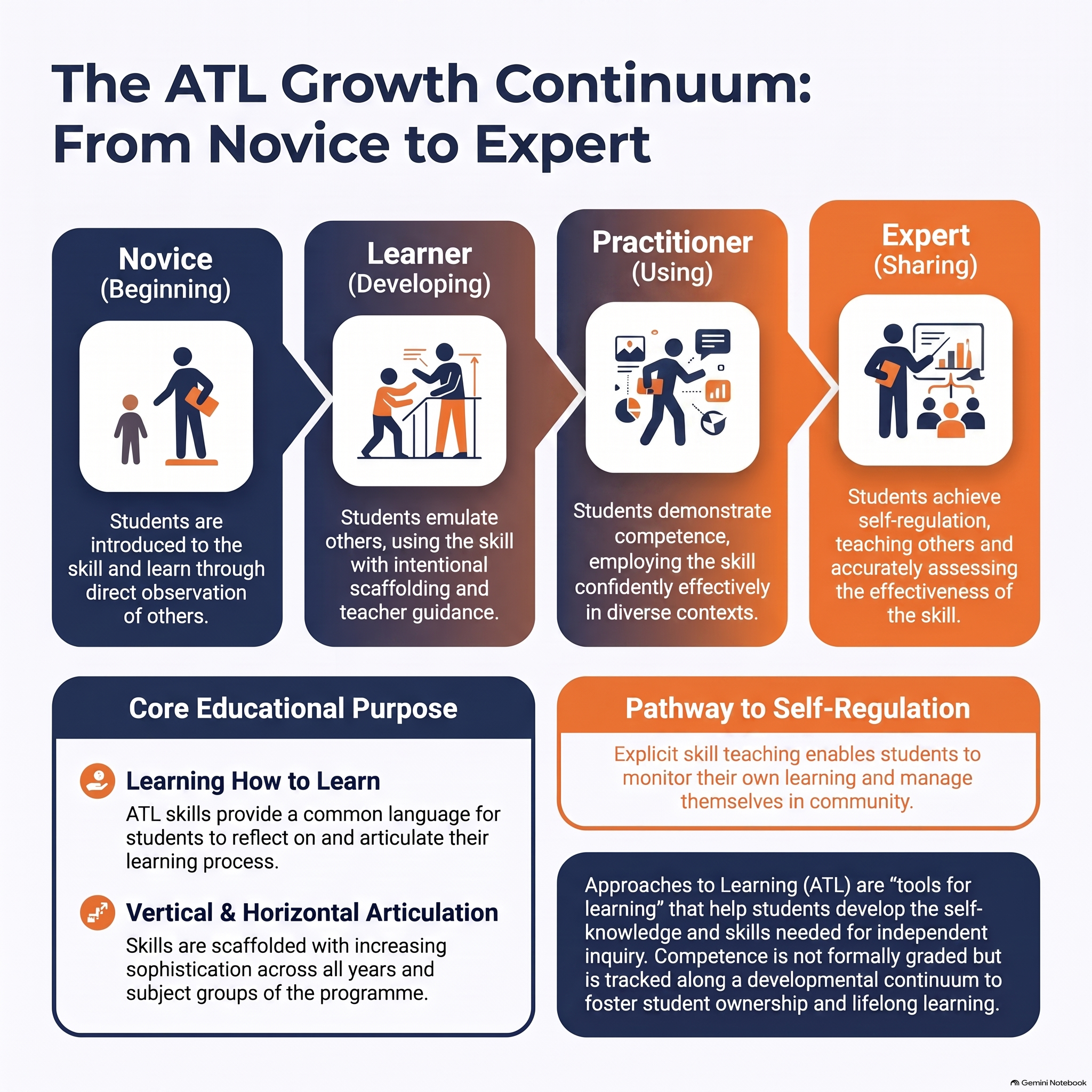
Rather than a letter grade, track development on four stages: Novice (observation), Learner (emulation, heavy scaffolding), Practitioner (confident, independent demonstration), Expert (self-regulation — can teach and assess others).
Common Mistakes
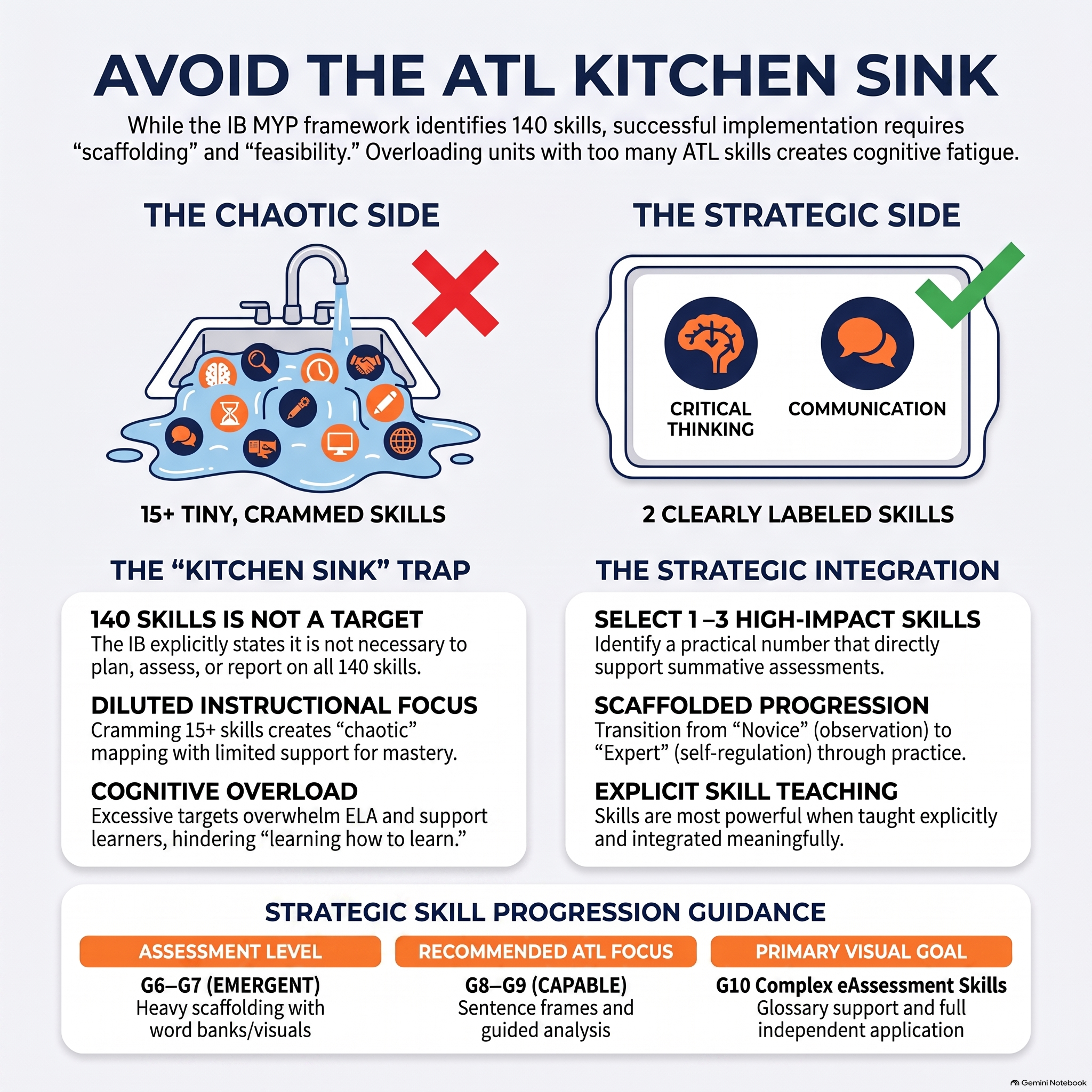
1. The "kitchen sink" approach
The mistake: 15 specific ATL skills listed for a four-week unit.
How to avoid: limit focus to 1-3 core skills, explicitly taught, modeled, and formatively assessed.
2. Grading ATL skills
The mistake: "4 out of 8" for Collaboration on a report card.
How to avoid: ATL skills are never formally graded; give regular formative feedback, keep grades reserved for subject-group objectives.
3. The "invisible" skill
The mistake: "Create references and citations" listed in Inquiry, never taught in Action.
How to avoid: describe clearly how the chosen skill is explicitly taught and practiced within daily learning experiences.
4. Generic assumptions
The mistake: "Students will use critical thinking" as the entire plan.
How to avoid: use specific terminology — "Students will evaluate evidence and arguments to recognize unstated assumptions and bias."
5. Ignoring the affective domain
The mistake: focusing only on Research and Thinking, ignoring resilience and anxiety management.
How to avoid: explicitly teach "bouncing back" strategies, especially before high-stakes assessments.
Practical Classroom Examples
Individuals and Societies. Target skill: evaluate and select information sources (Information Literacy). The teacher models the CRAAP test on a biased website, students practice on a historical source in groups before being trusted with summative research.
PHE. Target skill: give and receive meaningful feedback (Communication). A sentence-stem template ("I noticed you did X well, but next time try Y because...") scaffolds constructive criticism before the complex summative coaching task.
Mathematics. Target skill: persevere and "fail well" (Affective). A "3-Before-Me" routine (book, peer, internet before the teacher) builds resilience through mathematical trial and error.
Design. Target skill: generate novel ideas (Creative Thinking). The SCAMPER protocol forces three wildly different prototype variations before students proceed, turning "be creative" into an actionable tool.
Reflection Questions
- Are the ATL skills I selected genuinely necessary for the final assessment?
- Have I planned dedicated time to explicitly model these skills, or am I hoping students figure them out?
- How do I track student progression from Novice to Expert?
- Do I actively teach and praise affective skills, or only research and writing?
- Does my choice of ATL skills support the Statement of Inquiry and connect facts to concepts?
Quick Checklist: Integrating ATL Skills
- ☐ Identify the need from the summative assessment's cognitive and social hurdles.
- ☐ Select 1-3 highly specific skills, avoiding broad generic categories.
- ☐ Plan a 10-15 minute explicit mini-lesson using models and templates.
- ☐ Embed practice into daily learning experiences.
- ☐ Provide formative feedback via rubric, continuum, or peer-review before the summative task.
- ☐ End the unit with student self-assessment on the Novice-to-Expert continuum.
Key Takeaways
- ATL skills are the tools that allow rigorous, independent, concept-driven learning.
- Self-regulation is the goal — students managing their own learning, emotions, and interactions.
- Explicit teaching is required; adolescents don't naturally possess these skills.
- Quality over quantity — one deeply taught skill beats ten superficial ones.
- Feedback, not grades — ATL skills must never be used to calculate a subject grade.