 My IB
My IB Even the most brilliantly designed Unit Planner is ineffective if it stays a static document on your desk. Inquiry is not a document; it is a daily pedagogical practice — the process, initiated by student or teacher, that moves students from their current understanding to a new, deeper one.
Why This Matters
Educational purpose: the constructivist classroom
Students are not blank slates — they bring prior knowledge and construct meaning by connecting it to new information. Lecture-only teaching produces temporary memorization; inquiry-based learning that requires active engagement, experimentation, and problem-solving leads to the most substantial and enduring learning.
The common misconception: "inquiry means chaos"
Inquiry is often equated with giving students a broad topic and hoping they discover something. In reality, IB programmes feature structured inquiry — carefully scaffolded and more rigorously planned than a textbook reading.
What happens if this is ignored?
The SOI stays an abstract slogan, students remain passive consumers, ATL Skills lie dormant because the teacher does all the cognitive heavy lifting, and students are underprepared for assessments that evaluate transfer, not recall.
Core Concepts
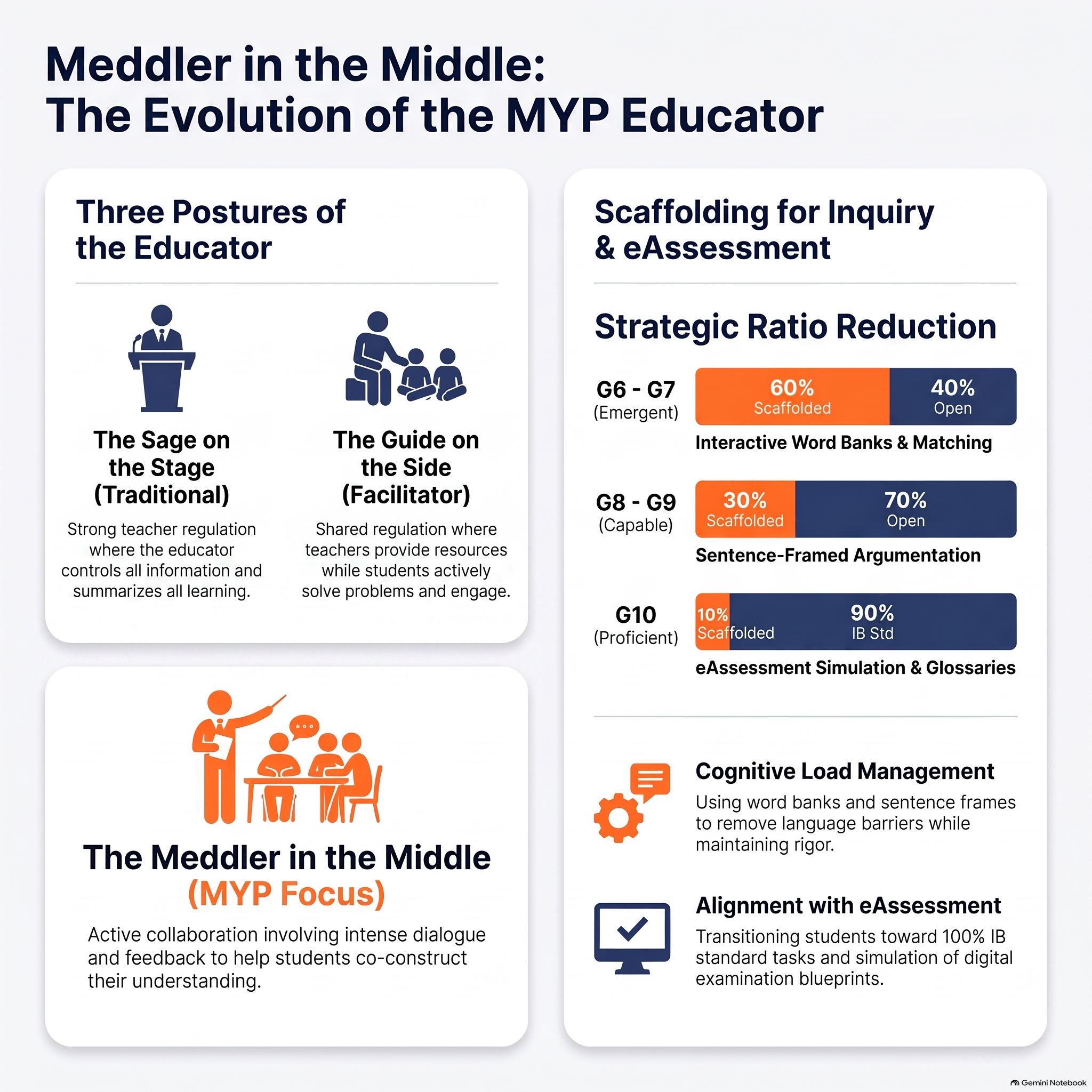
1. Shifting the teacher's role: the "meddler-in-the-middle"
Researcher Erica McWilliam describes teachers moving from "sage-on-the-stage" to "guide-on-the-side" to "meddler-in-the-middle" — actively posing challenges and prompting peer feedback while ensuring students do the intellectual work.
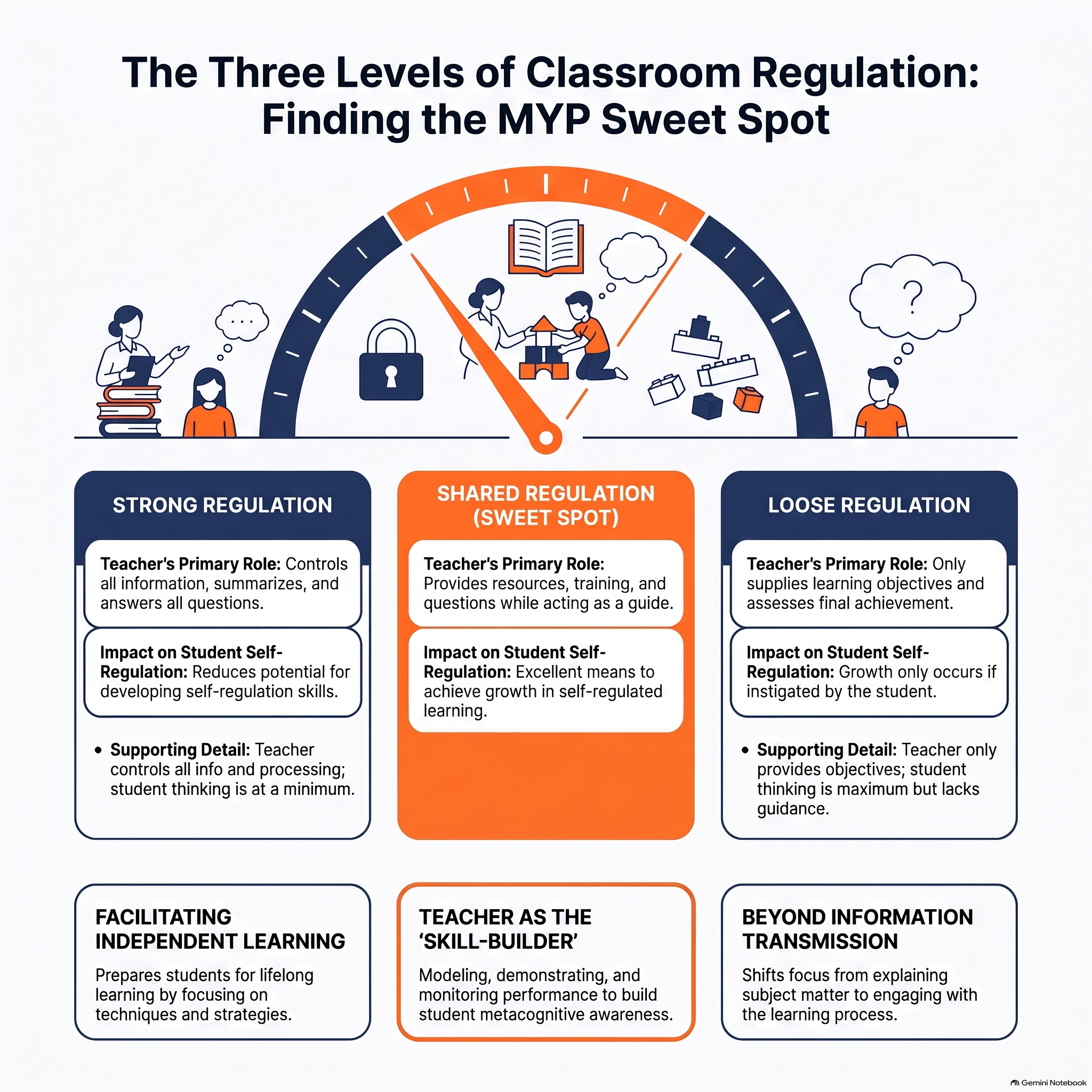
| Teaching Approach | Characteristics |
|---|---|
| Strong Teacher Regulation (Traditional) | Teacher controls all information and explains/summarizes; student thinking is minimal. |
| Shared Teacher Regulation (MYP Inquiry) | Teacher provides access to resources, skills, questions, and concepts; students actively solve problems while the teacher guides. |
| Loose Teacher Regulation (Unstructured) | Teacher only supplies objectives and assesses final achievement; no involvement in student thinking. |
The MYP thrives in the zone of Shared Teacher Regulation.
2. Making thinking visible
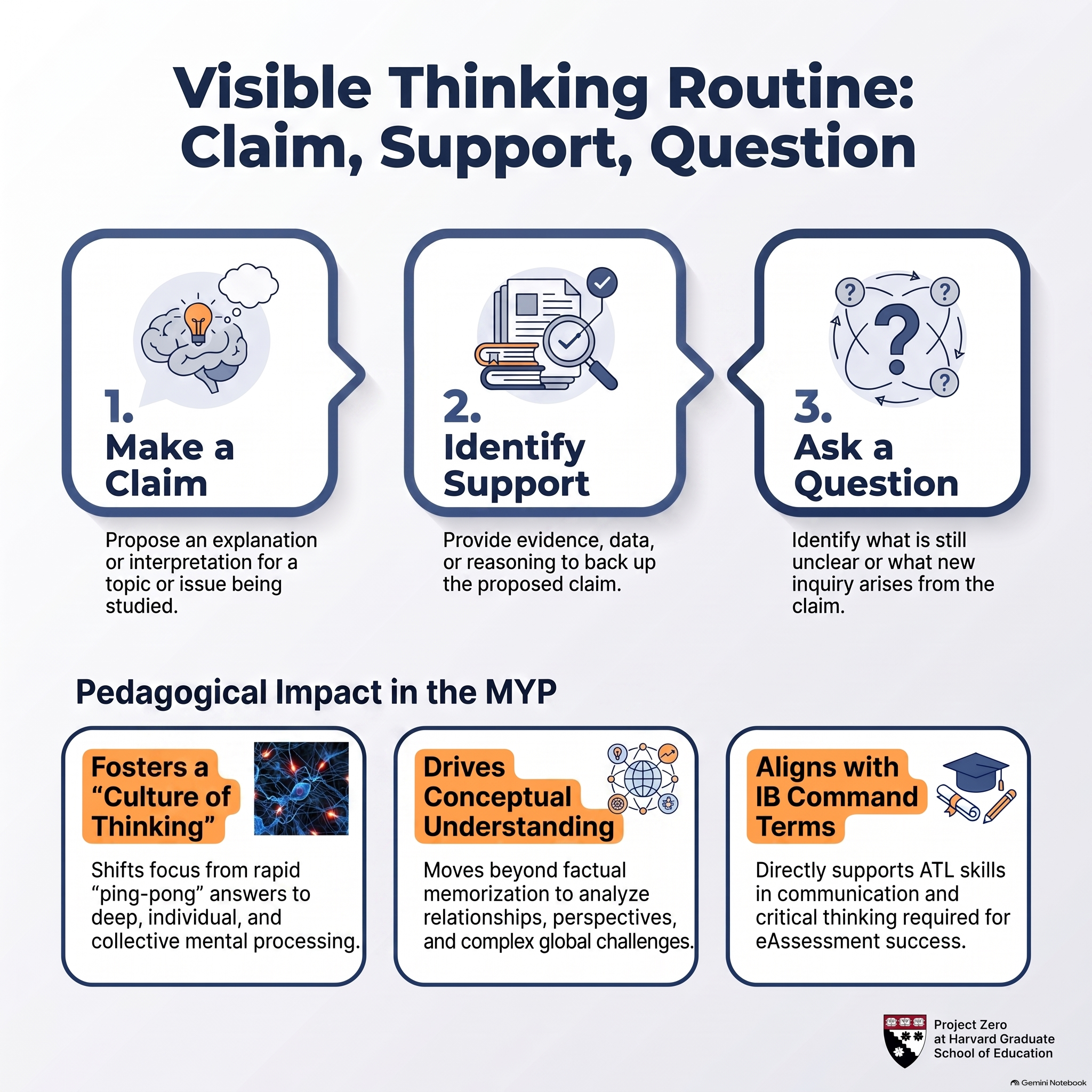
"Visible Thinking" routines (Harvard Project Zero) are short, easy-to-learn steps that scaffold higher-order thinking: Claim, Support, Question mirrors the factual-conceptual-debatable progression directly; Generate-Sort-Connect-Elaborate is a concept-mapping routine; "I used to think... now I think..." helps students reflect on how their conceptual understanding evolved.
3. Problem-Based Learning (PBL)
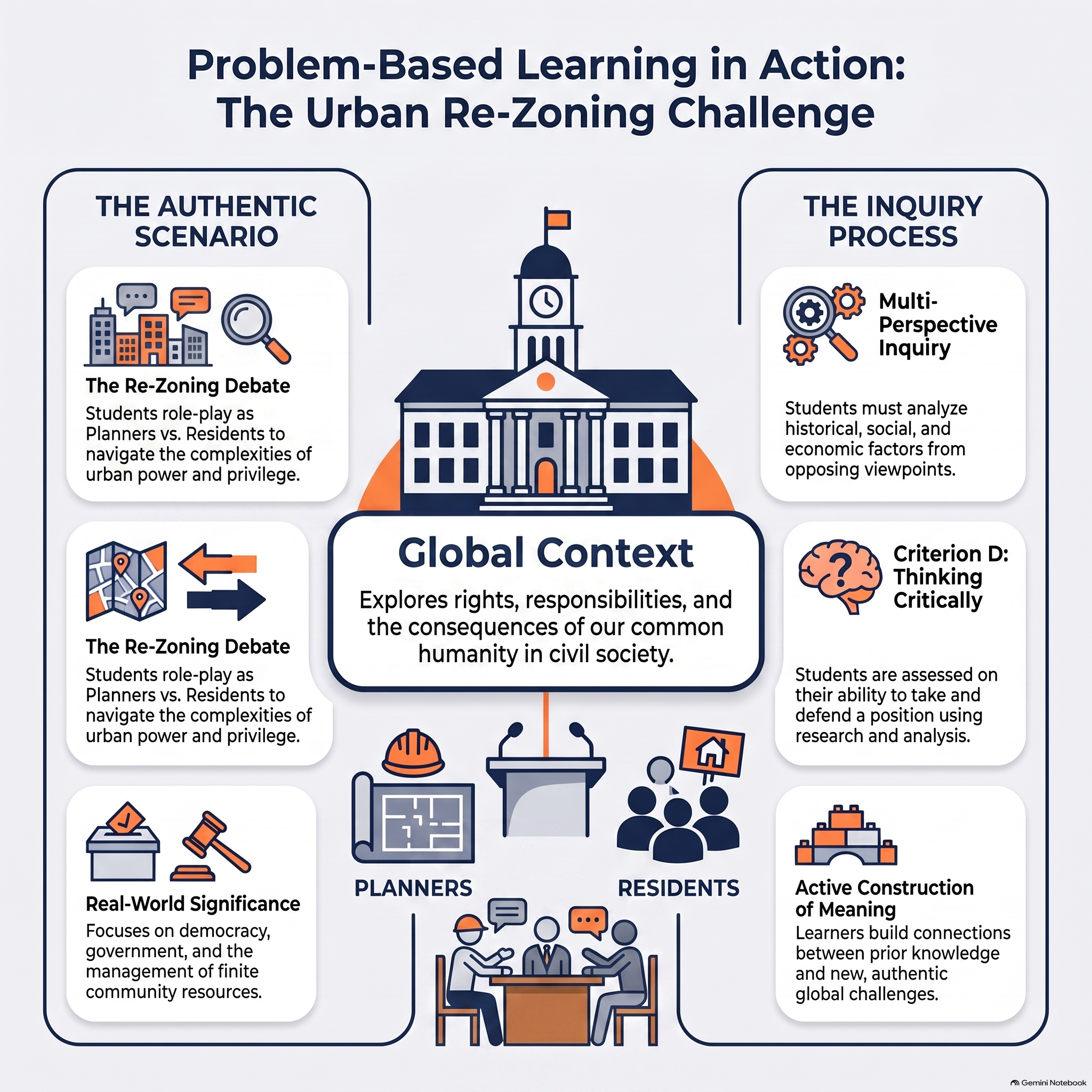
Students analyze and propose solutions to a real-world problem presented open-endedly — aligning perfectly with a specific Global Context. Teams define the problem, identify what they know and need to know, gather information (practicing research ATL Skills), and create justifiable solutions.
4. Experiential learning
Simulations, structured role-play, or hands-on design challenges shift learning from reading about a concept to experiencing it, providing a concrete foundation for abstract conceptual understanding.
Common Mistakes
1. The "answer-first" approach
The mistake: providing the answer after three seconds of silence.
How to avoid: use "Think, Pair, Share" — give students time to construct their own answers before opening the floor.
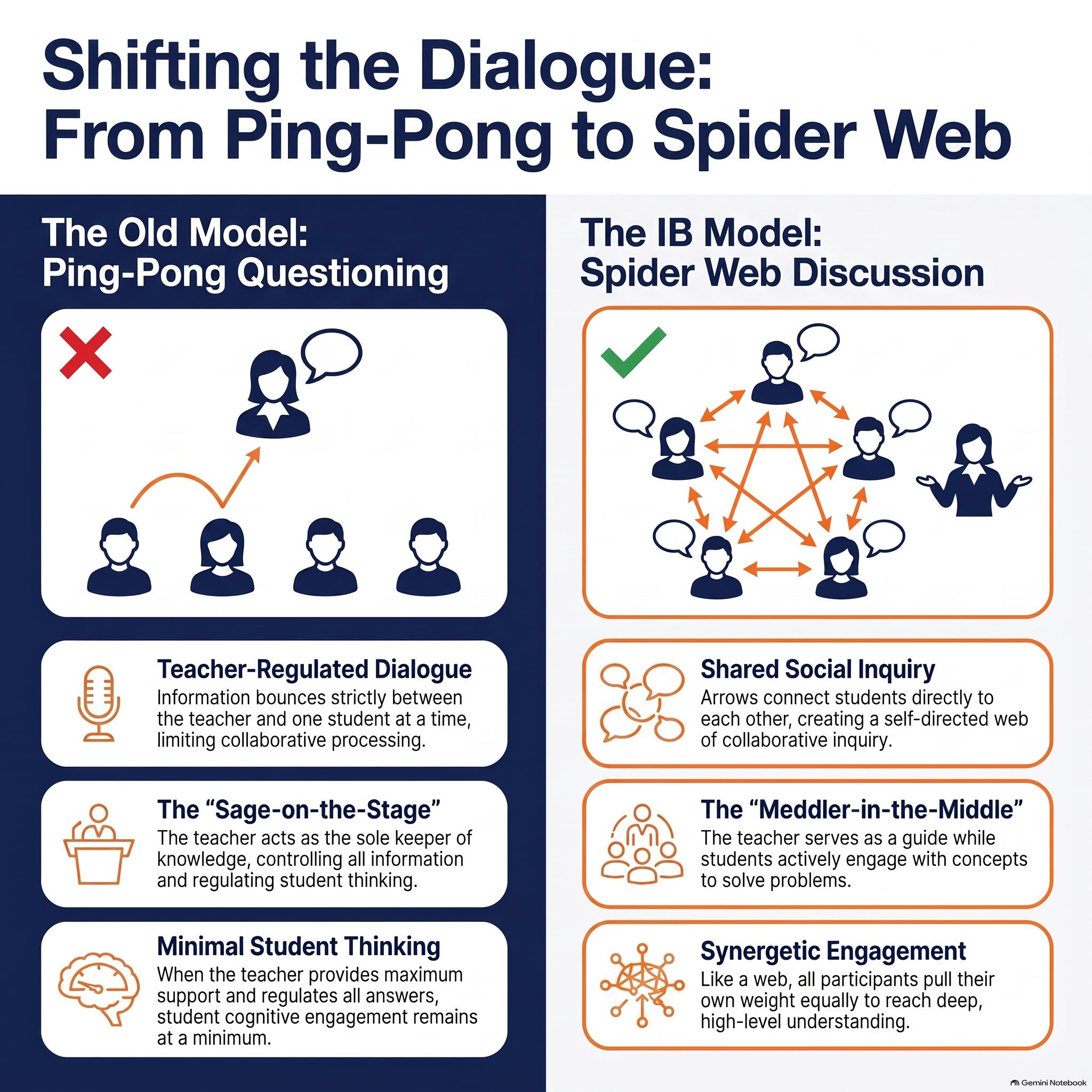
2. The "ping-pong" interrogation
The mistake: rapid-fire, low-level questioning mistaking pace for engagement.
How to avoid: ask conceptual questions requiring evidence-based defense; encourage students to respond to each other, not just the teacher.
3. Expecting skills to develop magically
The mistake: assigning collaborative research without teaching conflict resolution or source evaluation.
How to avoid: pause inquiry to provide direct, explicit skill instruction when you notice a gap.
4. Factual starvation
The mistake: jumping into a debatable question with no background knowledge.
How to avoid: front-loading content is essential; direct instruction is valid when it builds the foundation for inquiry.
5. Ignoring formative feedback
The mistake: proceeding through the planned sequence regardless of whether students are grasping concepts.
How to avoid: use exit tickets or process journals daily and adjust the next lesson based on the data.
Practical Classroom Examples
"Spider Web" Discussion (Language and Literature). The teacher sits outside a student discussion circle, drawing lines to track who speaks to whom. Students self-assess Communication and Social ATL Skills afterward using the "web" map.
Inquiry Cycle (Sciences). A phenomenon (two plants, different growth) launches the cycle: engaging with the question, designing procedures, prioritizing evidence, formulating explanations connected to the Key Concept of Systems — directly preparing students for Criterion B.
Problem-Based Learning (Individuals & Societies). A real re-zoning dispute (corporate campus vs. historical neighborhood) requires teams to define what they need to know, gather primary-source data, analyze competing perspectives, and present a justifiable solution.
Conceptual Transfer (Mathematics). After mastering the volume formula, students experiment with 3D models to discover that different shapes can hold equivalent volume, then transfer that understanding to real-world packaging design.
Reflection Questions
- If a visitor walked in, who would be doing the most talking and thinking — me or the students?
- Am I providing enough "wait time" for students to construct a thoughtful response?
- How am I making student thinking visible — documented and mapped, or gone into the air?
- When students struggle collaboratively, do I give the answer or teach the missing ATL skill?
- How am I using today's formative data to change tomorrow's teaching?
Quick Checklist: Making Inquiry Visible
- ☐ Plan the pivot — identify where you'll shift from direct instruction to inquiry.
- ☐ Embed a Visible Thinking routine to force active cognitive processing.
- ☐ Prepare 2-3 open-ended conceptual questions in advance.
- ☐ Check the ATL connection and plan a 5-minute mini-lesson.
- ☐ Design a formative check linked to the Statement of Inquiry.
Key Takeaways
- Inquiry is an active process — moving from transmission to the collaborative construction of meaning.
- The teacher is a facilitator, operating on shared regulation as a "meddler-in-the-middle."
- Thinking must be visible through routines that externalize student thought.
- PBL and experiential learning anchor abstract concepts in real-world problems.
- Inquiry requires explicit teaching of both skills and factual foundations.