 My IB
My IB Having a list of questions on the planner is not the same as facilitating an inquiry-based classroom. This chapter is about bridging the gap between the written curriculum and the delivered curriculum by sequencing Inquiry Questions into a coherent, investigative line of inquiry — moving students systematically from foundational facts to complex, transferable concepts.
Why This Matters
Educational purpose: the constructivist journey
A meaningful line of inquiry moves from real-world examples to concepts, ideas, theories, and facts, facilitating "synergistic thinking" between factual details and conceptual frameworks — deeper engagement that produces retained, transferable knowledge.
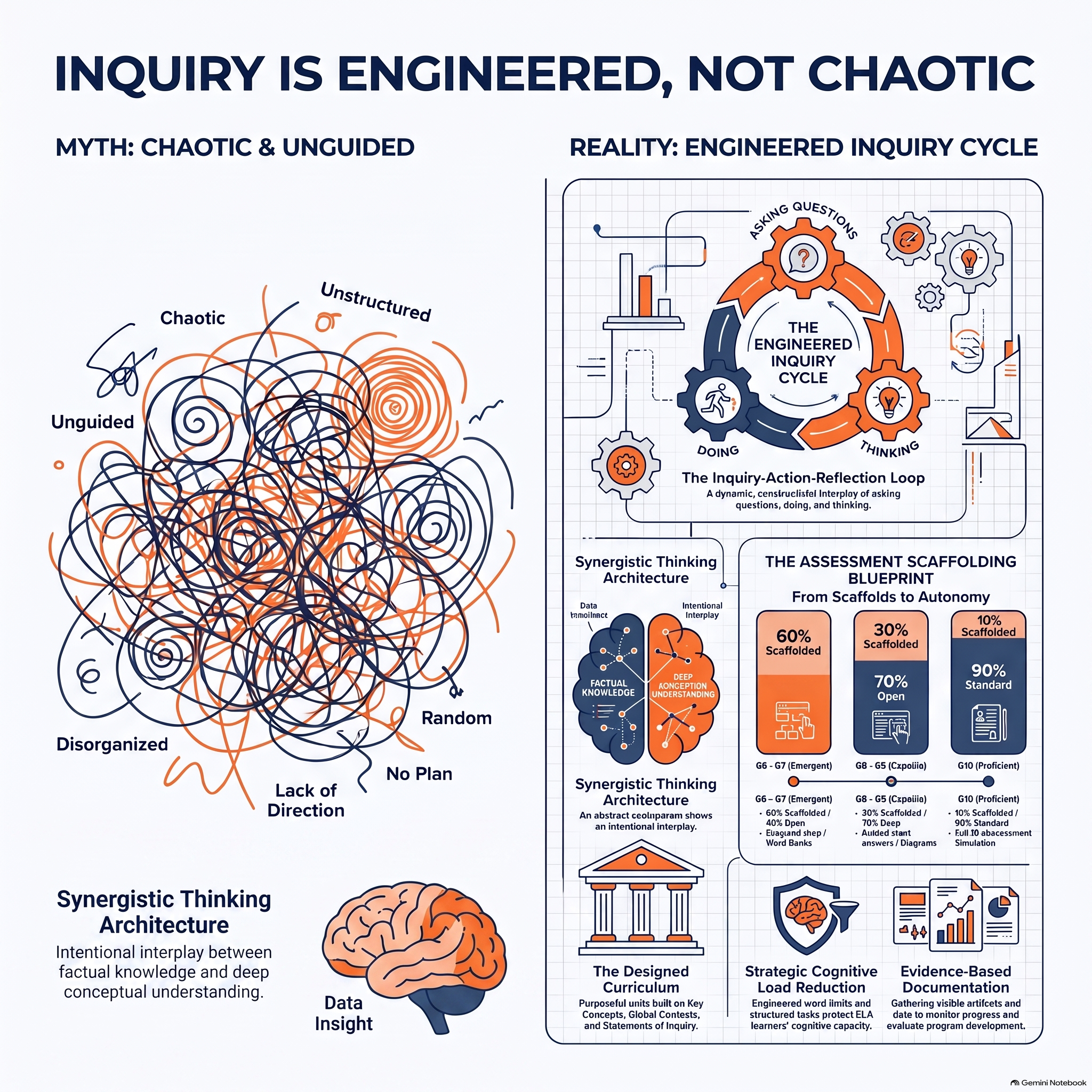
The common misconception: "inquiry is unstructured"
Inquiry-based teaching is often mistaken for posing a broad question and letting students "discover" answers unaided. In reality, IB education features structured inquiry — deliberate curriculum design that shifts the teacher's role to expert facilitator, not absent bystander.
What happens if this is ignored?
Teaching devolves into the "activity trap" — disconnected, activity-driven lessons; the SOI becomes an isolated wall sentence; students reach the summative without the conceptual frameworks or ATL Skills they need, resulting in poor performance and anxiety.
Core Concepts
1. The inquiry cycle as a daily framework
Inquiry is a continuous, iterative cycle of Inquiry (asking, drawing on prior knowledge), Action (doing — designing procedures, gathering data, practicing ATL Skills), and Reflection (thinking — formulating explanations, connecting findings, reappraising perceptions). A single line of inquiry cycles through these phases multiple times within one unit.
2. Scaffolding the pathway
A coherent line of inquiry sequences questions to scaffold understanding: the factual foundation front-loads content and vocabulary; the conceptual bridge asks students to find patterns using Key and Related Concepts; the debatable destination culminates in synthesizing knowledge to evaluate perspectives and address a real-world challenge tied to the Global Context.
3. Integrating ATL Skills
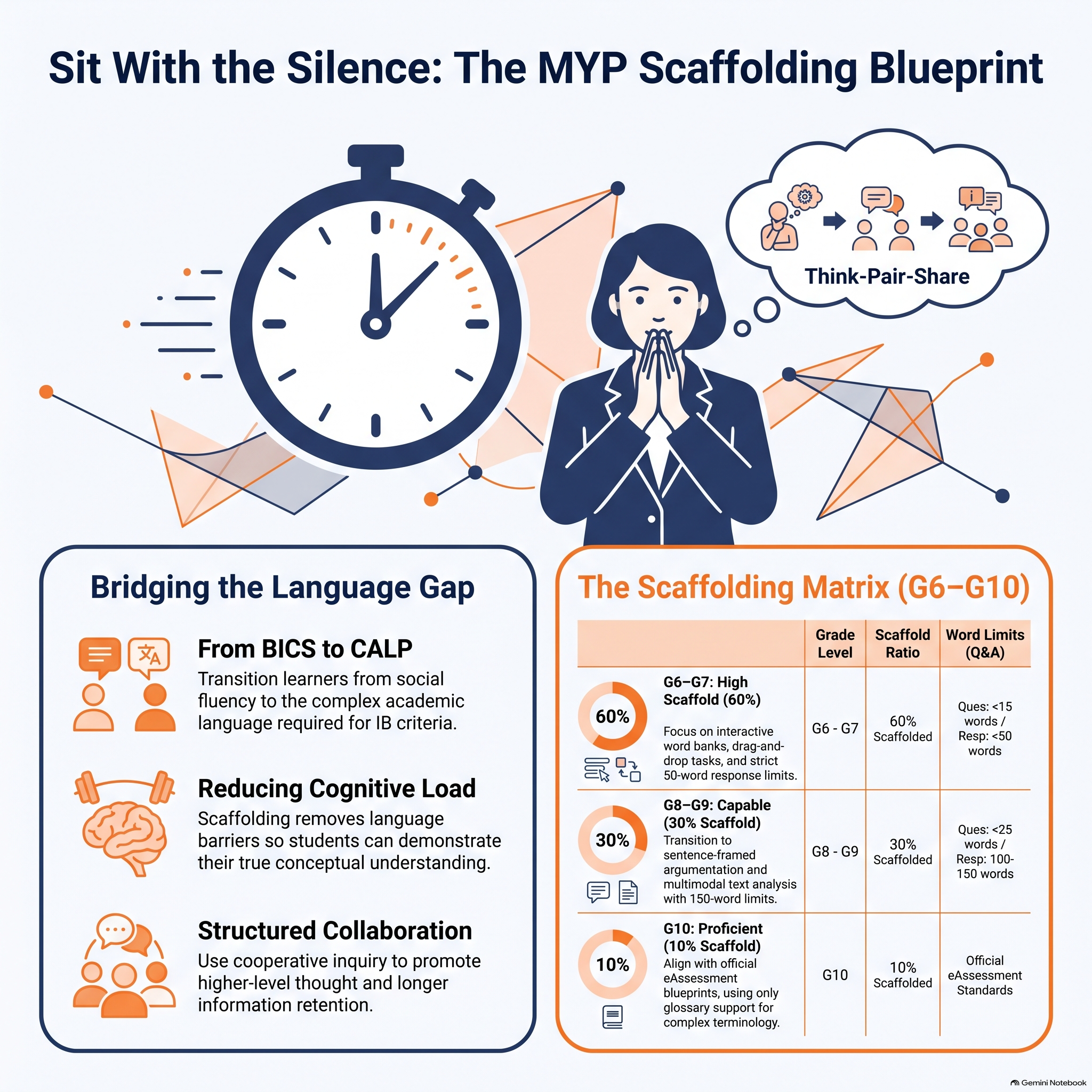
A line of inquiry collapses if students lack the skills to travel it. If the pathway requires independent research into a historical event's causes, you must embed a mini-lesson on evaluating source validity and citing information — the line of inquiry provides the authentic content through which transferable skills develop.
4. Alignment with the assessed curriculum
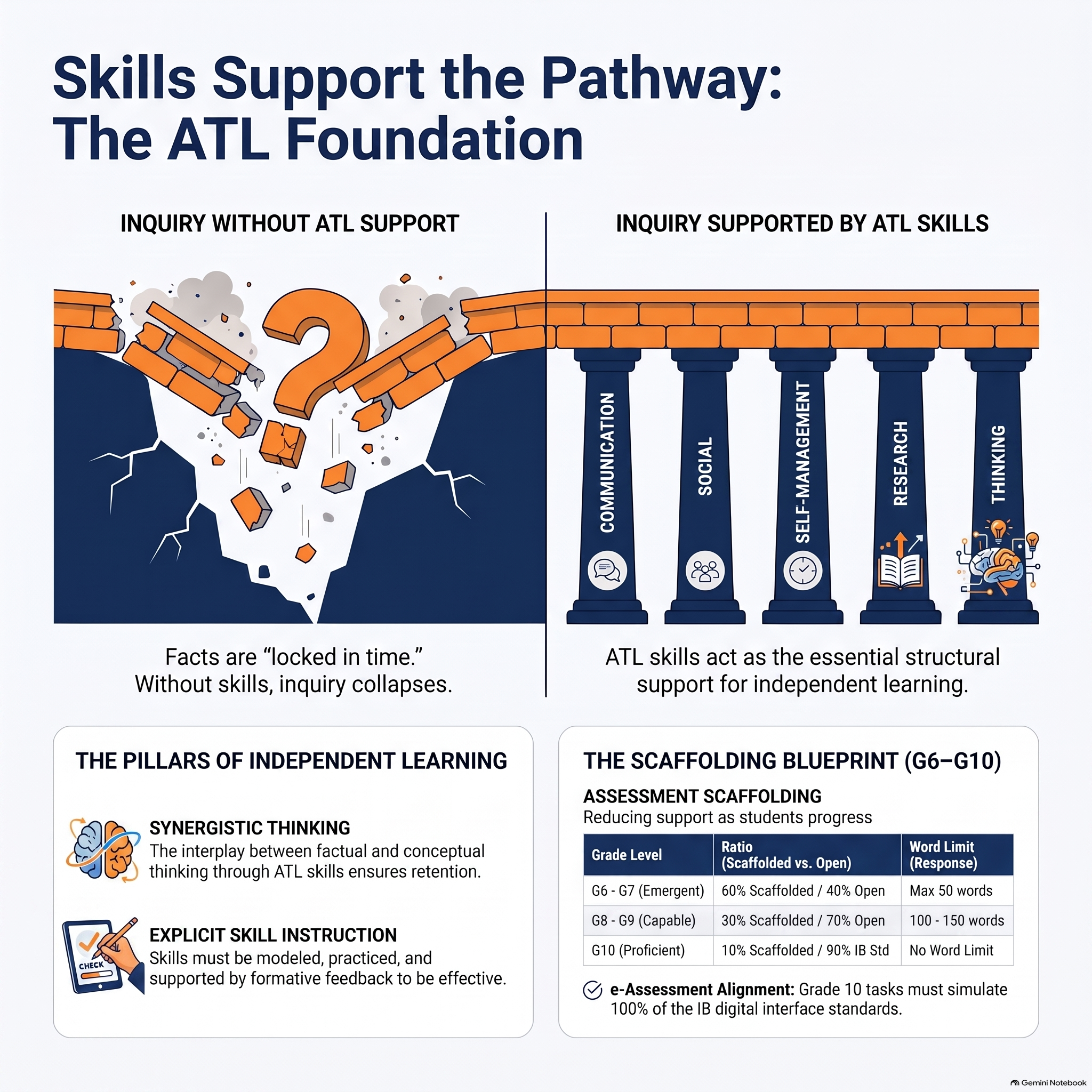
The ultimate destination of any line of inquiry is the summative assessment. If the summative requires designing a scientific investigation, daily lines of inquiry must provide formative opportunities to practice formulating hypotheses and identifying variables.
Common Mistakes
1. The "answer-first" approach
The mistake: posing a compelling question, then immediately lecturing the "correct" answer.
How to avoid: shift to "drawing understandings from" rather than "telling understandings to" — use Think-Pair-Share or Claim-Support-Question to force independent construction of meaning first.
2. Treating formative assessment as a separate event
The mistake: viewing formative checks as mini-tests that interrupt the line of inquiry.
How to avoid: integrate exit tickets, process journals, and peer feedback seamlessly, using the data to modify the next lesson.
3. The "invisible" concepts
The mistake: Key and Related Concepts listed on the planner but never spoken aloud in class.
How to avoid: make the concepts active verbs — "Let's analyse the Structure of this poem to see how the author manipulates Perspective."
4. Ignoring learner variability
The mistake: a rigid pathway expecting all students to access material at the same pace through the same materials.
How to avoid: differentiate the pathway with varied modes (visual, audio, kinaesthetic) and scaffold heavily for EAL students while extending for others.
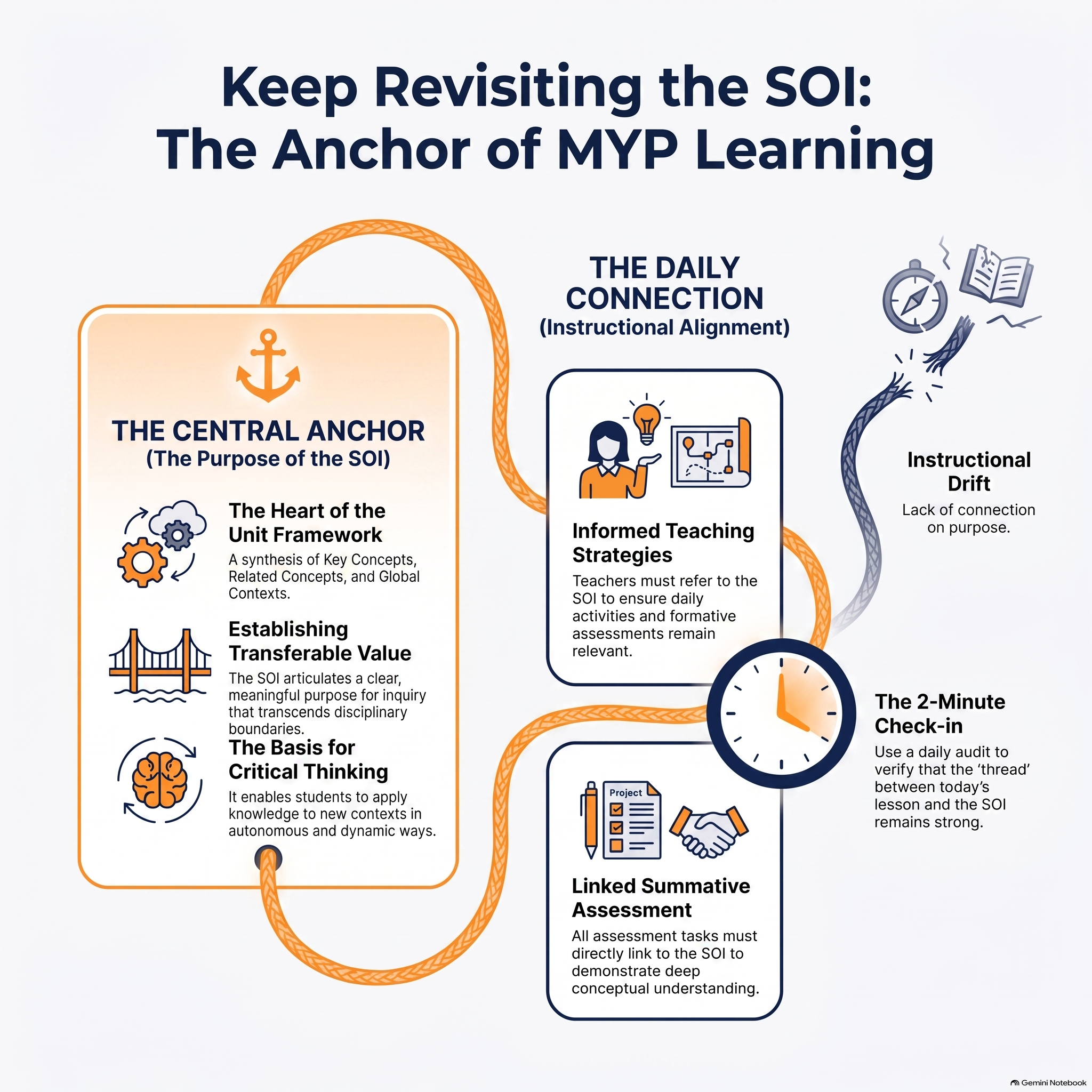
5. Forgetting to revisit the Statement of Inquiry
The mistake: the SOI is introduced on Day 1 and ignored until the final exam.
How to avoid: continually ask "Based on what we discovered today, how has our understanding of the SOI changed?"
Practical Classroom Examples
Language and Literature. SOI: Authors manipulate genre and perspective to challenge audiences to reflect on fairness and development. Factual (Days 1-4): dystopian genre conventions and narrative perspective. Conceptual (Days 5-10): how a child narrator forces the audience to view inequality differently. Debatable/Assessment (Days 11-15): "To what extent does dystopian fiction inspire real-world social change?" — students write their own dystopian narrative challenging a modern norm.
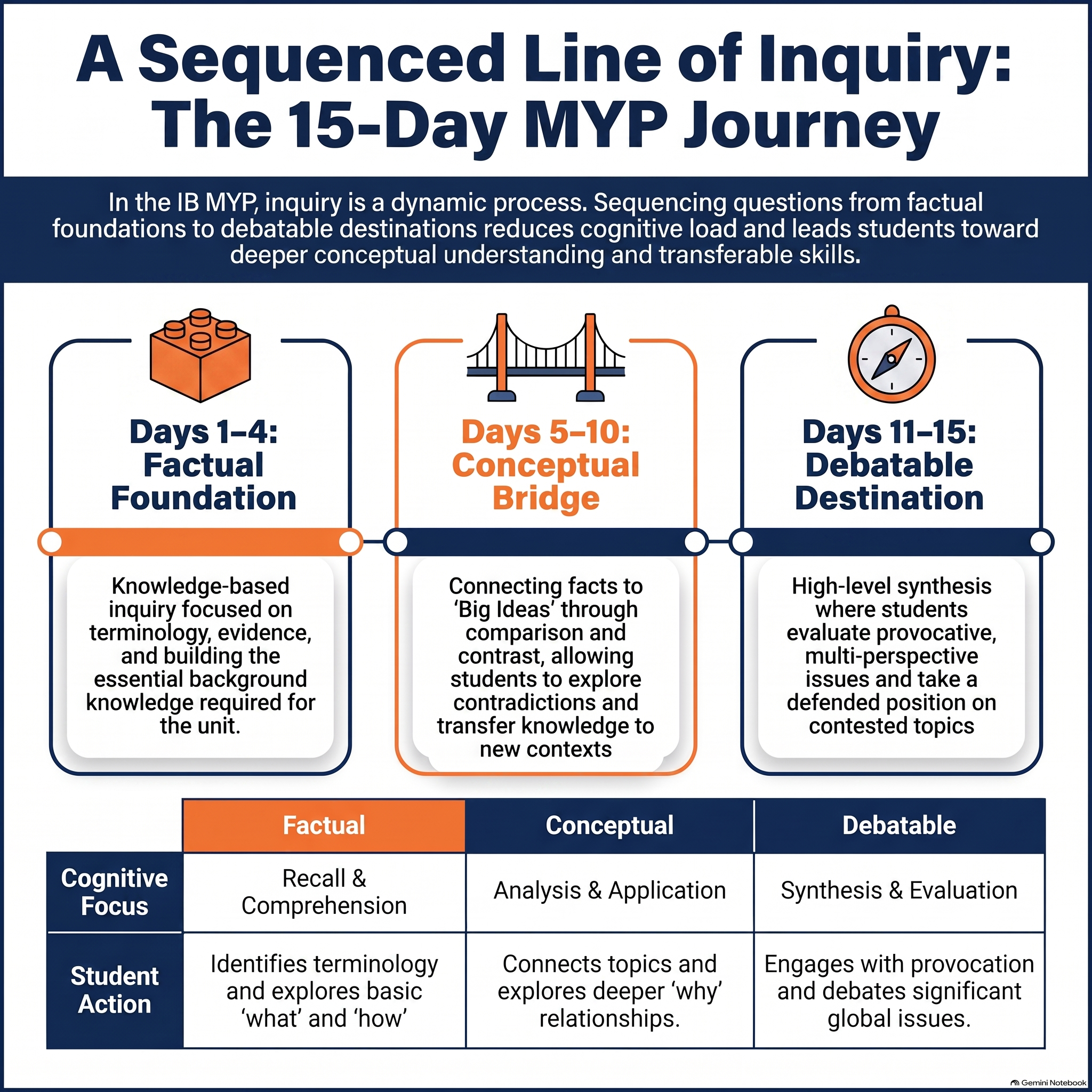
Sciences (Biology). SOI: Biological systems rely on the transformation of energy, a balance easily disrupted by human innovation. Factual (Days 1-3): chemical equations for photosynthesis and respiration. Conceptual (Days 4-8): a lab tracking energy transformation, modeling interdependence. Debatable/Assessment (Days 9-14): debating deforestation's economic benefits vs. disruption to energy systems.
Individuals and Societies (History). SOI: The unequal distribution of resources frequently dictates the structure of global systems and power. Factual (Days 1-4): geographical distribution of resources along the Silk Road. Conceptual (Days 5-9): "Spider Web Discussion" on how resource access consolidated power. Debatable/Assessment (Days 10-15): comparing a modern resource conflict to historical patterns.
Reflection Questions
- Are my lessons a logical Factual-Conceptual-Debatable pathway, or a random collection of activities?
- Am I front-loading enough factual knowledge for all students to engage in deep conceptual thinking?
- How often do I explicitly reference the Key and Related Concepts in daily dialogue?
- Are my formative assessments giving me real-time data, or just generating grades?
- Does every step prepare students with the knowledge and ATL Skills for the final assessment?
Quick Checklist: Designing the Pathway
- ☐ Establish the destination — look at the SOI and summative task.
- ☐ Plan the factual foundation — vocabulary, formulas, rules, context.
- ☐ Build the conceptual bridge — connect facts using Key and Related Concepts.
- ☐ Embed ATL instruction — explicit mini-lessons where students will struggle.
- ☐ Plan formative checkpoints — exit tickets, process journals.
- ☐ Prepare for the debate — culminate with a real-world, Global-Context-linked scenario.
Key Takeaways
- Effective MYP classrooms use structured lines of inquiry, deliberately guiding students from facts to complex conceptual understanding.
- The cycle is continuous — Inquiry, Action, and Reflection recur throughout a unit.
- Pedagogy must shift from "telling" to "drawing understandings from" students.
- Skills must be taught — a strong line of inquiry provides authentic opportunities to teach ATL Skills explicitly.
- Assessment drives the journey — every lesson must prepare students for the final summative task.