 My IB
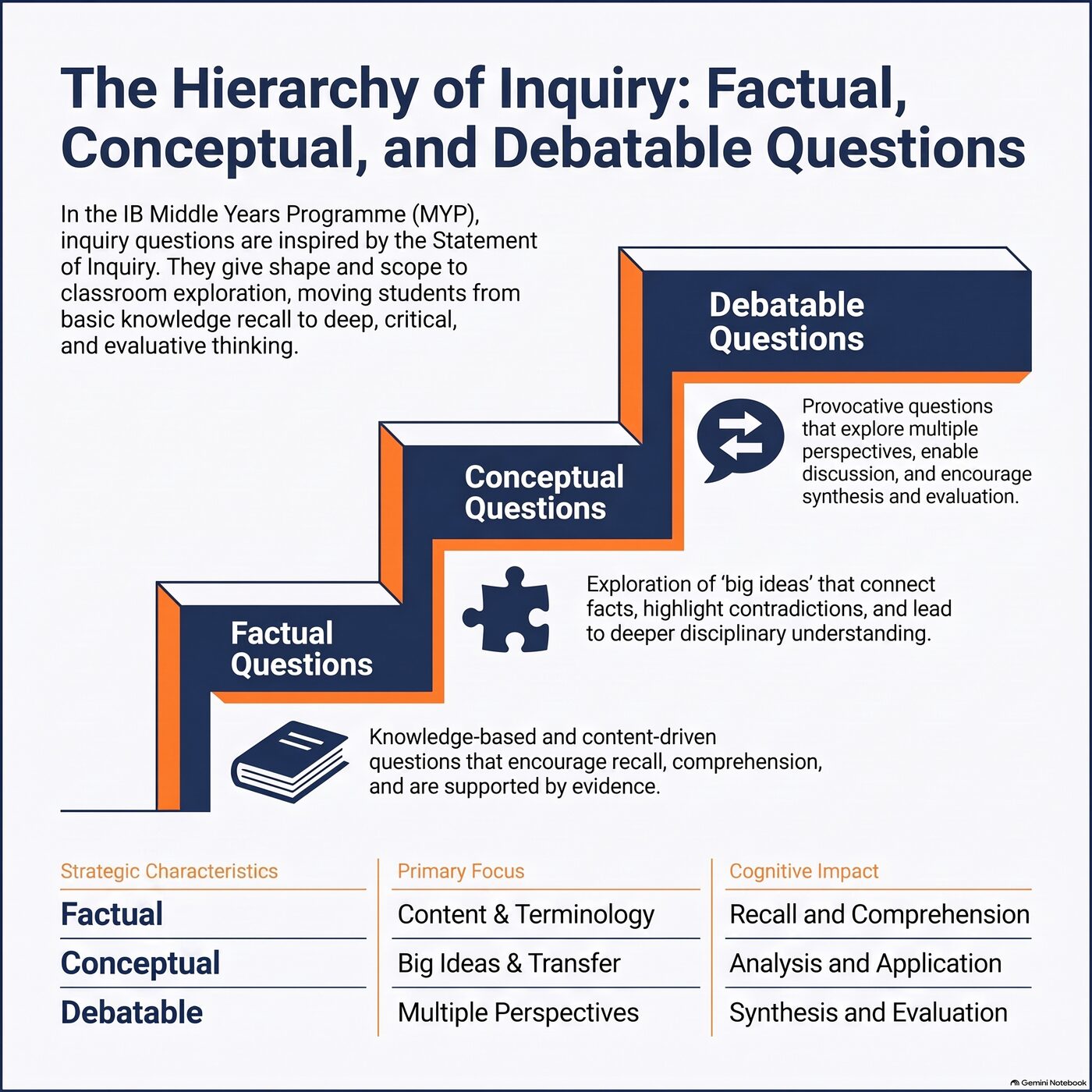
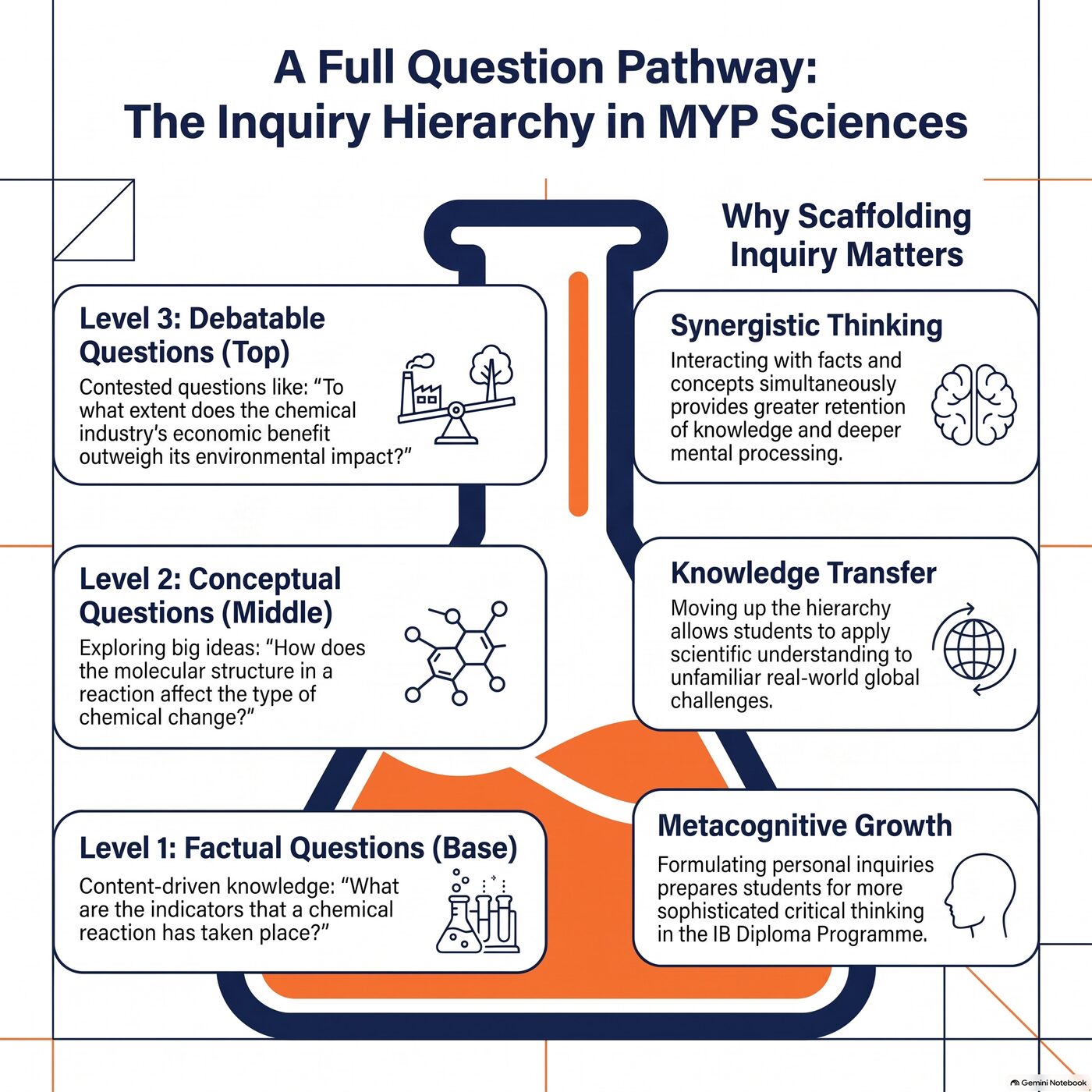
My IB If the Statement of Inquiry is the destination, Inquiry Questions are the pathway. Located in the Inquiry section of the Unit Planner, they give shape and scope to a unit, moving students from their current understanding to a deeper realization of the subject matter. The MYP categorizes them into three types: Factual, Conceptual, and Debatable.
Why This Matters
Educational purpose: the engine of constructivism
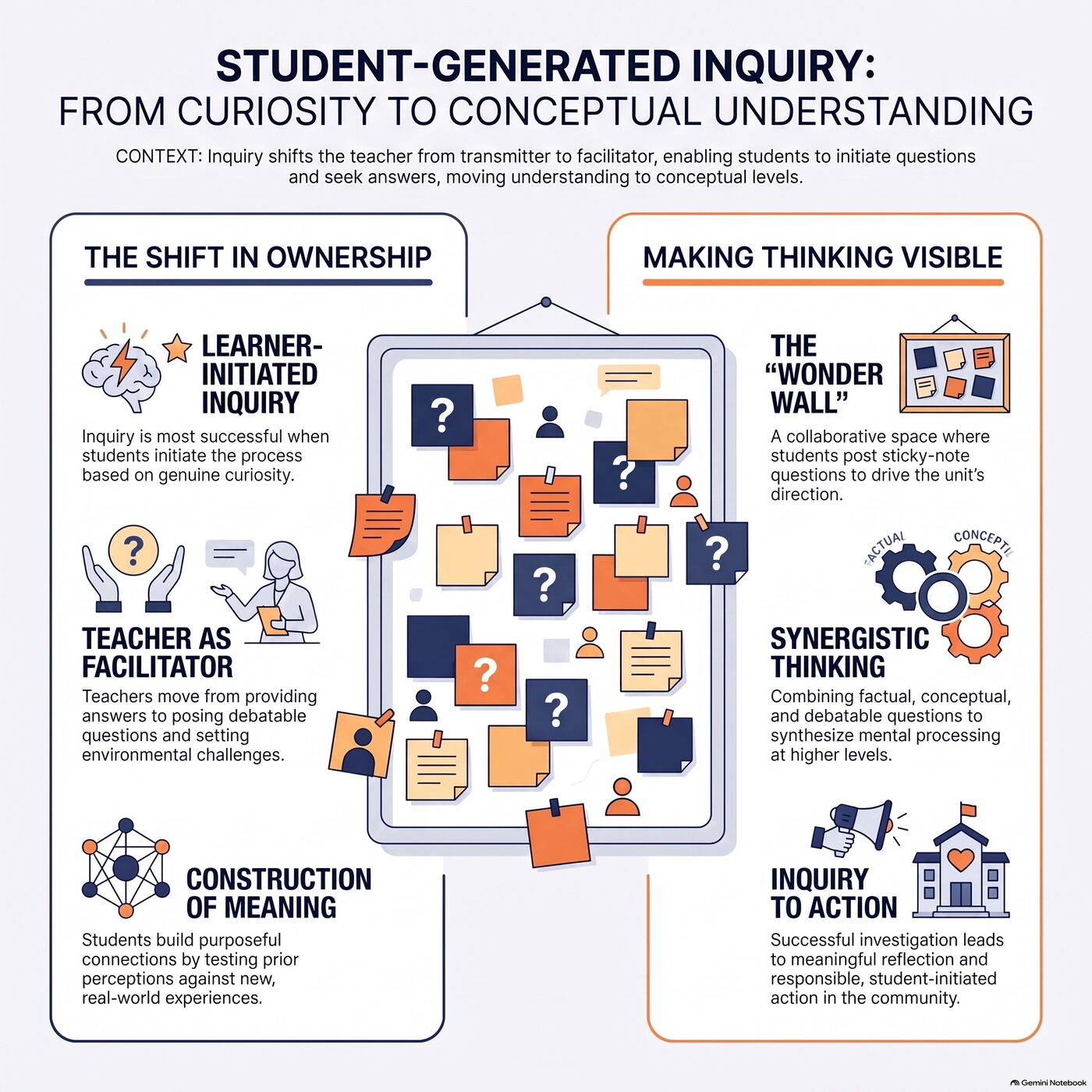
Inquiry questions force a shift from a teacher who supplies answers to one who promotes questions and facilitates exploration. Well-designed questions act as intellectual scaffolds, elevating discrete facts into transferable conceptual understandings.
The common misconception: "just fill in the boxes"
A common trap is writing one question of each type simply because the template demands it, then never revisiting them once the unit begins.
What happens if this is ignored?
The unit lacks direction, the SOI stays an abstract sentence on the wall, students miss the relevance of daily tasks, and classroom dialogue stays superficial rather than critical.
Core Concepts: The Three Tiers of Inquiry
1. Factual questions (the "What")
These establish foundational knowledge — content-driven, knowledge-based, supported by evidence. They usually have a definitive right answer and build the vocabulary and context needed for deeper discussion.
2. Conceptual questions (the "How" and "Why")
These bridge isolated facts to overarching ideas, forcing students to synthesize facts through the Key and Related Concepts, look for patterns, and compare and contrast.
3. Debatable questions (the "To what extent")
These are the destination of the inquiry — provocative, multi-perspective, and contested. They form the basis of rich discussions (like Socratic seminars) and frequently align with the summative assessment prompt.
Empowering Student-Led Inquiry
While teachers design the core questions, MYP planning also expects students to generate and answer their own factual, conceptual, and debatable questions — a wonder wall or digital board where students post questions as the unit progresses transfers ownership of learning to the student.
Common Mistakes
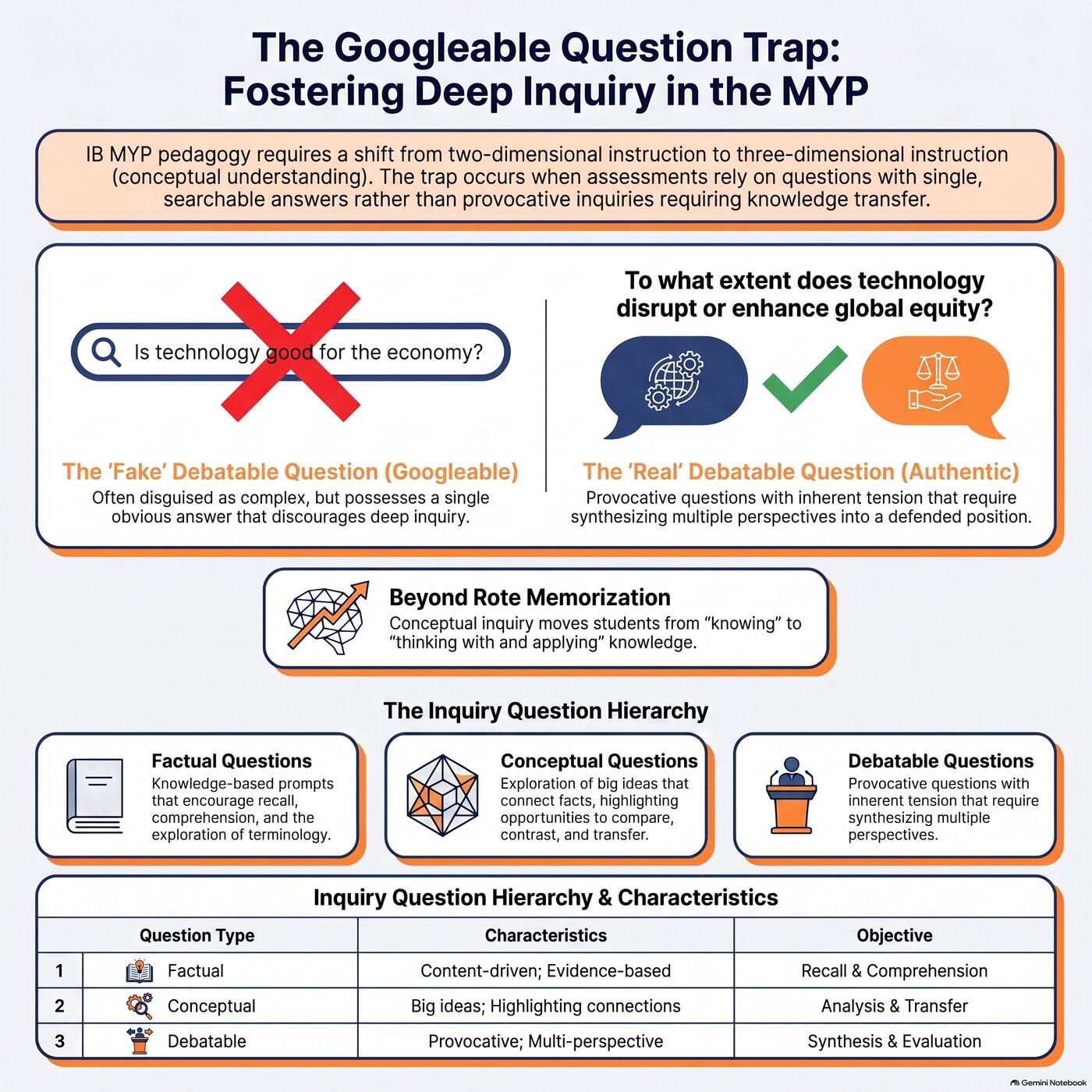
1. The "Googleable" debatable question
The mistake: "Did the Industrial Revolution happen in the 19th Century?" — a factual question disguised as debatable.
How to avoid: use stems like "To what extent..." or "Is it ever justified to..." to ensure genuine tension.
2. The disconnected question
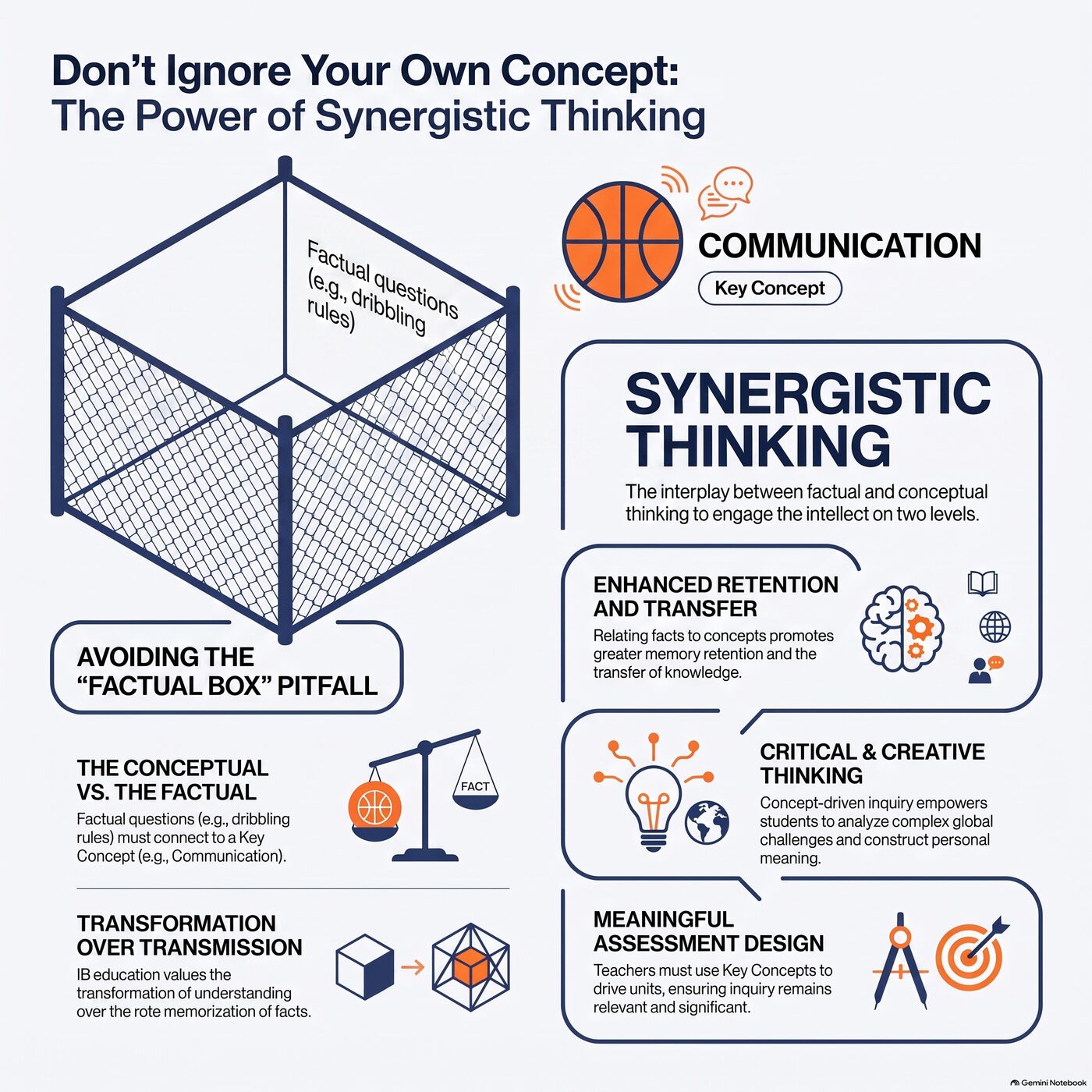
The mistake: questions focus on facts (basketball rules) but ignore the Key Concept (Communication).
How to avoid: explicitly use the words from your Statement of Inquiry when drafting conceptual and debatable questions.
3. Skipping the factual foundation
The mistake: asking 12-year-olds to debate genetic ethics before they know what DNA is.
How to avoid: build background knowledge first — especially for diverse learners and EAL students.
4. Closed conceptual questions
The mistake: "Do systems use energy?" — answerable with yes/no.
How to avoid: start conceptual questions with How or Why.
5. The "invisible" questions
The mistake: excellent questions live only on the planner; students never see them.
How to avoid: print them on assignment sheets, the whiteboard, and use them as exit-ticket prompts.
Practical Classroom Examples
Sciences. Factual: What are the reagents and products of different chemical reactions? Conceptual: How does molecular structure affect the type of chemical change? Debatable: To what extent should governments restrict artificial chemical compounds to protect environmental balance?
Individuals & Societies. Factual: Which regions have the greatest and least availability of specific resources? Conceptual: How does resource scarcity dictate economic systems between neighboring countries? Debatable: Should resource-rich nations be required to share with resource-scarce nations?
Mathematics. Factual: What are the formulas for mean, median, mode, standard deviation? Conceptual: How can altering a graph's axis scale change the narrative the data represents? Debatable: Is it ethical to use valid data to intentionally mislead an audience?
Design. Factual: What materials are biodegradable and locally sourced in our region? Conceptual: How does a product's ergonomic form dictate long-term user interaction? Debatable: To what extent should comfort be sacrificed for environmental sustainability?
Reflection Questions
- Do my factual questions ensure students learn the vocabulary and context before higher-order thinking?
- Do my conceptual questions explicitly use the Key and Related Concepts I selected?
- Does my debatable question contain genuine tension — could reasonable people disagree?
- Are these questions visible in my classroom, actively guiding daily learning experiences?
- Does my summative prompt mirror my debatable question?
Quick Checklist: Designing the Inquiry
- ☐ Review the SOI — questions must deconstruct and explore this exact sentence.
- ☐ Draft factual questions targeting definitions, dates, formulas, or mechanics.
- ☐ Draft conceptual questions using Key and Related Concepts to find patterns.
- ☐ Draft debatable questions that force evaluation and defended positions.
- ☐ Plan a routine (wonder wall, K-W-L chart) to capture student-generated questions.
Key Takeaways
- Inquiry questions transition classrooms from passive transmission to active, student-centered meaning-making.
- Effective units rely on a balanced mix of Factual, Conceptual, and Debatable questions.
- Factual knowledge is the necessary foundation for rigorous conceptual and debatable thinking.
- Questions must live in daily activities and formative assessments, not just the planner.
- A hallmark of a strong MYP classroom is student-generated inquiry questions.