 My IB
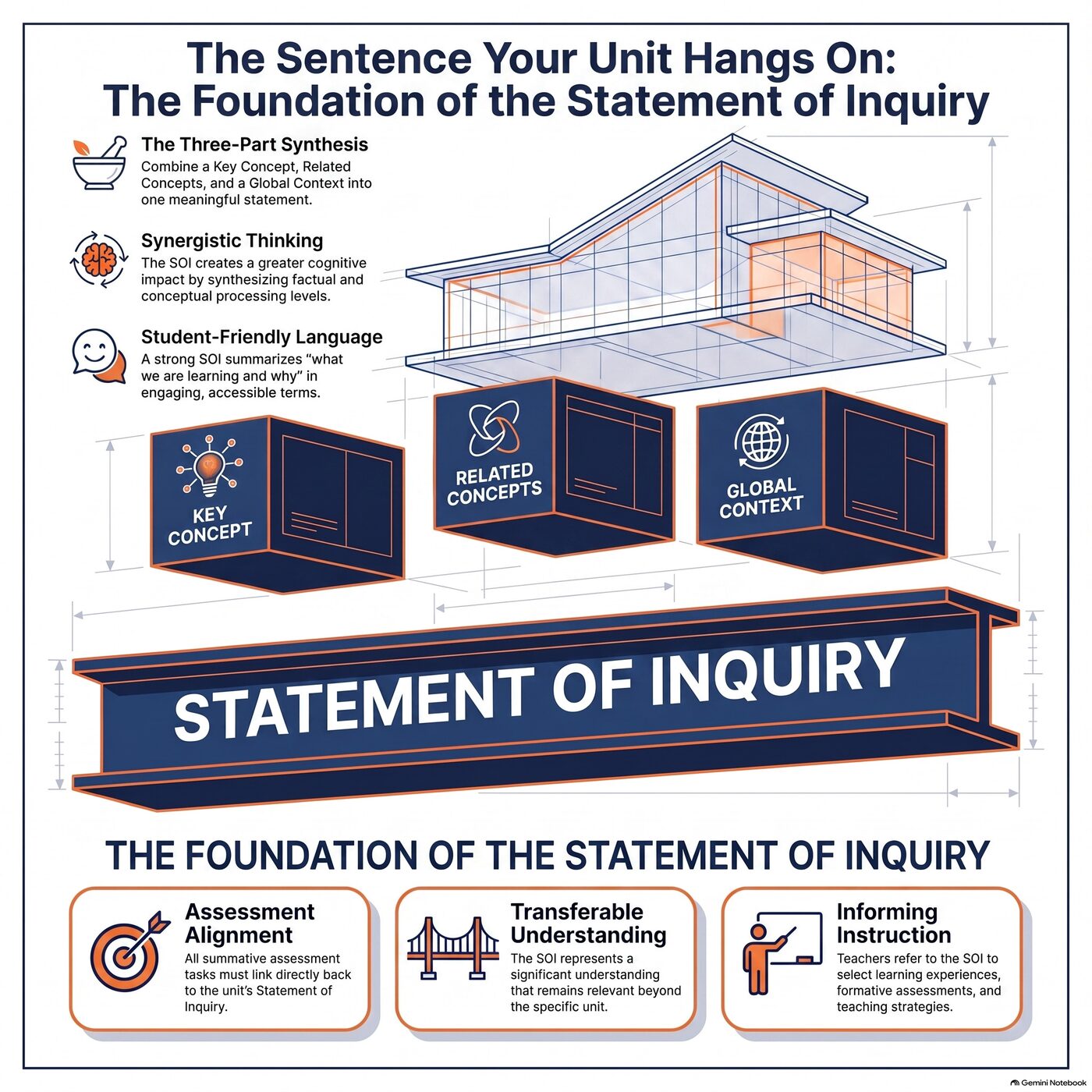
My IB Having selected a Key Concept, Related Concepts, and a Global Context, we arrive at the intellectual centrepiece of the unit: the Statement of Inquiry (SOI). If the unit planner is an architectural blueprint, the SOI is the building's foundation — the single, enduring understanding students should carry long after they've forgotten the factual details of the lessons.
Writing one is often where planning feels hardest: teachers frequently struggle to synthesize abstract terms without sounding robotic. This chapter covers the anatomy of a strong SOI, the principle of transferability, the use of qualifiers, and how the SOI sets up the final assessment.
Why This Matters
Educational purpose: synthesizing meaning
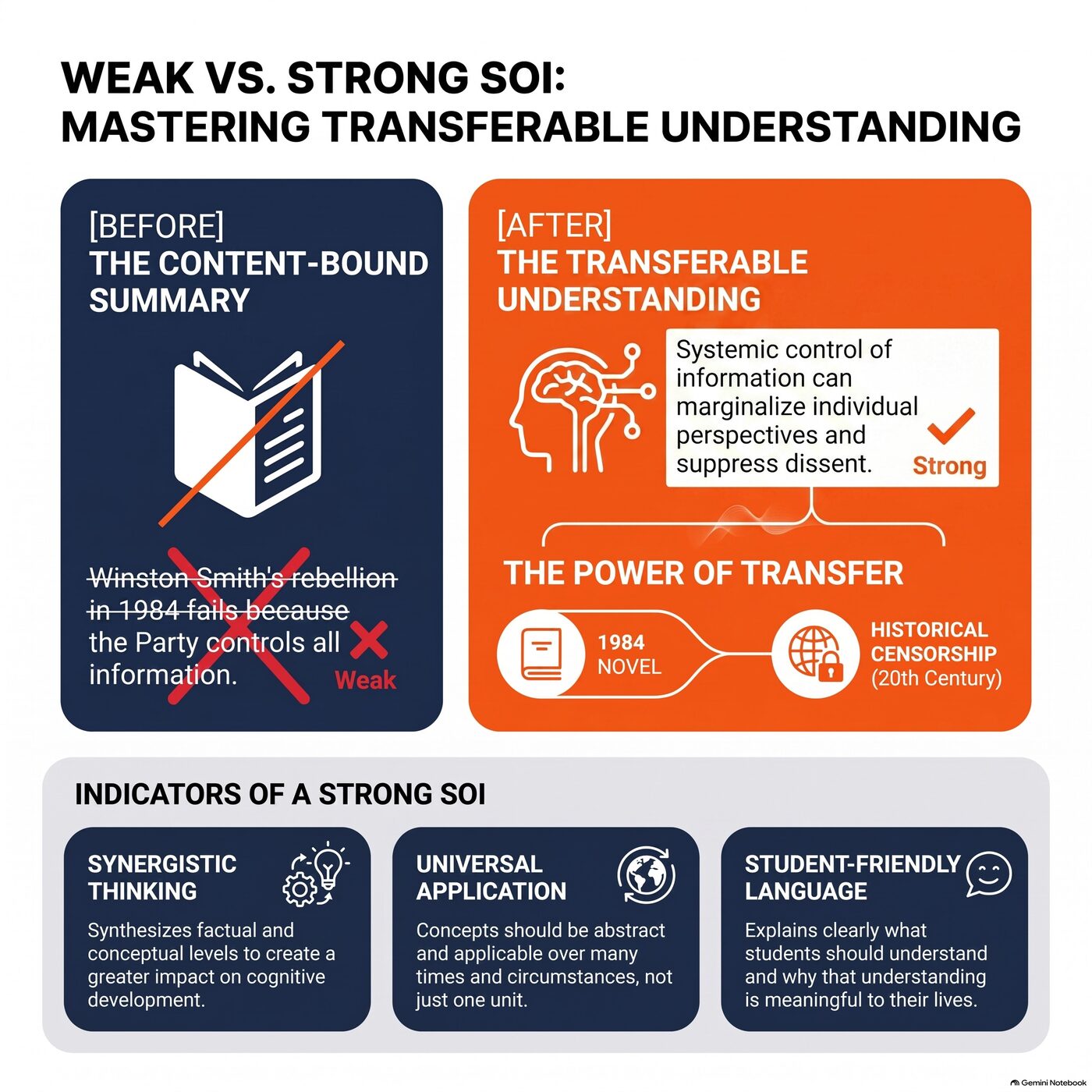
The SOI facilitates "synergistic thinking" — synthesizing factual knowledge and conceptual understanding — which has greater cognitive impact than either level of thinking alone. It also serves a communicative purpose: translating complex educational design into student-friendly language that summarizes what will be learned and why.
The common misconception: "it's a grammar exercise"
Many teachers treat writing an SOI as cramming the Key Concept, Related Concepts, and Global Context title into one sentence. The result is usually clunky and confusing to teacher and students alike.
What happens if this is ignored?
Without a strong SOI, the unit loses its compass: students see tasks as disconnected chores, teaching defaults to rote memorization, and the summative test measures recall instead of transferable understanding.
Core Concepts
1. The anatomy of a Statement of Inquiry
An effective SOI integrates the Key Concept (the broad, interdisciplinary lens), the Related Concept(s) (the discipline-specific lens), and the Global Context exploration (the real-world situation). You don't need the exact categorical title of the Global Context — using the specific exploration (e.g., "health and well-being" rather than "Identities and relationships") usually reads more naturally.
2. The power of transferability
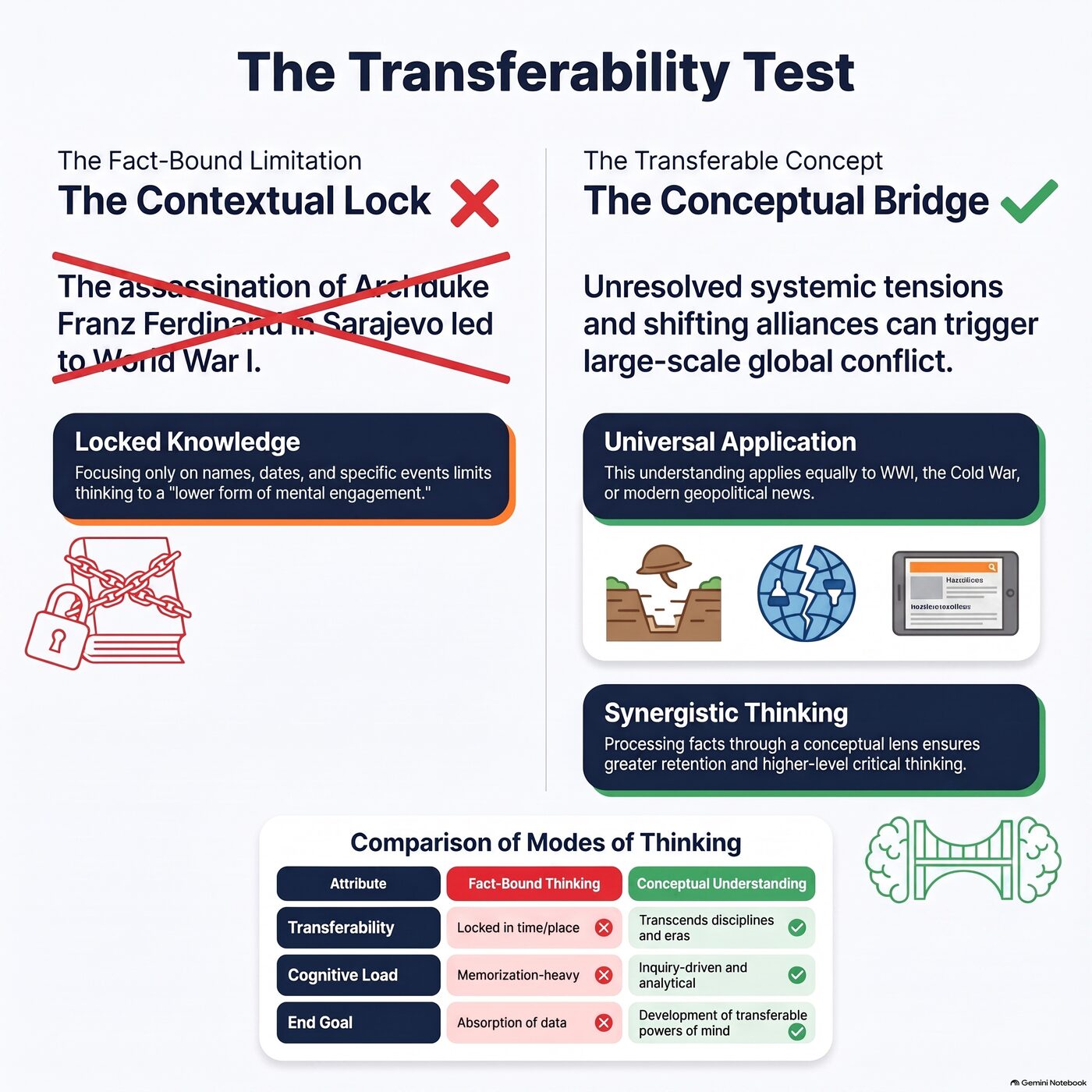
The most crucial trait of an SOI is that it is transferable — universally true (or debatable) beyond the specific facts of your unit. "The assassination of Archduke Franz Ferdinand caused a change in global interactions, leading to WWI" is a historical fact, not a conceptual truth. "Sudden systemic changes often disrupt global interactions, causing widespread conflict" is transferable — usable for WWI, but also the modern economy or the Cold War. Rule of thumb: never include specific names, dates, or titles in the SOI itself.
3. Using qualifiers
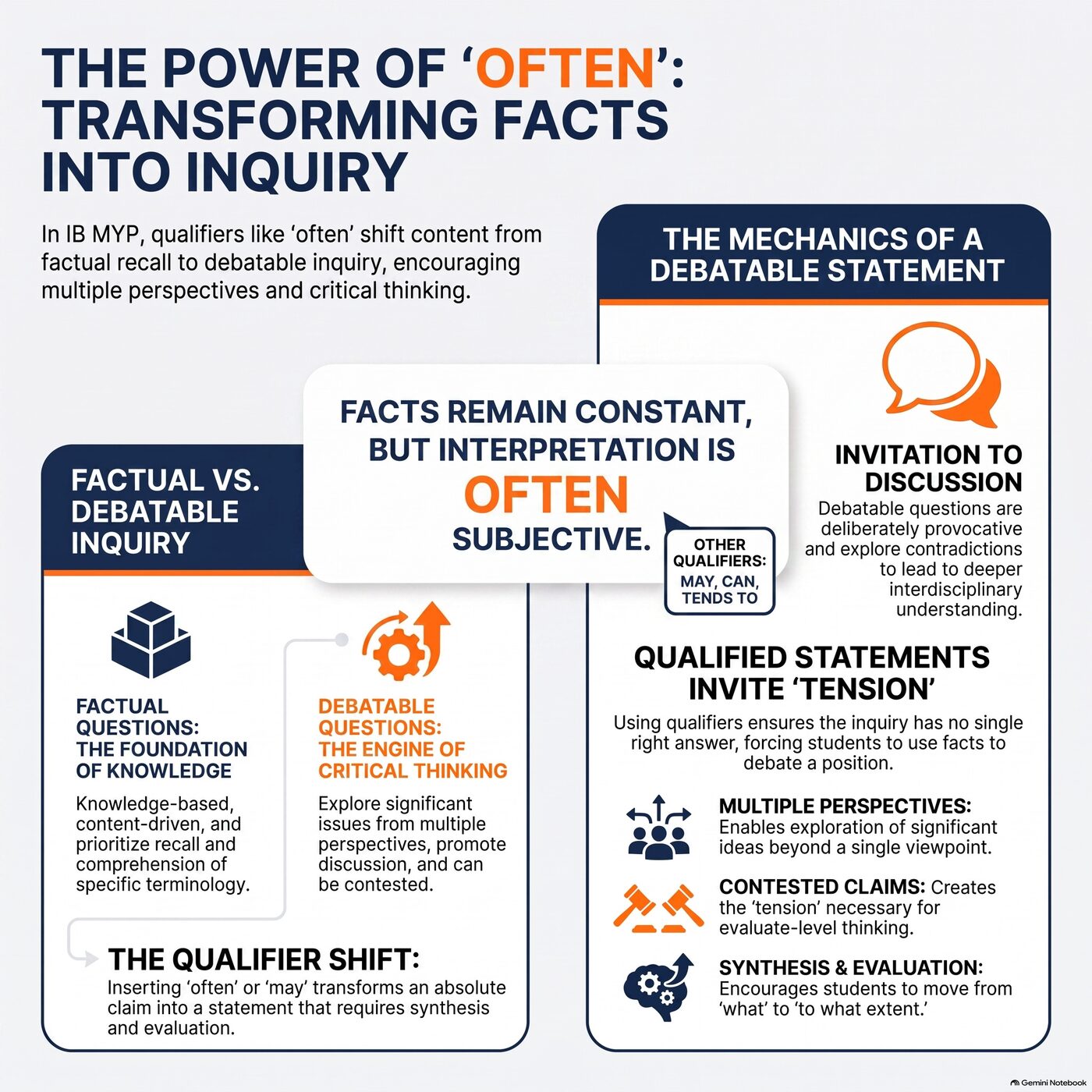
Because concepts deal with complex human, natural, and built environments, absolute truths are rare. The IB explicitly advises using qualifiers — often, may, can, frequently, under certain conditions, tends to — to make the statement intellectually defensible and open to debate.
4. Setting the stage for assessment
The SOI is the ultimate destination of the unit, so the summative assessment must be explicitly designed to let students demonstrate understanding of that exact statement. If the SOI claims "Creative expression can challenge societal norms," the final task must require analyzing or producing creative expression that challenges a norm — the alignment must be flawless.
Common Mistakes
1. The "word salad" (mechanical connections)
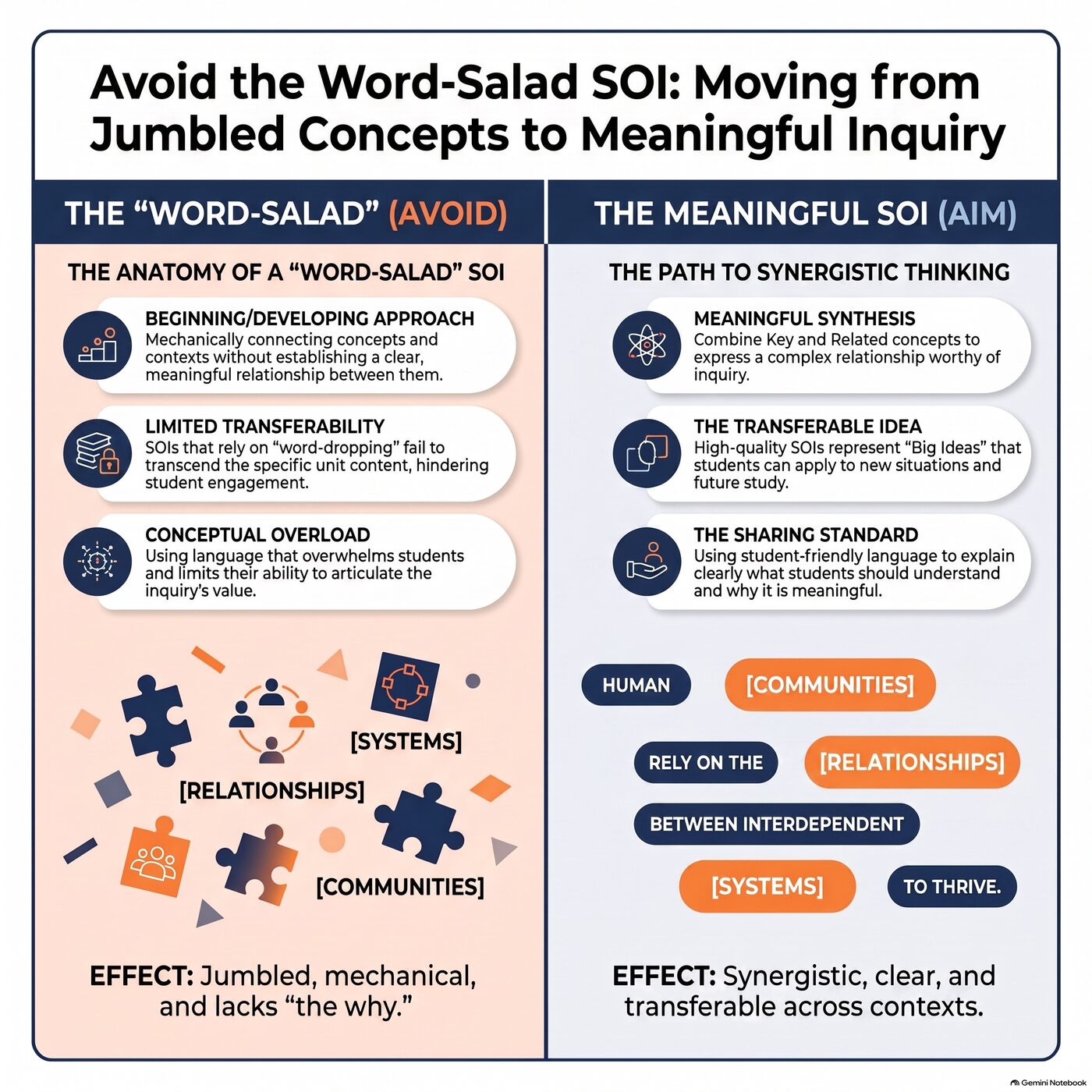
The mistake: "Systems use equivalence during globalization" — terms mechanically forced together.
Why it happens: forcing exact terms together without considering the relationship between them.
How to avoid: ask "How do mathematical systems rely on equivalence to navigate a globalized economy?" → "Globalized trade relies on equivalent mathematical systems to ensure fair exchange."
2. Overwhelming academic jargon
The mistake: an SOI that reads like a doctoral thesis, inaccessible to a 12-year-old.
Why it happens: mistaking complex vocabulary for rigor.
How to avoid: use student-friendly language; if a complex term is necessary, unpack its meaning explicitly in daily lessons.
3. The factual summary
The mistake: "In this unit, we will learn how Shakespeare used character and perspective to write Macbeth."
Why it happens: reluctance to let go of content-driven teaching.
How to avoid: remove the specific topic — "Authors construct complex characters from diverse perspectives to explore universal human flaws."
4. The "orphaned" statement
The mistake: a brilliant SOI written once, never displayed, referenced, or assessed.
Why it happens: viewing the planner as an administrative hurdle rather than a daily tool.
How to avoid: print it on the whiteboard and assignment sheets; use it as a reflective prompt at lesson's end.
5. The "un-assessable" statement
The mistake: SOI claims "Scientific innovation creates ethical dilemmas," but the summative is a multiple-choice periodic-table quiz.
Why it happens: a disconnect between the Inquiry phase and the Assessed curriculum.
How to avoid: work backwards — immediately ask "How will I collect evidence students understand this specific idea?"
Practical Classroom Examples
Language and Literature — Dystopian Fiction. Weak SOI: "The setting of The Hunger Games shows a perspective on power and privilege" (too factual). Strong SOI: "Authors manipulate setting and perspective to explore themes regarding the abuse of power and privilege" — transferable to a news article on censorship or a historical speech.
Sciences (Physics) — Thermodynamics. Strong SOI: "Scientific innovations designed to transform energy often alter the delicate relationship between human societies and natural environments." The qualifier "often" lets students debate whether some innovations (solar) are less disruptive than others (coal).
Mathematics — Statistics and Probability. Strong SOI: "The logical representation of data can be manipulated to influence human behaviour, requiring us to question its validity" — turning a dry stats unit into a media-literacy investigation of advertising and political data.
Design — Sustainable Community Garden. Strong SOI: "Designers must adapt spaces to promote sustainable consumption habits within local communities" — the word "Designers" anchors the statement in the discipline and the student's role.
Reflection Questions
- Is my SOI truly transferable, or trapped by the specific facts of this unit?
- Does it explain what students should understand and why it matters to the real world?
- Is the language accessible to my age group while staying academically rigorous?
- Would a colleague see how my daily learning experiences connect back to this statement?
- Does my final assessment require students to demonstrate this exact statement?
Quick Checklist: Crafting the Statement of Inquiry
- ☐ Gather the ingredients: 1 Key Concept, 1-3 Related Concepts, one specific Global Context exploration.
- ☐ Find the connection — how do these concepts interact with this real-world situation?
- ☐ Draft one clear, active sentence synthesizing concepts and context.
- ☐ Erase the topic — remove names, dates, titles, or overly specific facts.
- ☐ Add a qualifier (often, can, tends to) for intellectual flexibility.
- ☐ Read it aloud — is it student-friendly, or a mechanical word salad?
Key Takeaways
- The Statement of Inquiry is the intellectual centrepiece of an MYP unit — it summarizes what students learn and why it matters.
- An effective SOI creates synergistic thinking by processing facts through a conceptual and contextual lens.
- The statement must be transferable — a universal or debatable truth beyond this unit's facts.
- Avoid the mechanical "word salad." Concepts and context must connect meaningfully.
- The SOI is the foundation for Inquiry Questions and the ultimate target of the summative assessment.