 My IB
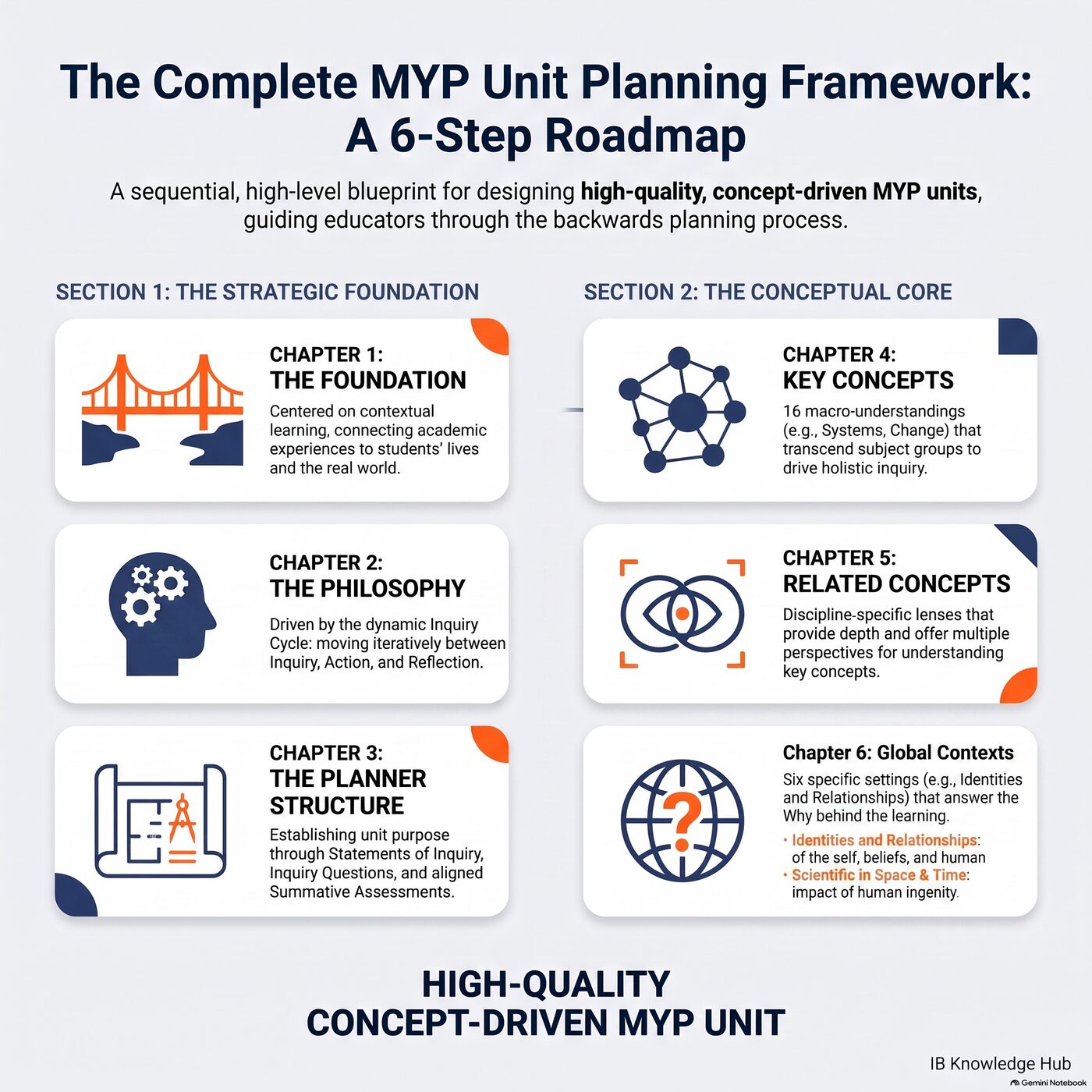
My IB In previous chapters, we constructed the conceptual framework of an MYP Unit Plan — how Key Concepts provide interdisciplinary breadth and Related Concepts drill down into disciplinary depth. But abstract concepts and factual content alone are not enough to sustain student engagement.
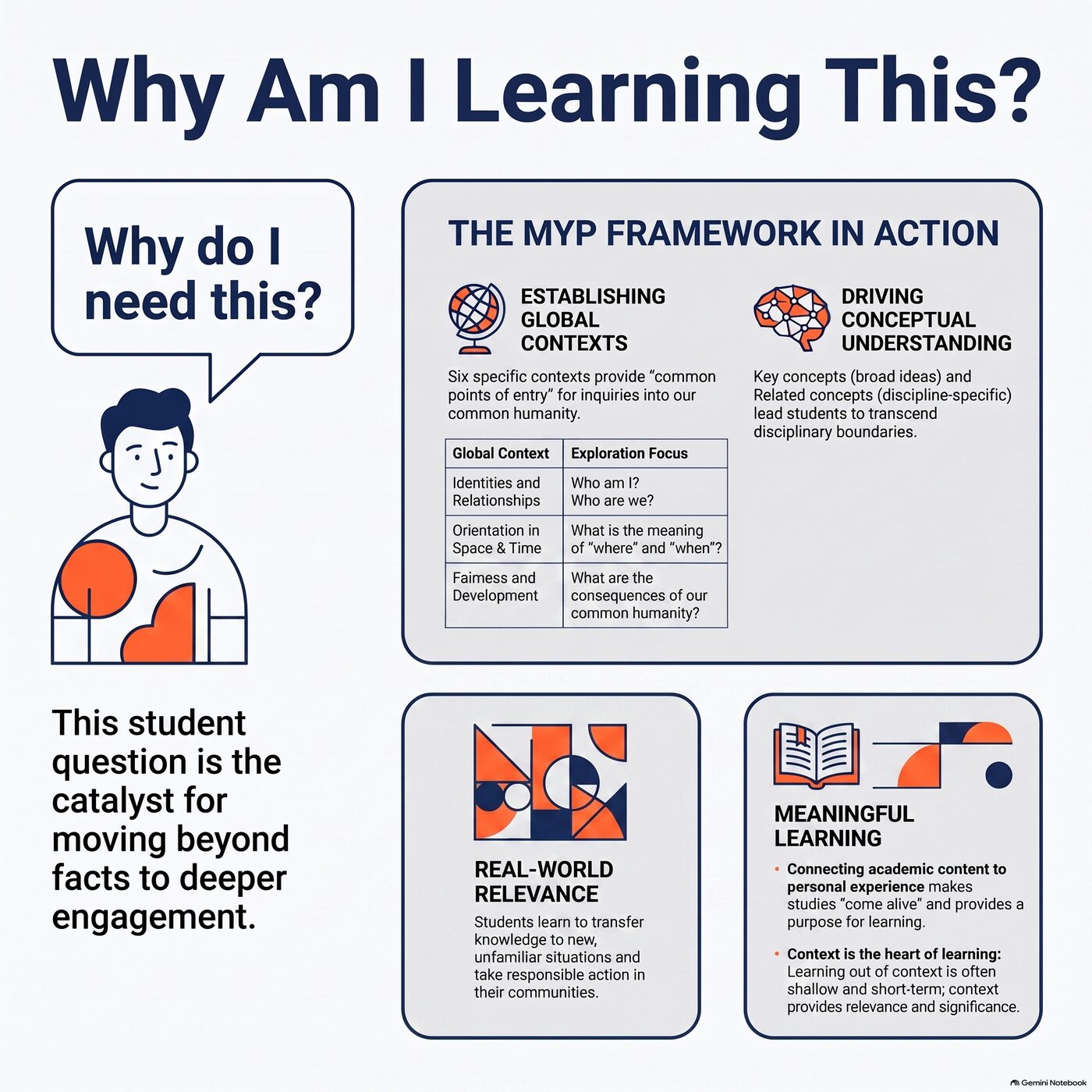
If you have ever stood in front of a classroom of middle schoolers, you have heard the eternal question: "Why do we need to learn this?" The MYP explicitly demands that teachers answer this question before the unit even begins, through the selection of a Global Context — the authentic, real-world setting that ties academic theory to the messy, complex reality of human existence.
In this final chapter of the series, we explore the philosophy behind contextualized learning, the six MYP Global Contexts and their specific explorations, how to select the right context, and how changing the context alters the direction of a unit.
Why This Matters
Educational purpose: the "why" of learning
All learning is contextual. Adolescents learn best when their educational experiences are explicitly connected to their own lives, interests, and the world around them; when a student can connect academic content to their own experience, they discover meaning, which provides the fundamental motivation to learn. Learning that occurs out of context — memorizing dates or a formula without understanding its application — is often shallow and short-term.
The common misconception: "it's just a theme"
A frequent struggle is treating the Global Context as a superficial "theme" — selecting Identities and Relationships because students are working in groups, or Scientific and Technical Innovation simply because students are using iPads. The Global Context is not a description of what you are doing in class; it is the lens through which students should be thinking about the academic content.
What happens if this is ignored?
If Global Contexts are ignored or mechanically forced, the curriculum suffers from "false coverage." Students view the subject as a siloed academic exercise with no relevance to their lives, and are deprived of the opportunity to develop true international-mindedness by exploring how different cultures interpret and solve common human problems.
Core Concepts
1. The six MYP Global Contexts
These build directly on the transdisciplinary themes introduced in the Primary Years Programme (PYP), creating a cohesive continuum of learning:
- Identities and relationships: the nature of the self, health, human relationships, and what it means to be human.
- Orientation in space and time: personal histories, turning points in humankind, migrations, and the interconnectedness of individuals and civilizations.
- Personal and cultural expression: how we discover and express ideas, feelings, nature, and culture, and our appreciation of the aesthetic.
- Scientific and technical innovation: the natural world, how humans use scientific principles, and the impact of technology on society.
- Globalization and sustainability: the interconnectedness of human-made systems, local and global processes, and the impact of decision-making on the environment.
- Fairness and development: rights and responsibilities, sharing finite resources, equal opportunities, and peace and conflict resolution.
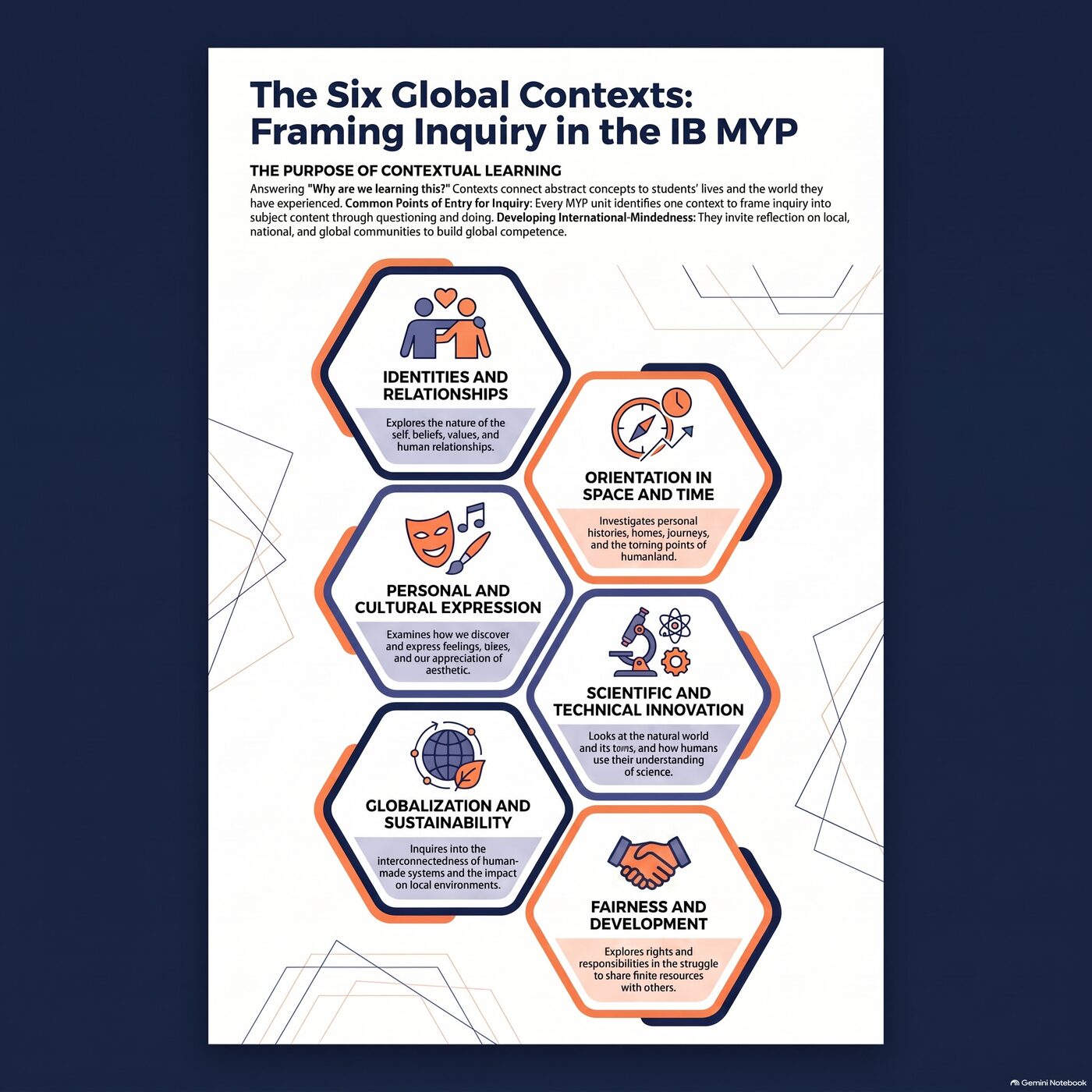
Over their MYP journey, students must encounter all six of these contexts across their subject groups.
2. Drilling down: the power of "explorations"
A common planning mistake is stopping at the top-level title — "Globalization and sustainability" is a massive, unwieldy concept for a 12-year-old to tackle. The MYP provides specific "explorations" within each category to narrow the focus. For Fairness and Development, that might mean Democracy, politics, government and civil society, Inequality, difference and inclusion, or Power and privilege.
Practical implication: use the specific exploration (e.g., Power and Privilege) rather than the broad category title to shape Inquiry Questions and the Statement of Inquiry.
3. Contexts dictate the direction of the unit
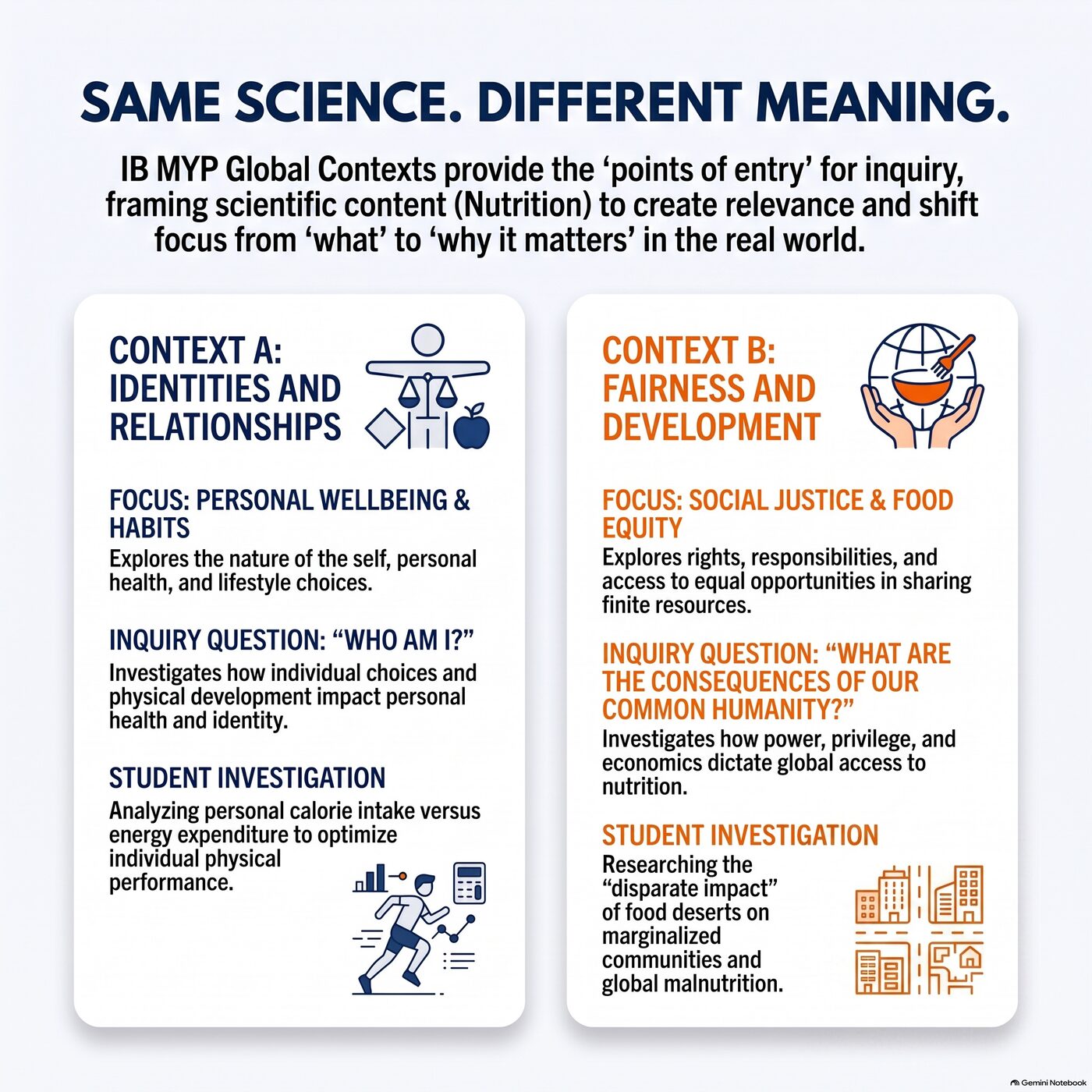
Concepts (Key and Related) are abstract and universal, but their meaning changes depending on context. Teaching a Science unit on human nutrition, the facts stay the same (vitamins, digestion, caloric intake), but the direction transforms based on the chosen context: Identities and Relationships (exploration: Lifestyle Choices) focuses on personal habits and cultural food traditions; Fairness and Development (exploration: Ecology and Disparate Impact) shifts to global food deserts, agricultural monopolies, and unequal access to nutritious food.
Common Mistakes
1. The "obvious rut" (subject silos)
The mistake: a Science teacher only ever uses Scientific and Technical Innovation, or a Language teacher only ever uses Personal and Cultural Expression.
Why it happens: it feels safe and requires the least lateral thinking.
How to avoid: explore "less likely" contexts — a genetics unit becomes far more rigorous viewed through Orientation in Space and Time (the historical role of agriculture and genetic modification over centuries).
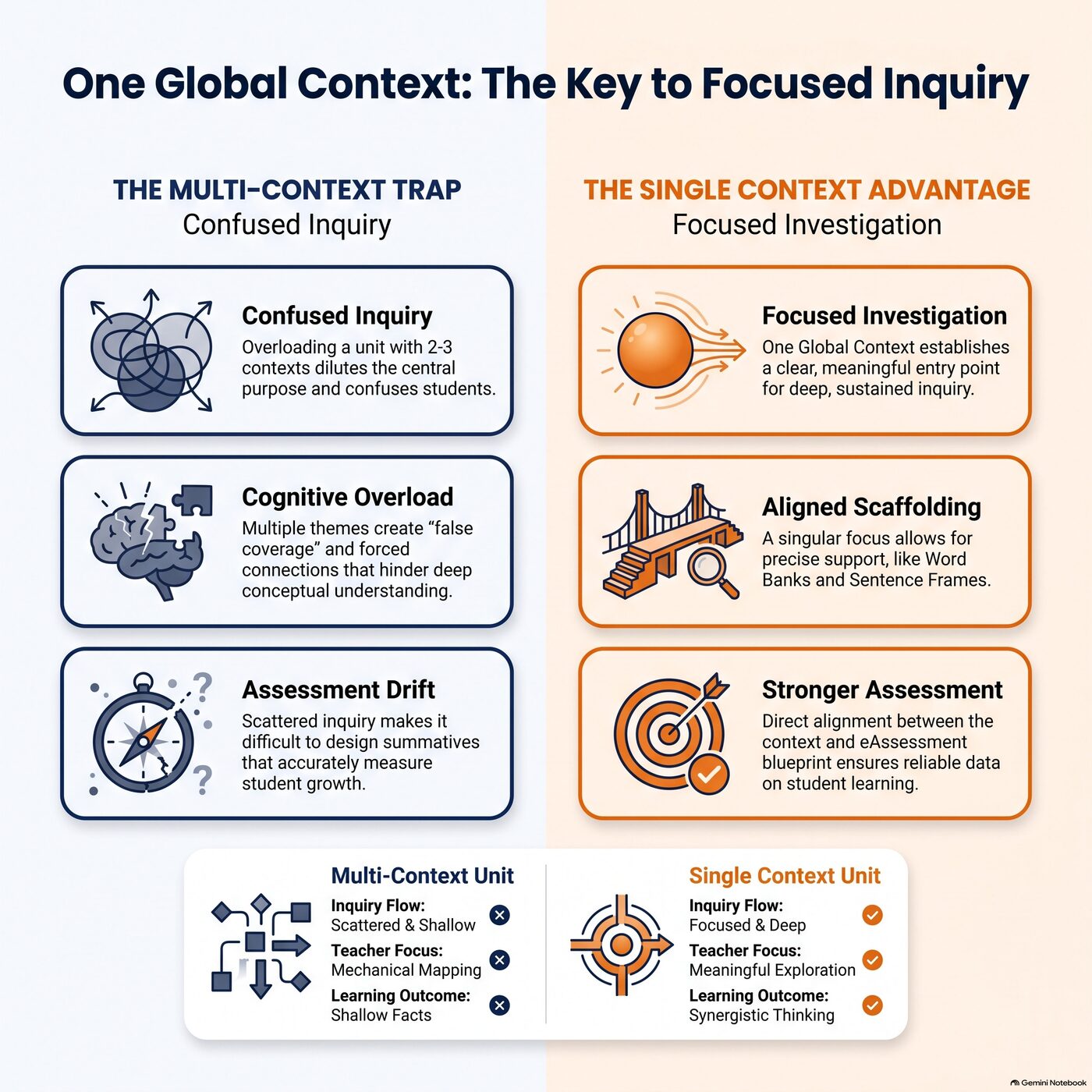
2. The "kitchen sink" approach
The mistake: selecting three different Global Contexts for a single four-week unit hoping for a "richer" experience.
Why it happens: topics naturally overlap and the teacher wants to cover all bases.
How to avoid: choose only one Global Context per unit — selecting one establishes a clear, primary lens for the summative assessment.
3. The "invisible" context
The mistake: the Global Context is beautifully identified in the Inquiry section, but daily learning and the final test focus purely on rote memorization.
Why it happens: reverting to traditional content-delivery habits during the Action phase.
How to avoid: the summative assessment must evaluate students' understanding of the context, not just vocabulary.
4. Forced mechanical connections
The mistake: forcing Orientation in Space and Time into a swimming unit because the tracking spreadsheet shows it hasn't been covered.
Why it happens: prioritizing administrative compliance over authentic learning.
How to avoid: if a context is missing, look horizontally across the grade level for a subject where it creates genuine, meaningful intellectual synergy.
Practical Classroom Examples
Example 1: Mathematics. Content: data collection, statistical analysis, and graphing. Global Context Fairness and Development, exploration Inequality, difference and inclusion. Instead of textbook numbers, students analyze real-world datasets on the gender pay gap or global literacy rates, seeing mathematical logic as a tool for exposing societal inequalities.
Example 2: Design. Content: designing a physical product (e.g., a chair). Global Context Identities and Relationships, exploration Physical, psychological and social development. Students design a product tailored to the physical and psychological needs of a specific user group, such as a sensory-friendly chair for neurodivergent children.
Example 3: Language Acquisition. Content: vocabulary for travel, directions, and city infrastructure. Global Context Globalization and Sustainability, exploration Urban planning, strategy and infrastructure. Students use the target language to investigate how different cities prioritize public transport versus cars, comparing sustainability of urban planning across countries.
Example 4: Arts (Performing Arts). Content: scriptwriting and theatrical performance. Global Context Personal and Cultural Expression, exploration Social roles, norms and expectations. Students study how different cultures use theatre to reinforce or rebel against societal norms, then write and perform a short play challenging a specific social expectation in their own community.
Reflection Questions
- Did I select this Global Context because it provides a fascinating, real-world anchor, or because it was the easiest option?
- Have I drilled down into the specific "explorations," or is the inquiry too broad?
- If a student asks "Why do I need to learn this?", does my chosen Global Context provide a compelling answer?
- Does my final summative assessment require students to apply their knowledge directly to this Global Context?
Quick Checklist: Embedding a Global Context
- ☐ Identify the relevance — where does this content live in the real world?
- ☐ Select one context — choose only one of the six MYP Global Contexts.
- ☐ Choose a specific exploration rather than the broad category title.
- ☐ Break out of the silo — use a context outside your subject's comfort zone.
- ☐ Link to assessment — the summative prompt must engage with the chosen context and exploration.
Key Takeaways
- Context creates meaning — abstract concepts only become engaging when anchored in a real-world situation.
- The six Global Contexts provide a shared framework for developing international-mindedness.
- Use specific explorations to make a broad context highly actionable and focused.
- Contexts alter the curriculum — the same factual topic becomes a different learning journey depending on context.
- Avoid mechanical planning — the connection between discipline and context must be authentic.