 My IB
My IB In Chapter 4, we explored the power of Key Concepts — the "macro" lenses of an MYP Unit Plan that provide interdisciplinary breadth. But breadth alone is not enough; if we only ever viewed the curriculum from a high-level, interdisciplinary perspective, student understanding might remain too generalized.
To achieve true academic rigor, students must plunge deeply into the specific, nuanced thinking of individual academic disciplines. This is where Related Concepts come in — firmly rooted within subject boundaries, providing the specialized vocabulary, structural frameworks, and disciplinary lenses that make a scientist think differently than an artist, or a historian differently than a mathematician.
In this chapter, we explore the breadth/depth distinction, the purpose of embedding discipline-specific concepts, how many to choose and track, and how to pair Related Concepts with a Key Concept to generate meaningful Inquiry Questions and a powerful Statement of Inquiry.
Why This Matters
Educational purpose: depth and disciplinary rigor
The MYP aims to develop students who can transfer knowledge across situations, but transfer is impossible without a deep foundation of disciplinary understanding. Related Concepts emerge from the actual craft of a subject — its specific features, processes, and history. When a student studies Communication (Key Concept) in Language and Literature, the learning remains abstract until the teacher introduces Genre, Audience, or Style (Related Concepts), ensuring engagement with the structural mechanics of literary analysis rather than an abstract philosophical discussion.
The common misconception: "they are just vocabulary words"
Teachers often define Related Concepts at the start of a unit and then revert to traditional content delivery. But Related Concepts are cognitive tools, meant to be used continuously to analyze content and solve complex problems.
What happens if this is ignored?
If Related Concepts are treated superficially, learning remains shallow. Students may memorize facts but fail to grasp the deeper, transferable principles of the discipline, lacking the sophisticated conceptual structures needed for the DP, CP, or MYP eAssessments.
Core Concepts
1. Breadth vs. depth
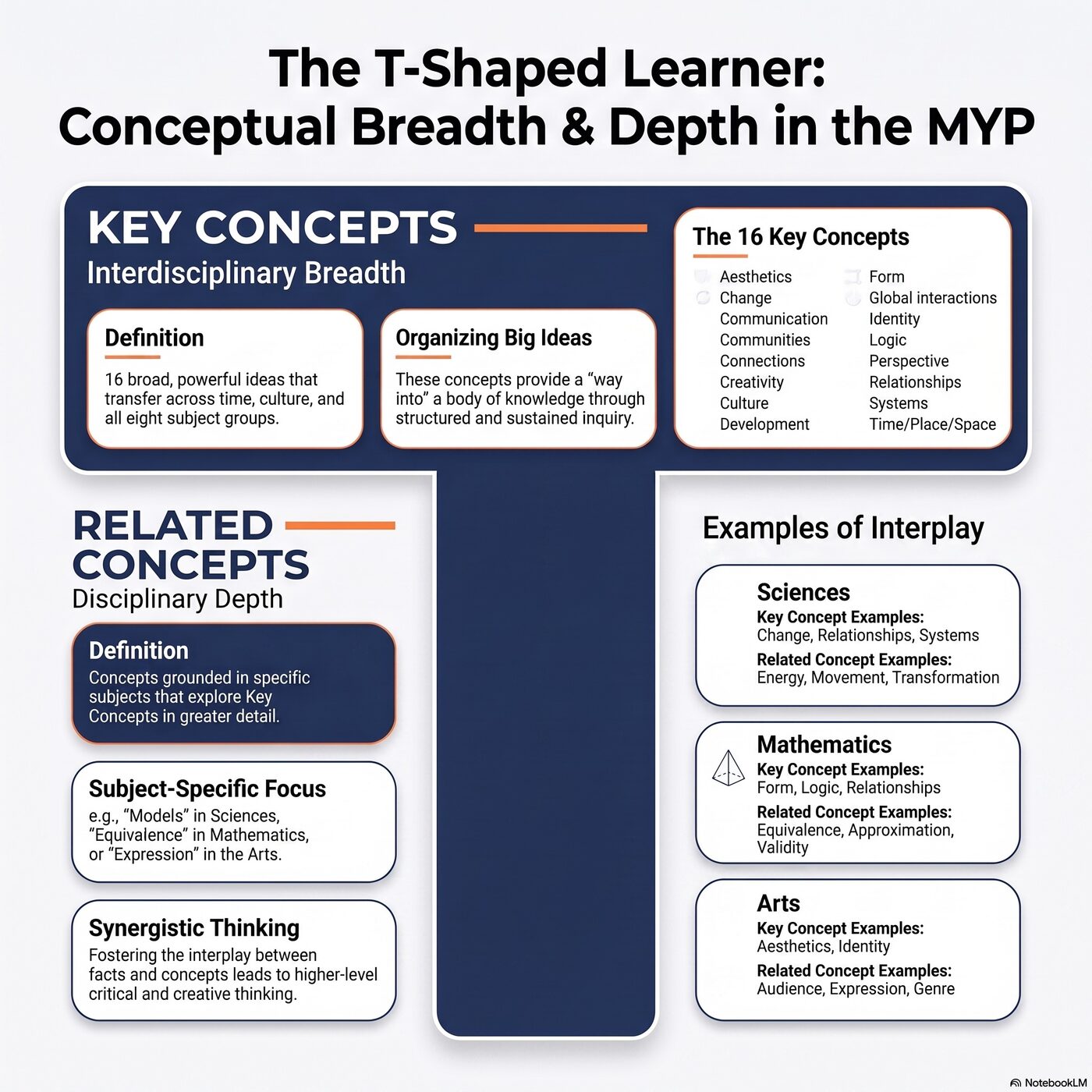
Picture a "T-shaped" learner: the horizontal bar (breadth) is the Key Concept, connecting learning across the school — a student explores Change in Science, in History, and in PHE. The vertical bar (depth) is the Related Concepts, plunging into the specific discipline — in Science, Change is explored through Energy and Transformation; in History, through Causality and Innovation.
2. Selection and scope
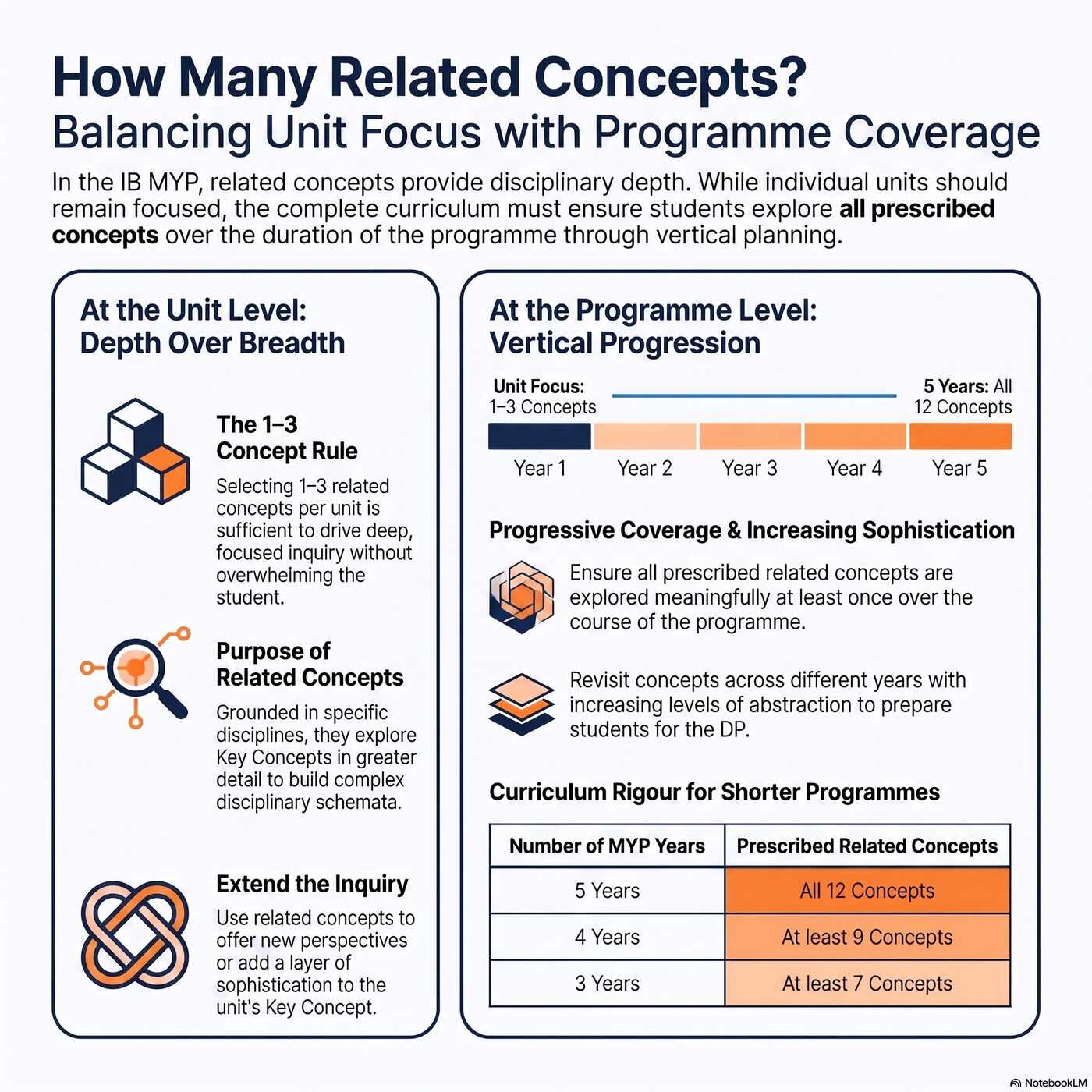
Every MYP subject-group guide provides a prescribed list of Related Concepts, usually 12 per subject. Best practice suggests selecting one to three Related Concepts per unit — choosing too many dilutes the inquiry into a shallow vocabulary exercise.
Over a five-year programme, students must have meaningful opportunities to inquire into all 12 prescribed Related Concepts for each relevant subject group. Shorter programmes adapt the requirement:
- 5-year programme: all 12 prescribed related concepts.
- 4-year programme: at least 9.
- 3-year programme: at least 7.
- 2-year programme: at least 5.
Schools and teachers are explicitly encouraged to add their own additional Related Concepts to meet local curriculum requirements or unique student needs.
3. Pairing concepts for synergy
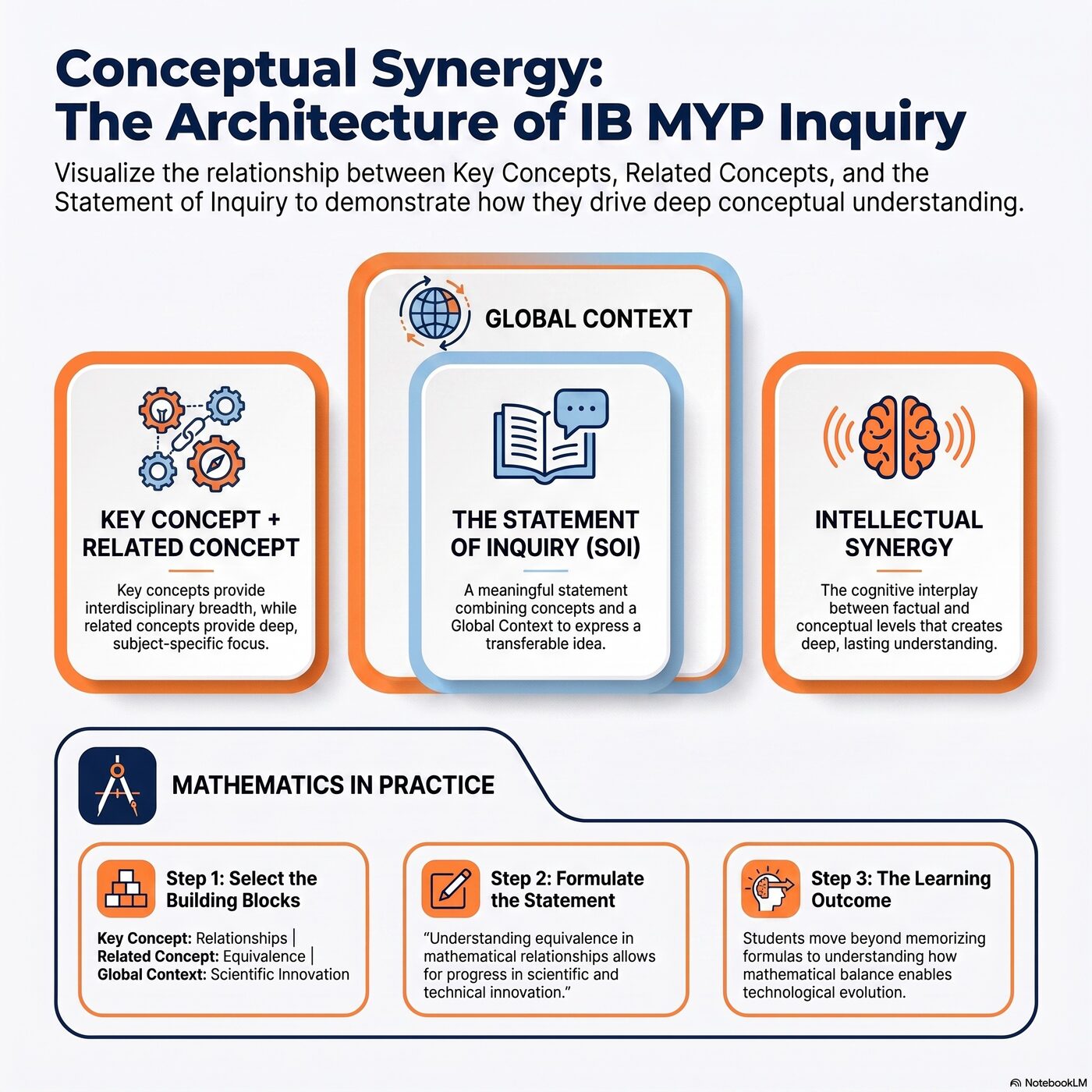
The magic of MYP curriculum design happens when you pair a Key Concept with Related Concepts, creating "intellectual synergy." If the Key Concept is Systems, and the Related Concepts are Equivalence and Models (Mathematics), you are no longer just teaching "how to solve equations" — you are teaching that "mathematical systems rely on equivalence to create accurate models."
Common Mistakes
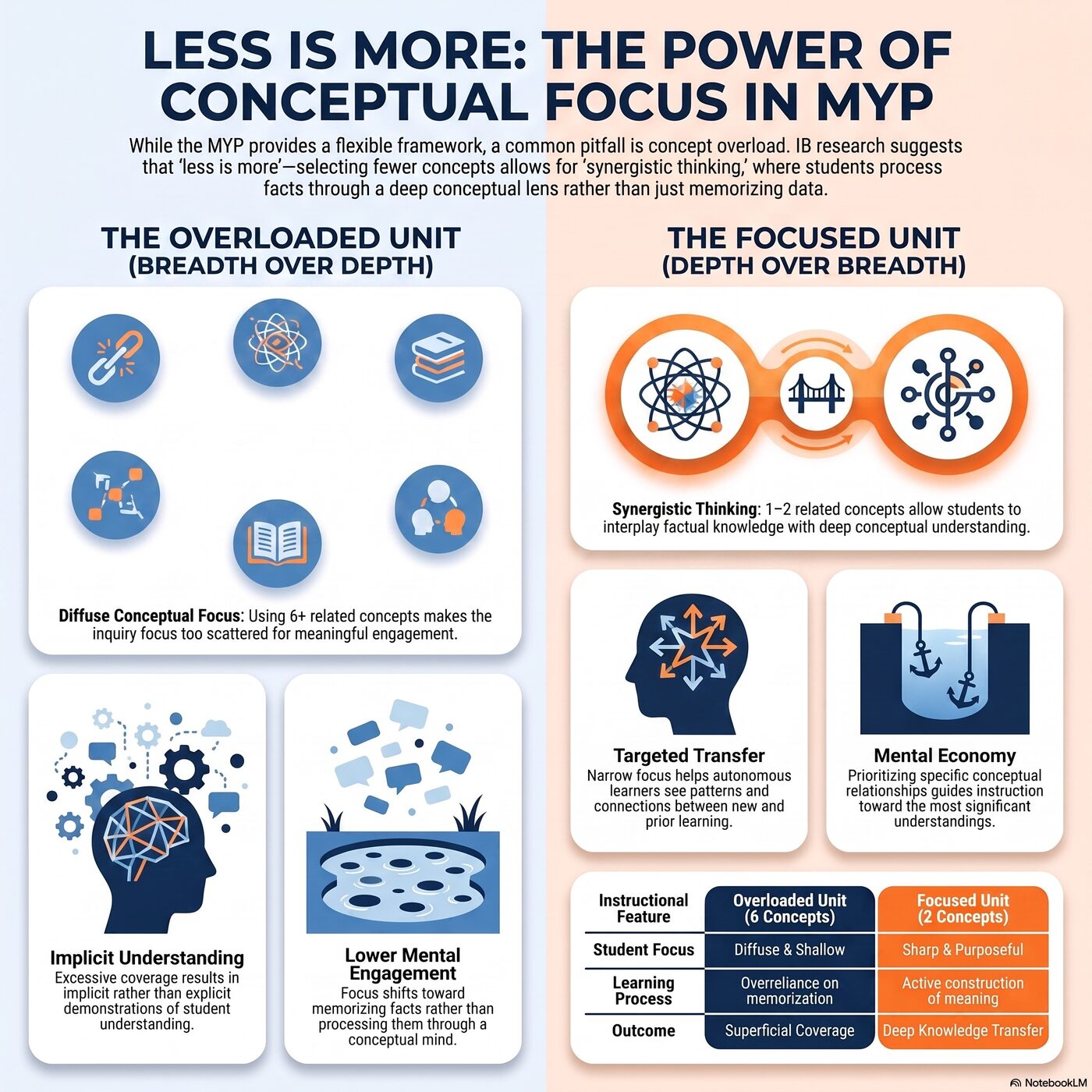
1. The "concept salad" (overloading)
The mistake: selecting 5–6 Related Concepts for a single four-week unit to show "rigorous" planning.
Why it happens: coverage anxiety.
How to avoid: limit to 1–3 Related Concepts — deep learning requires sustained focus.
2. The "invisible" concept
The mistake: Related Concepts are listed at the top of the plan but never appear in daily learning experiences, formative tasks, or the summative assessment.
Why it happens: treating the planner as an administrative form.
How to avoid: actively use the concept — if it's Audience, an Inquiry Question should explicitly ask "How does the author manipulate the narrative to provoke fear in the audience?"
3. Ignoring the subject guide
The mistake: making up all your own Related Concepts and never using the prescribed IB list.
Why it happens: unfamiliarity with the official subject-group guides.
How to avoid: local concepts are fine as additions, but the prescribed IB list must still be mapped and taught, since it forms the basis of the MYP eAssessments.
4. The forced fit
The mistake: forcing "Ergonomics" into a Design unit about coding a website simply because it hasn't been ticked off the tracking spreadsheet.
Why it happens: mechanical, compliance-driven mapping.
How to avoid: adjust the curriculum map holistically to place the concept where it creates genuine intellectual synergy.
Practical Classroom Examples
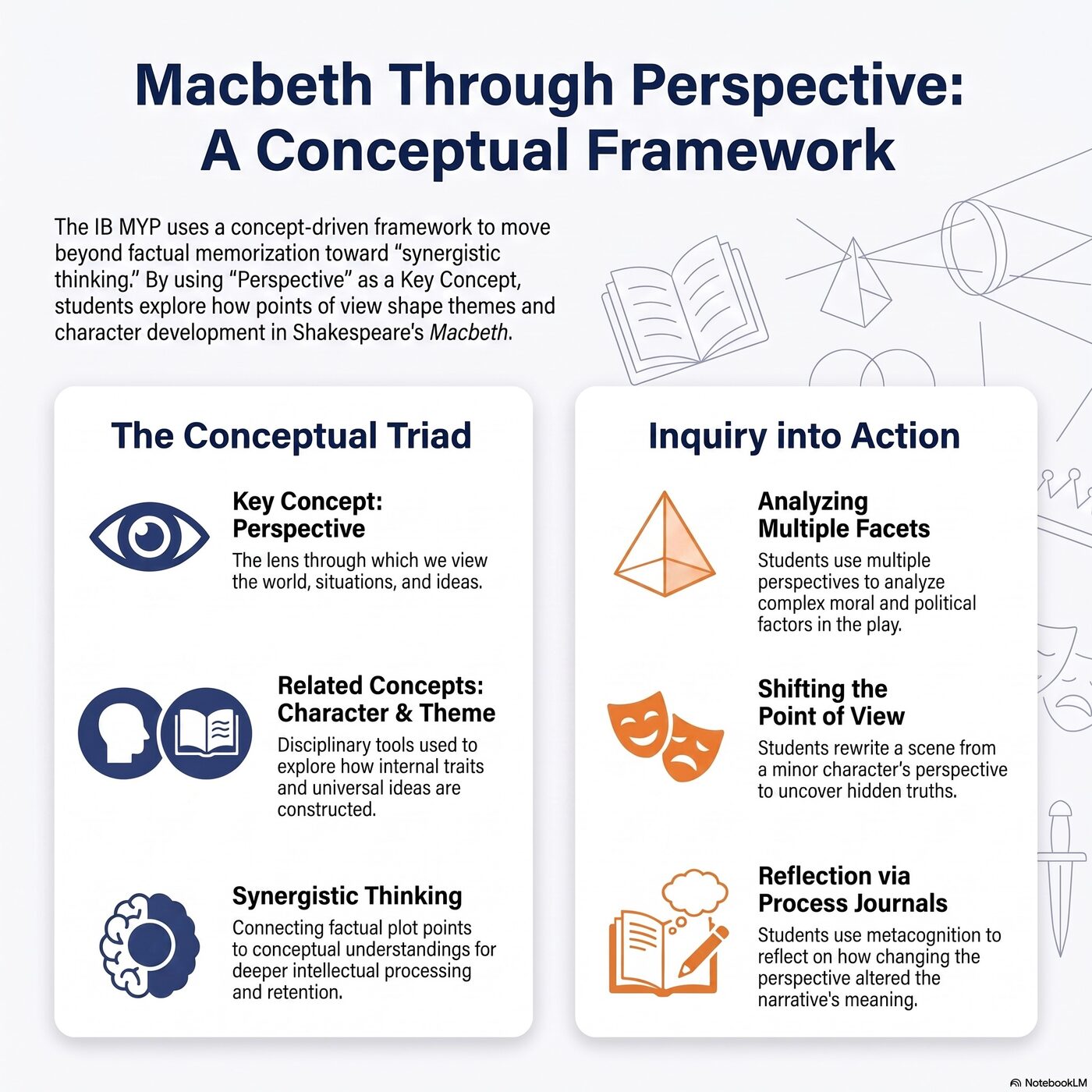
Example 1: Language and Literature — Macbeth. Key Concept Perspective; Related Concepts Character and Theme. Statement of Inquiry: "Exploring diverse perspectives allows us to understand how authors construct complex characters to deliver timeless themes." The summative asks students to rewrite a pivotal scene from a minor character's perspective, demonstrating how shifting the lens alters the theme.
Example 2: Sciences (Biology) — Cellular Respiration and Photosynthesis. Key Concept Systems; Related Concepts Energy and Transformation. Statement of Inquiry: "Biological systems rely on the continuous transformation of energy to sustain life." A formative task traces a photon of light from the sun through a plant and into an animal, explaining how the system balances itself.
Example 3: Individuals & Societies (Geography) — Urbanization and Megacities. Key Concept Change; Related Concepts Sustainability and Disparity and Equity. Statement of Inquiry: "Rapid urban change frequently threatens environmental sustainability and creates deep social disparity." Inquiry Questions challenge students to analyze city-planning data to determine if a megacity's growth is equitable or sustainable.
Example 4: Physical and Health Education — Gymnastics Routine. Key Concept Aesthetics; Related Concepts Movement and Refinement. Statement of Inquiry: "The aesthetic beauty of a performance relies on the continuous refinement of complex movements." Students record and analyze their routines, applying peer feedback to iteratively refine technique — assessed on the conceptual understanding of refinement, not just the final output.
Reflection Questions
- Am I selecting these Related Concepts because they truly deepen the inquiry, or because they haven't been "covered" yet this year?
- Are my chosen Related Concepts too numerous? Could I narrow them to 1 or 2 for a sharper focus?
- Do these Related Concepts actively appear in my Inquiry Questions and summative assessment prompt?
- How will my students explicitly use these concepts to analyze the factual content?
Quick Checklist: Embedding Related Concepts
- ☐ Consult your subject-group guide for the prescribed list of Related Concepts.
- ☐ Prioritize focus — select only 1 to 3 Related Concepts per unit.
- ☐ Create synergy by pairing Related Concept(s) with the Key Concept and Global Context.
- ☐ Drive the inquiry — use the Related Concepts explicitly in Factual, Conceptual, and Debatable questions.
- ☐ Track for coverage across the required lifespan of the programme.
Key Takeaways
- Key Concepts provide breadth; Related Concepts provide depth — together, a powerful, three-dimensional framework.
- Related Concepts are discipline-specific, providing the vocabulary and structural lenses of a subject.
- Less is more — 1–3 Related Concepts per unit for deep conceptual understanding.
- Related Concepts must be actively utilized, not just listed.
- Schools must ensure all prescribed Related Concepts are taught and assessed across the MYP.