 My IB
My IB In the architecture of an MYP Unit Plan, if the Global Context provides the real-world setting, the Key Concepts provide the structural foundation. Selecting the Key Concept is often one of the first, and most consequential, decisions teachers make.
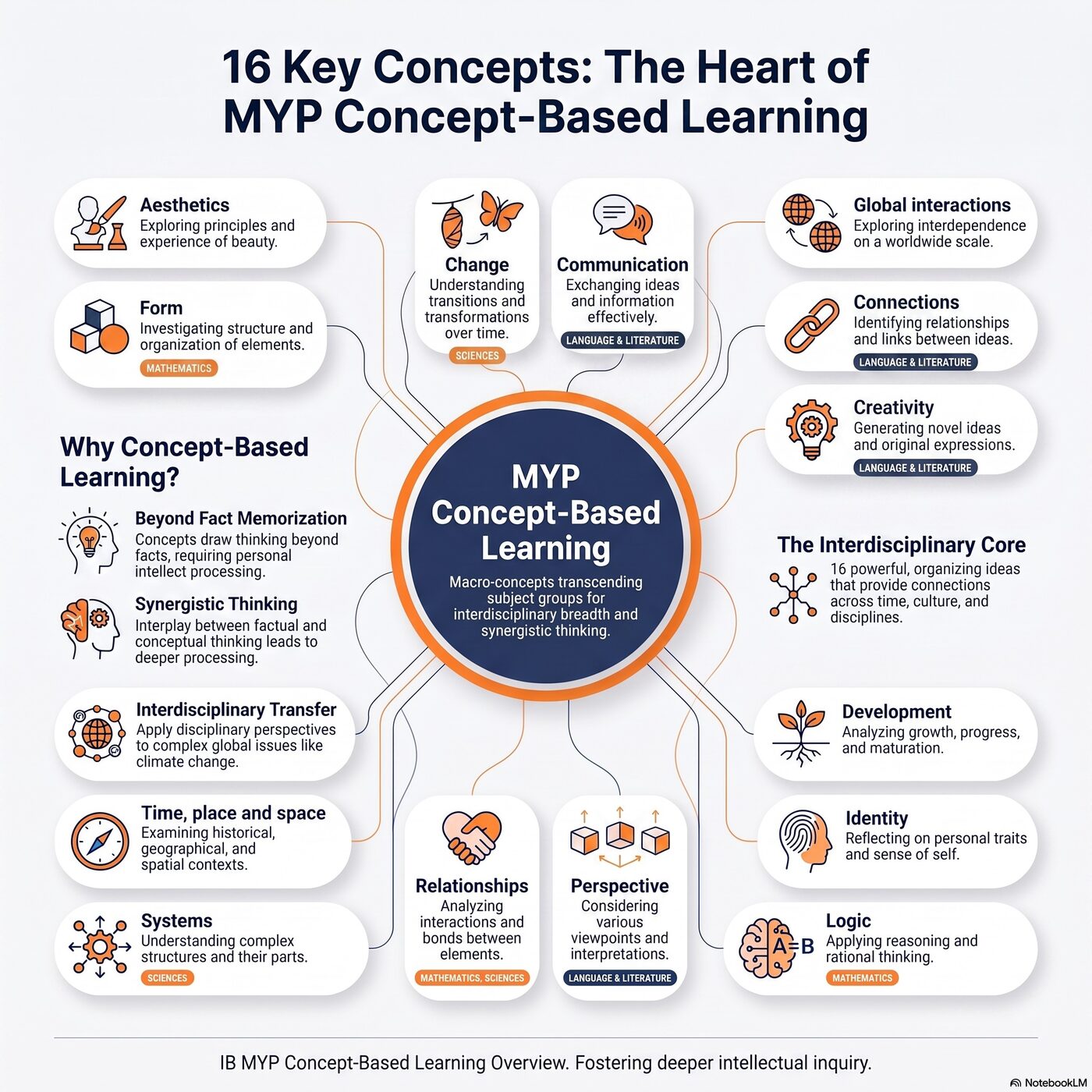
The MYP prescribes 16 overarching Key Concepts — Change, Systems, Relationships, Communication, and others — shared across all eight subject groups. They are broad, organizing, powerful ideas relevant within and across disciplines, acting as "macro" lenses for examining academic content.
Many teachers treat Key Concepts as decorative titles rather than active pedagogical tools. This chapter explores their educational purpose, differentiates them from Related Concepts, examines the "Rule of One," and gives practical guidance on selecting the right conceptual lens.
Why This Matters
Educational purpose: synergistic thinking
In a world where factual information is a keyboard click away, instructional time must shift away from merely covering and memorizing facts. Synergistic thinking is the active mental interplay between factual details and conceptual understanding — learning the water cycle (facts) through the lens of Systems (Key Concept) engages the intellect on two levels, leading to significantly greater retention and preventing overreliance on rote memorization.
The struggle: "which one is right?"
Almost any topic could be viewed through almost any concept. Teaching the French Revolution — is the Key Concept Change? Global Interactions? Systems? The answer depends on what you want students to understand. This flexibility can feel paralyzing, and teachers often default to the most obvious concept without considering how it shapes the Statement of Inquiry or the final assessment.
What happens if this is ignored?
Choosing a Key Concept mechanically — just to tick a box — produces "false coverage" and "forced connections." Learning remains shallow; students fail to build the conceptual frameworks needed to transfer learning to unfamiliar situations, and intercultural understanding is hindered.
Core Concepts
1. Key Concepts vs. Related Concepts
A strong Unit Plan utilizes two distinct levels of conceptual understanding:
- Key Concepts (breadth): 16 concepts transcending disciplines, highly abstract, building interdisciplinary connections — a student can explore Relationships in Arts and apply the same understanding in PHE.
- Related Concepts (depth): specific to individual subject groups, providing disciplinary depth and specific language — Equivalence in Mathematics, Audience in Language and Literature.
Combined, they create a powerful matrix: the Key Concept connects learning to the wider world, while Related Concepts ground it in the rigor of the specific discipline.
2. The 16 MYP Key Concepts
| Aesthetics | Change | Communication | Communities |
| Connections | Creativity | Culture | Development |
| Form | Global interactions | Identity | Logic |
| Perspective | Relationships | Systems | Time, place and space |
3. Subject-group contributions and flexibility
Each subject group "contributes" specific Key Concepts that most naturally fit its disciplinary focus — Sciences contributes Change, Relationships, Systems; Mathematics contributes Form, Logic, Relationships; Language Acquisition contributes Communication, Connections, Creativity, Culture.
Practical implication: this is not a rigid requirement. Teachers are explicitly encouraged to select any of the 16 Key Concepts from outside their subject group — using Aesthetics in a Mathematics unit on geometry, or Logic in a persuasive-writing unit, often yields rich, innovative inquiry. Over the course of the MYP, students should encounter Key Concepts contributed by other subject groups.
4. The "Rule of One"
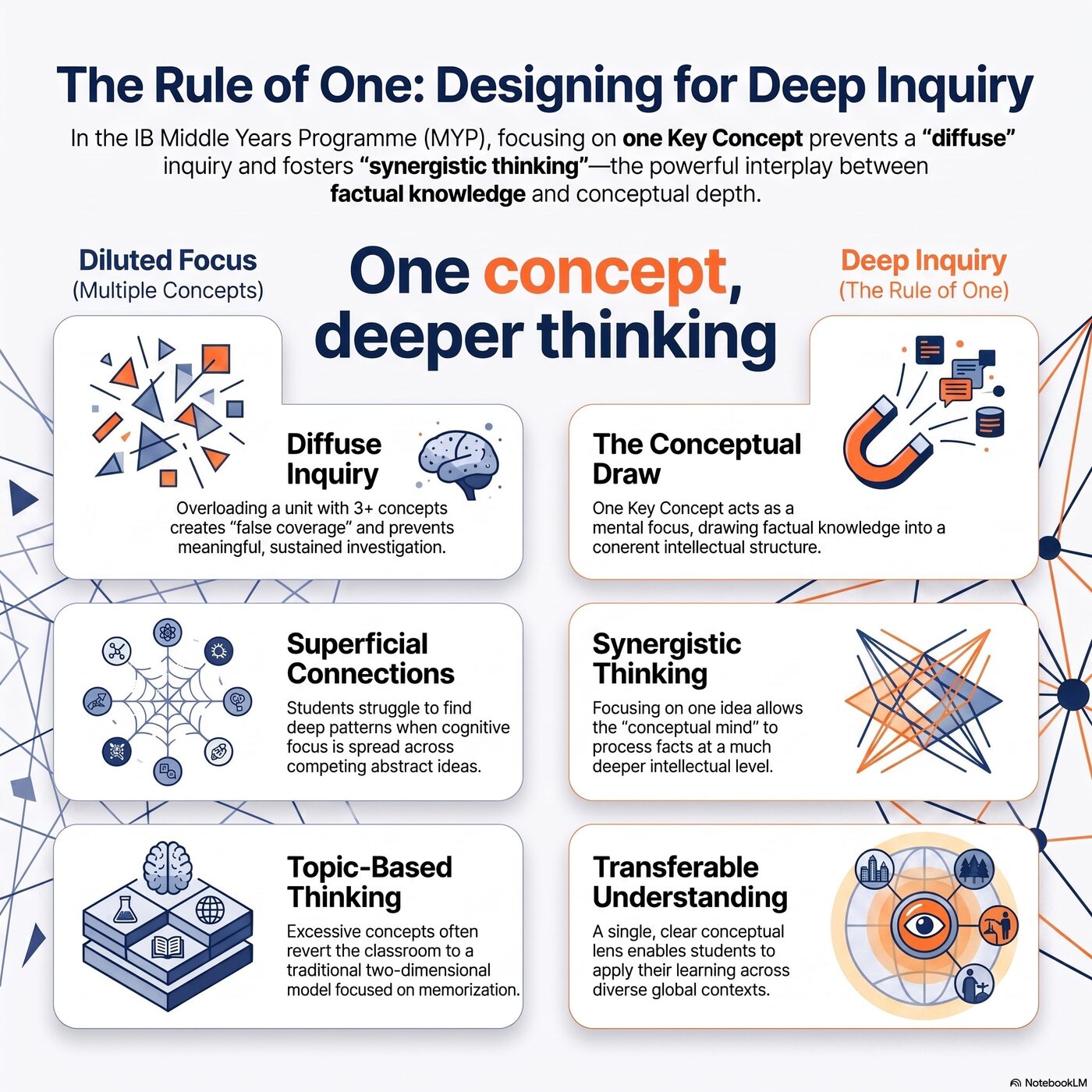
Official guidance advises choosing only one Key Concept to drive a unit's development, because these macro-concepts are vast and complex — "big enough to merit individual consideration." Selecting three Key Concepts for a four-week unit makes the conceptual focus entirely too diffuse; instead of deep analysis through a single powerful lens, concepts become passing vocabulary. One Key Concept paired with 1–3 Related Concepts provides the optimal scope for sustained inquiry.
Content-Driven vs. Concept-Driven Instruction
| Domain | Content-Driven (Traditional) | Concept-Driven (MYP) |
|---|---|---|
| Focus | Memorization of factual examples. | Utilizing concepts alongside content for synergistic thinking. |
| Role of Facts | Facts are the end goal of the unit. | Facts support deeper conceptual understanding. |
| Teacher's Role | "Telling understandings to" students. | "Drawing understandings from" students through inquiry. |
| Transferability | Low — knowledge is siloed. | High — students apply concepts to new situations. |
Common Mistakes in Concept Selection
1. The "concept salad" (choosing too many)
The mistake: listing Change, Systems, and Development as Key Concepts for a single three-week unit.
Why it happens: feeling the topic touches on all three and wanting the unit to look "rigorous."
How to avoid: enforce the Rule of One — narrow the unit to one word students must understand, and let Related Concepts handle the nuance.
2. False coverage (mechanical horizontal mapping)
The mistake: forcing "Time, place and space" into a basketball unit because it's missing from the Year 3 tracking spreadsheet.
Why it happens: treating the curriculum framework as a clerical checklist.
How to avoid: the IB explicitly warns against "forced connections." If a concept is missing, find a subject where it creates genuine intellectual synergy.
3. The subject silo
The mistake: a Sciences teacher only ever uses Change, Relationships, or Systems.
Why it happens: misunderstanding the flexibility of the framework and sticking to what feels "safe."
How to avoid: actively consider how an "outside" concept — Communication for chemical equations, Perspective for environmental data — might revolutionize a unit.
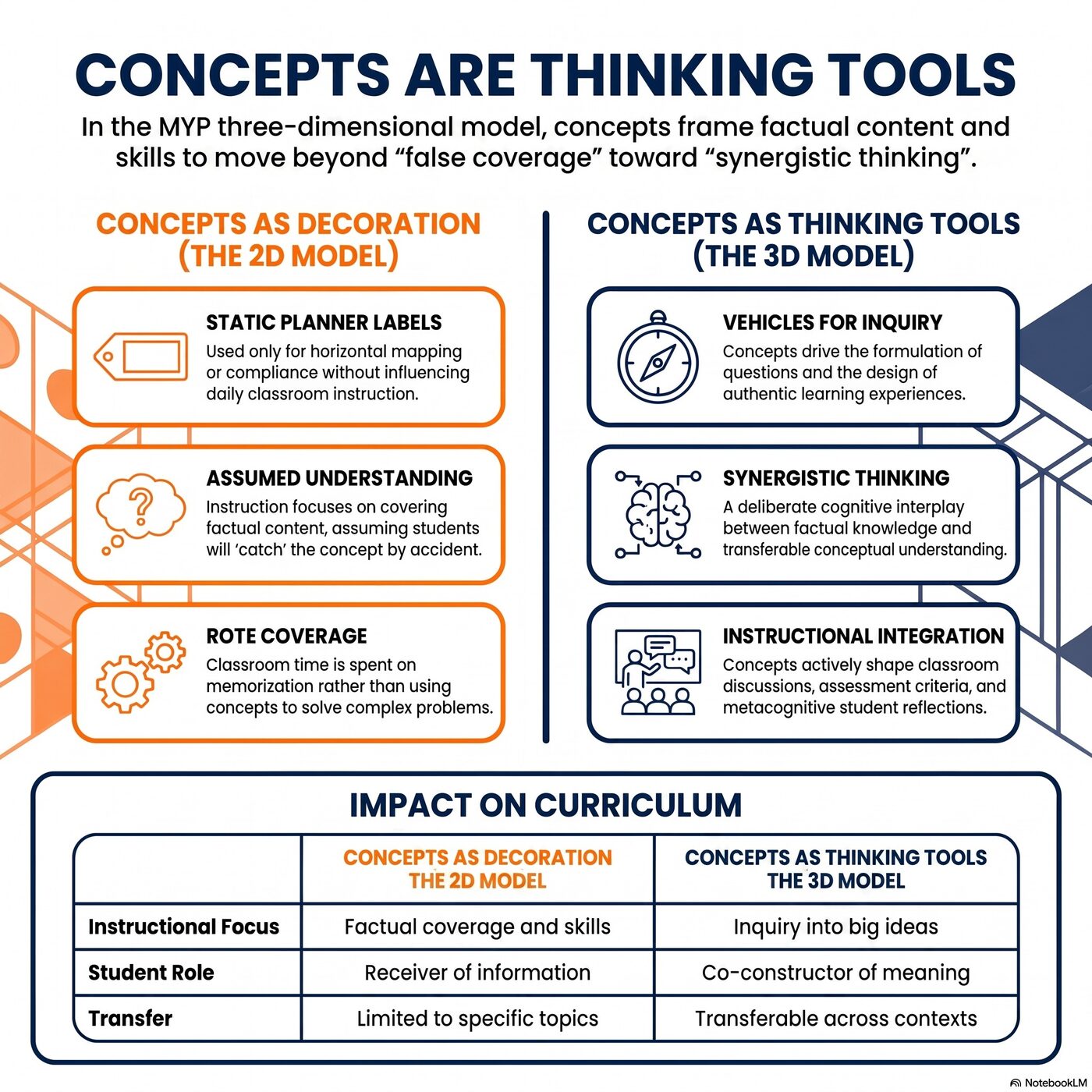
4. Concepts as decorative vocabulary
The mistake: the Key Concept is on the planner but never appears in classroom dialogue, Inquiry Questions, or the summative assessment.
Why it happens: planning content and assessment first, then choosing a concept to satisfy the requirement.
How to avoid: use the Key Concept to write Inquiry Questions — if the concept is Logic, ask "How does logic dictate the structure of this system?"
5. Ignoring the "Action" and "Assessment" alignment
The mistake: choosing Creativity as the Key Concept but assessing with a multiple-choice recall test.
Why it happens: a disconnect between the planned Inquiry section and the assessed reality.
How to avoid: the summative assessment must actually measure the student's ability to create, innovate, or evaluate creative processes.
Practical Classroom Examples
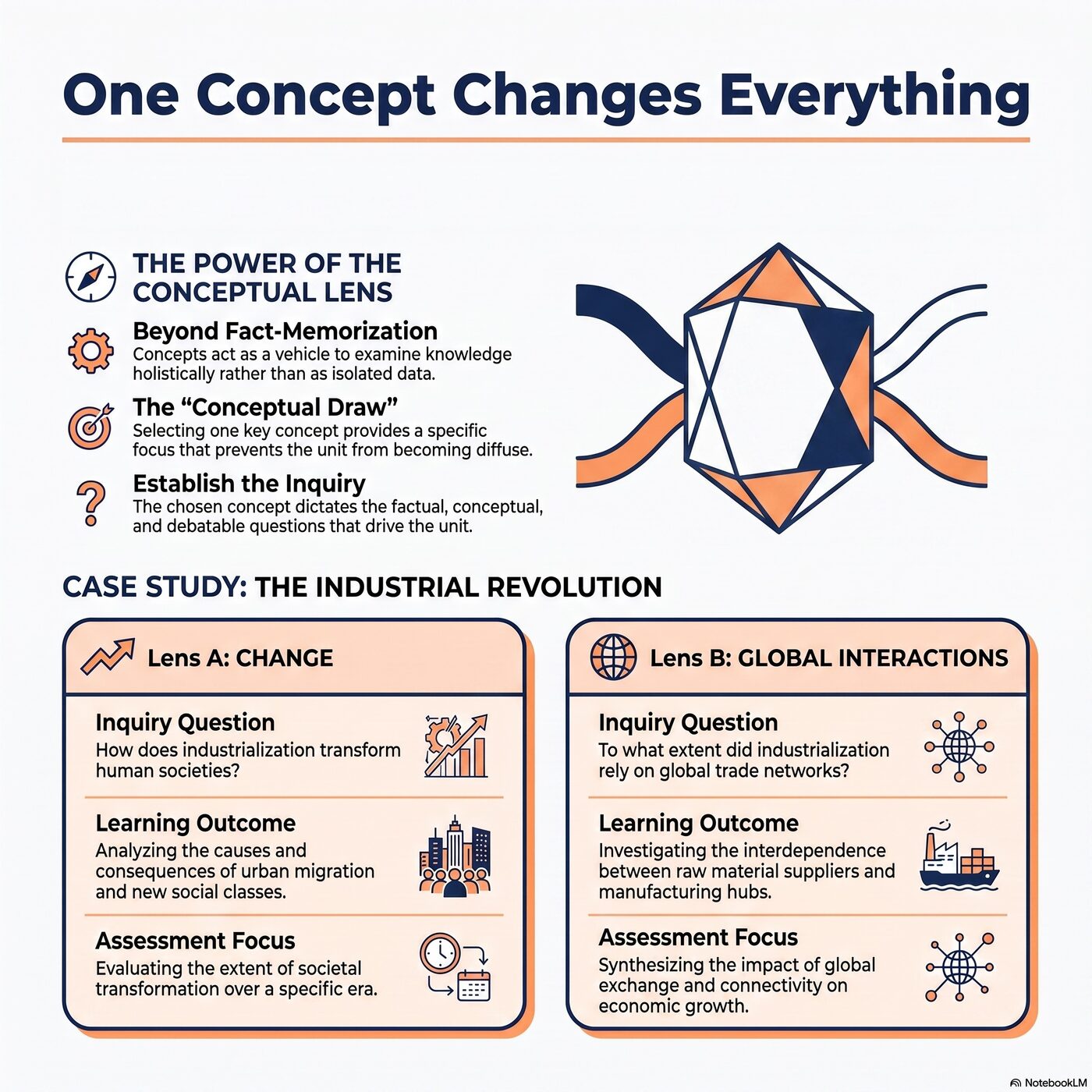
Topic: The Industrial Revolution (Individuals and Societies). Scenario A — Key Concept Change: students map the timeline, investigate factual causes, and evaluate the changes to living standards. Scenario B — Key Concept Global Interactions: focus shifts to how industrialization in one region impacted the rest of the world — raw materials, empires, global trade — tracing how a European invention sparked economic shifts in Asia or Africa. The facts stay the same; the Key Concept drastically alters the meaning students construct.
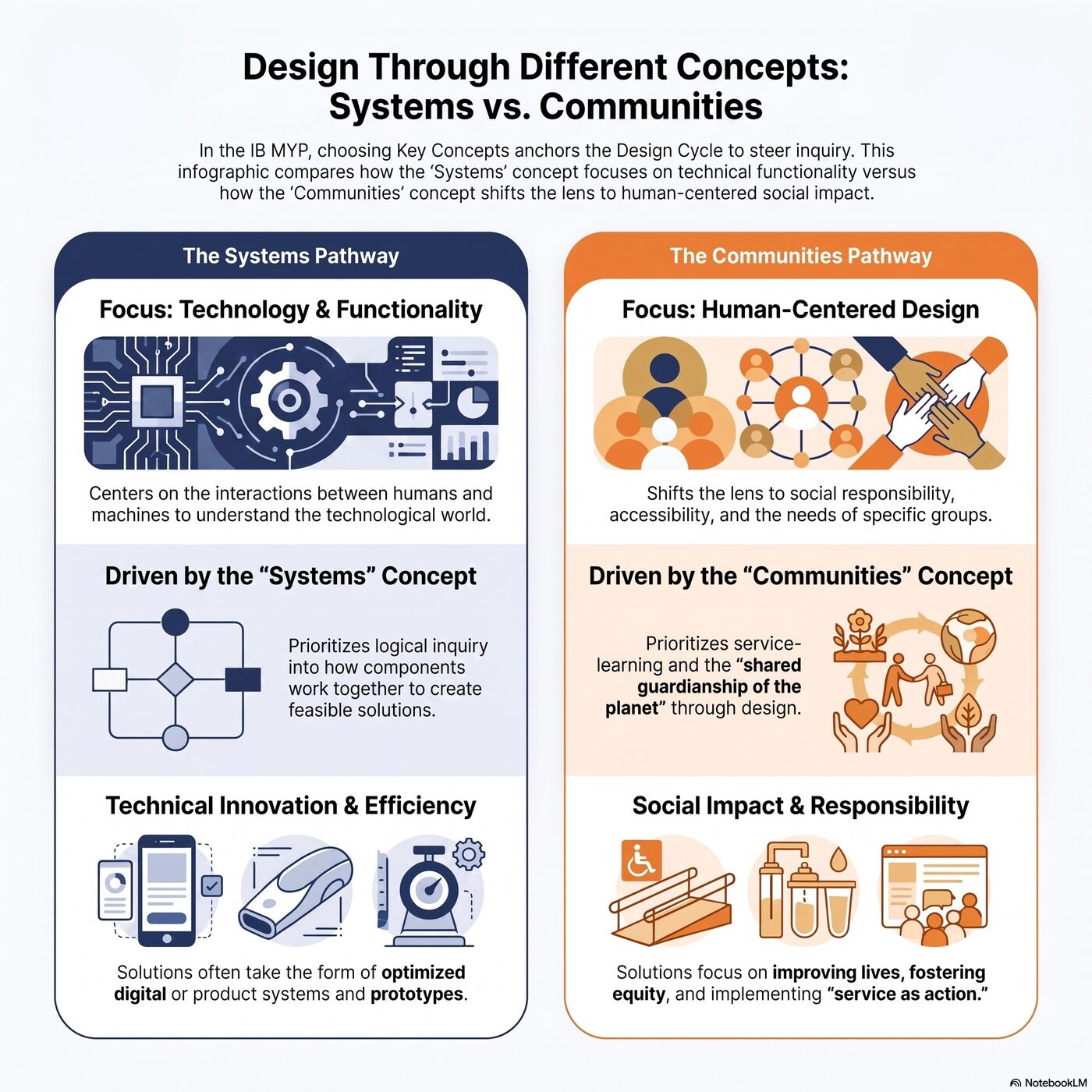
Example 2: Designing a Mobile App (Design). Standard Key Concept Systems: inquiry focuses on how code, UI, and hardware interact. Alternative Key Concept Communities: the inquiry shifts to user demographics — does the app serve a specific community, is it accessible to the elderly — with Criterion A research becoming community-based rather than purely technical.
Example 3: Statistical Analysis (Mathematics). Standard Key Concept Logic: rigorous rules for mean, median, mode, standard deviation. Alternative Key Concept Communication: the unit becomes an analysis of data visualization and bias — the assessment requires presenting the same data in two graphs to intentionally communicate opposing narratives.
Reflection Questions
- Are we choosing this Key Concept because it genuinely deepens the inquiry, or because it's the most obvious choice for our subject group?
- If we changed the Key Concept entirely, how would that alter the final summative assessment?
- Have we selected only one Key Concept to keep the unit focused?
- Will this Key Concept help students transfer learning to other subjects, or is it too narrow?
- Are we explicitly planning to use this concept in daily teaching, or will it only appear on the printed plan?
Quick Checklist: Choosing and Using a Key Concept
- ☐ Review the 16 MYP Key Concepts — don't limit yourself to your subject group's contributed concepts.
- ☐ Apply the Rule of One — select one Key Concept for a sharp interdisciplinary focus.
- ☐ Pair with Related Concepts — 1–3 subject-specific concepts for disciplinary depth.
- ☐ Draft the Statement of Inquiry, weaving in the Key Concept explicitly.
- ☐ Formulate conceptual Inquiry Questions that force students to use the Key Concept.
- ☐ Align the assessment so the summative task lets students demonstrate the concept.
Key Takeaways
- Key Concepts are the lenses of learning, demanding synergistic thinking rather than rote memorization.
- Breadth vs. depth: Key Concepts provide interdisciplinary breadth; Related Concepts provide disciplinary depth.
- The Rule of One: choose only one Key Concept per unit for a sharp, impactful focus.
- Embrace flexibility — cross subject-group boundaries to spark innovative learning.
- Beware false coverage — connections must be authentic, not mechanically forced.