 My IB
My IB In previous chapters, we explored the educational philosophy underpinning the MYP and established that it is a cohesive framework for concept-based, inquiry-driven learning. Now it's time to look at the primary tool used to translate that philosophy into daily classroom practice: the MYP Unit Planner.
For many teachers, the official planner can look like a daunting administrative hurdle, filled with specific terminology and requiring a shift from chronological lesson planning to backward design. But it is much more than a compliance document — it is the architectural blueprint for a coherent learning journey.
In this chapter, we take a guided walkthrough of the planner, exploring:
- The dynamic, iterative nature of MYP planning.
- How the Inquiry section establishes the unit's destination.
- How the Action section maps the day-to-day student experience.
- How the Reflection section drives continuous improvement.
Why This Matters
The educational purpose
The MYP curriculum model states that the designed (written), delivered (taught), and assessed curriculums must be completely integrated. The Unit Planner forces this integration by requiring teachers to explicitly link Key Concepts, Related Concepts, and Global Context to both daily activities and final assessments — shifting focus from teacher inputs to student outputs.
The common misconception: the linear checklist
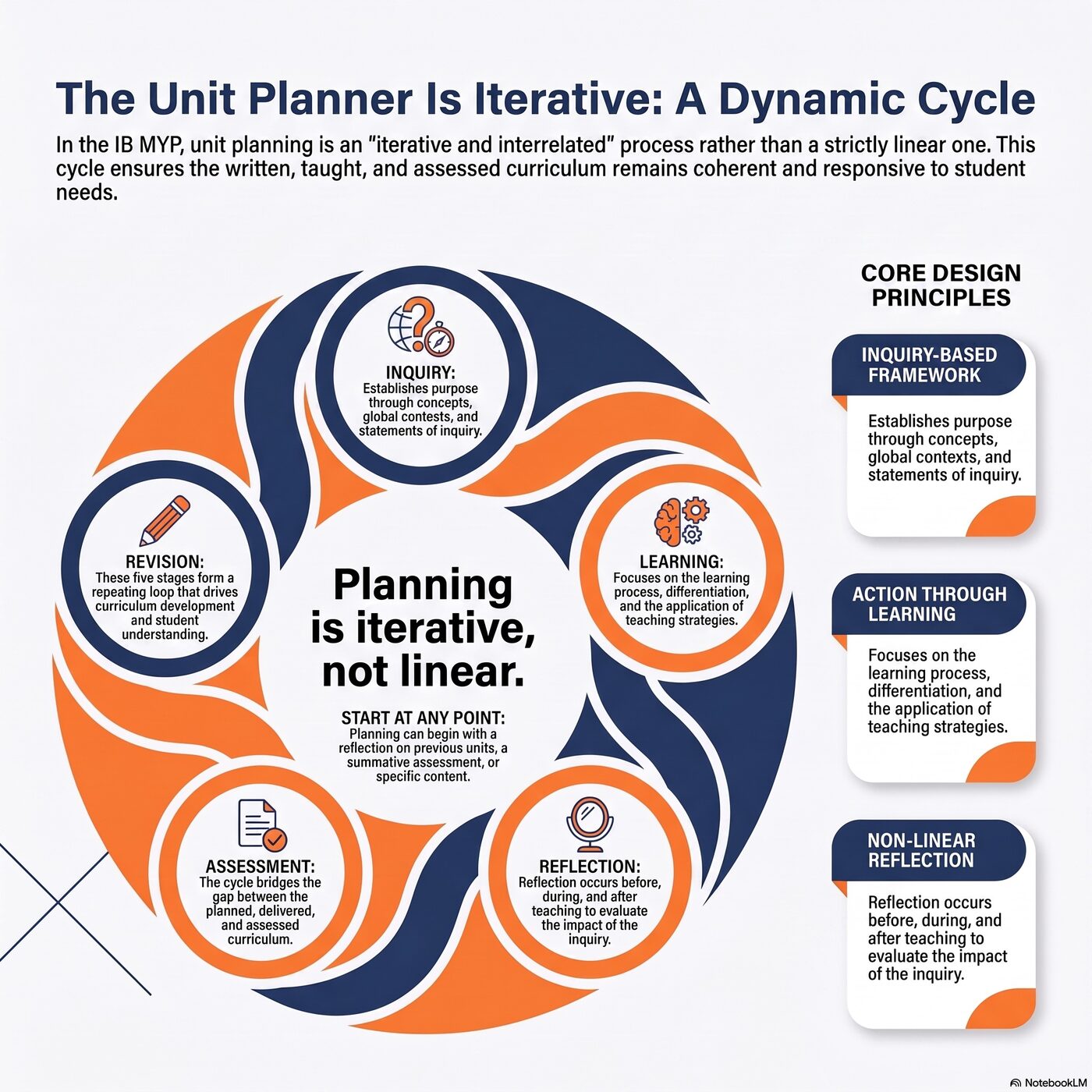
The most common misconception is that the planner is a linear document to be completed top to bottom before teaching begins. In reality, curriculum planning is iterative and interrelated — you might start with a great summative assessment idea and work backward to the Statement of Inquiry, or notice an ATL skills gap and build a unit to address it.
What happens if this is ignored?
When teachers view the planner as paperwork: students experience disconnected activities lacking unifying purpose ("the disjointed journey"); summative tasks are poorly aligned with learning experiences, testing skills never explicitly taught (the "gotcha" assessment); and concepts or contexts get "ticked off" without embedding in the actual student experience ("false coverage").
Core Concepts: The Anatomy of the Planner
The official MYP unit planner is divided into three major sections — Inquiry, Action, and Reflection — representing a continuous cycle of educational design.
Part 1: Inquiry (establishing the purpose)
Before planning a single lesson, define the conceptual takeaways, real-world relevance, and final evidence of learning.
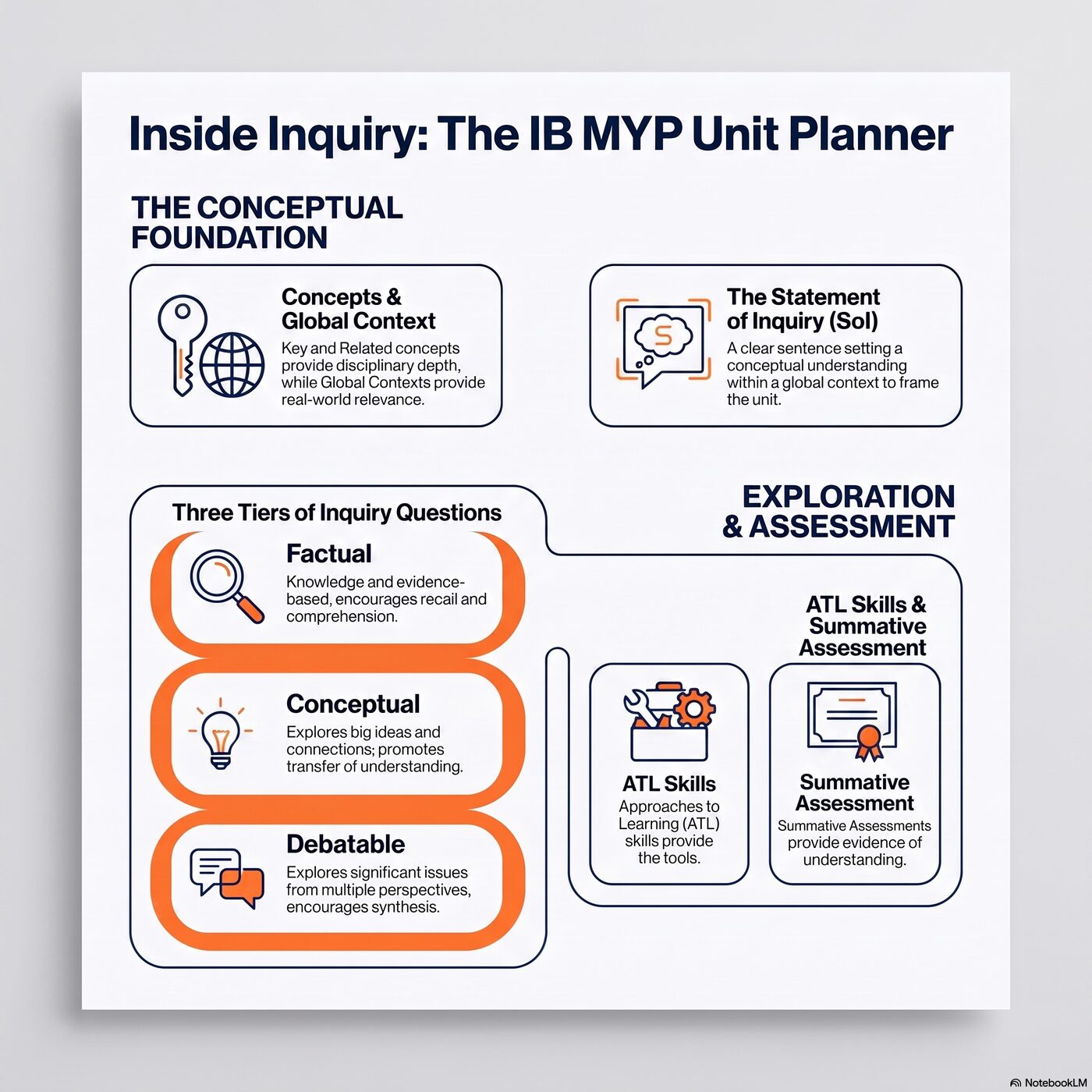
Concepts and context: Key Concepts provide interdisciplinary breadth; Related Concepts provide disciplinary depth; the Global Context anchors learning in the real world.
The Statement of Inquiry and Inquiry Questions: the Statement combines concepts and context into one transferable sentence — the enduring understanding you want students to retain. Inquiry Questions (Factual, Conceptual, Debatable) are the stepping stones toward it.
Objectives and summative assessment: select the specific subject-group objectives (A, B, C, D) this unit targets, then design an authentic performance task explicitly linked back to the Statement of Inquiry.
Approaches to Learning (ATL): identify the specific, teachable skills students need to succeed on the summative assessment. If the assessment requires a persuasive essay on climate change, ATL skills must include explicit instruction on structuring an argument and researching reliable sources — the Inquiry section creates an unbroken thread from broad concepts down to specific skills.
Part 2: Action (learning and teaching through inquiry)
This section outlines the delivered (taught) curriculum — where the intent of the Inquiry section becomes classroom reality.
- Content: the specific disciplinary knowledge, topics, and standards to be taught — the vehicle through which students explore concepts.
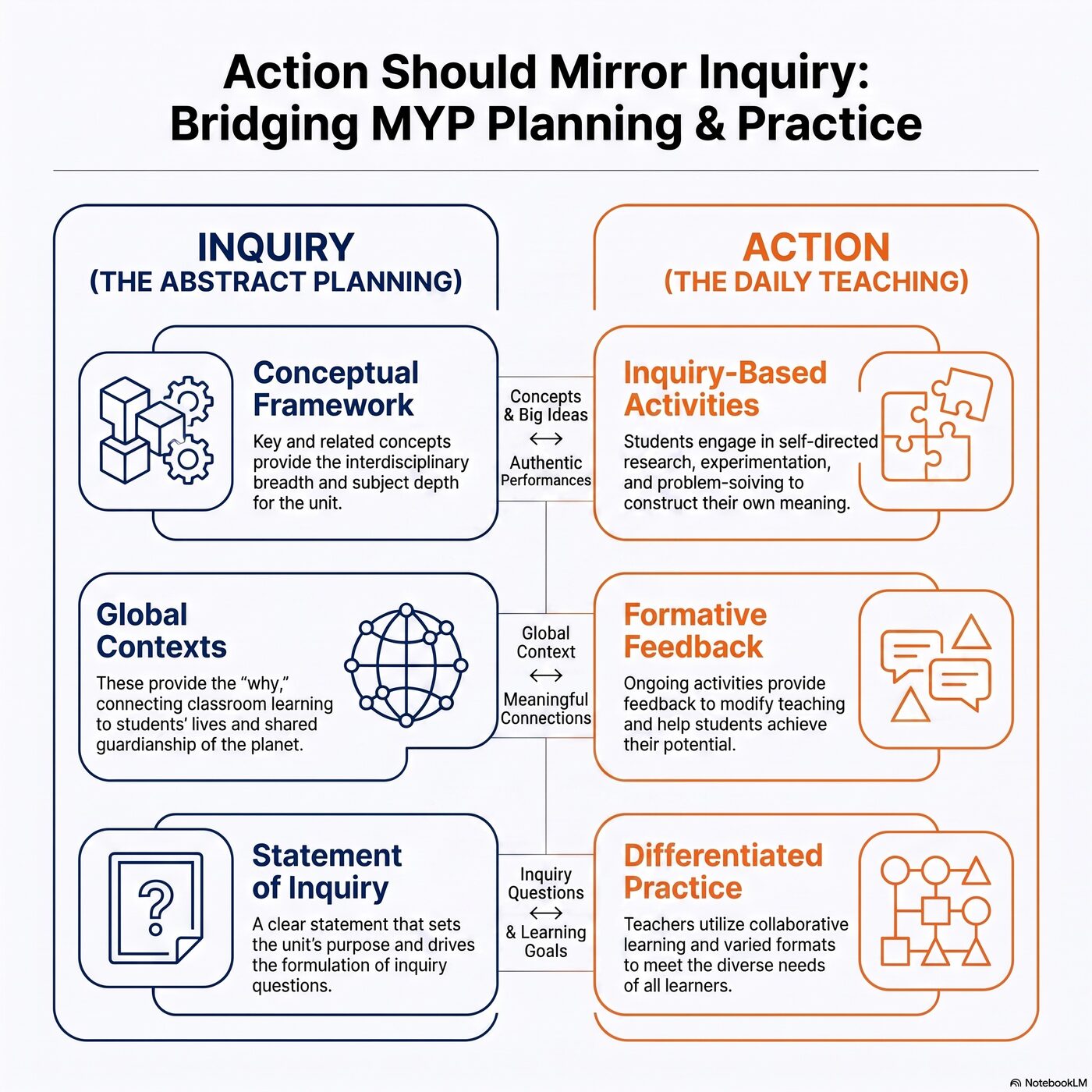
- Learning experiences and teaching strategies: how you front-load background knowledge, sequence investigation of the Inquiry Questions, and explicitly teach the chosen ATL Skills.
- Formative assessment: ongoing checks for understanding that directly prepare students for the summative — if the summative asks students to design a lab experiment, formatives should practice hypothesis writing and variable identification.
- Differentiation: adapting environment, process, or task to ensure every student has access.
How they work together: the Action section must directly reflect the Inquiry section. A reviewer should be able to look at daily learning experiences and clearly see how they prepare students to answer the Statement of Inquiry and succeed on the summative task.
Part 3: Reflection (considering the planning, process, and impact)
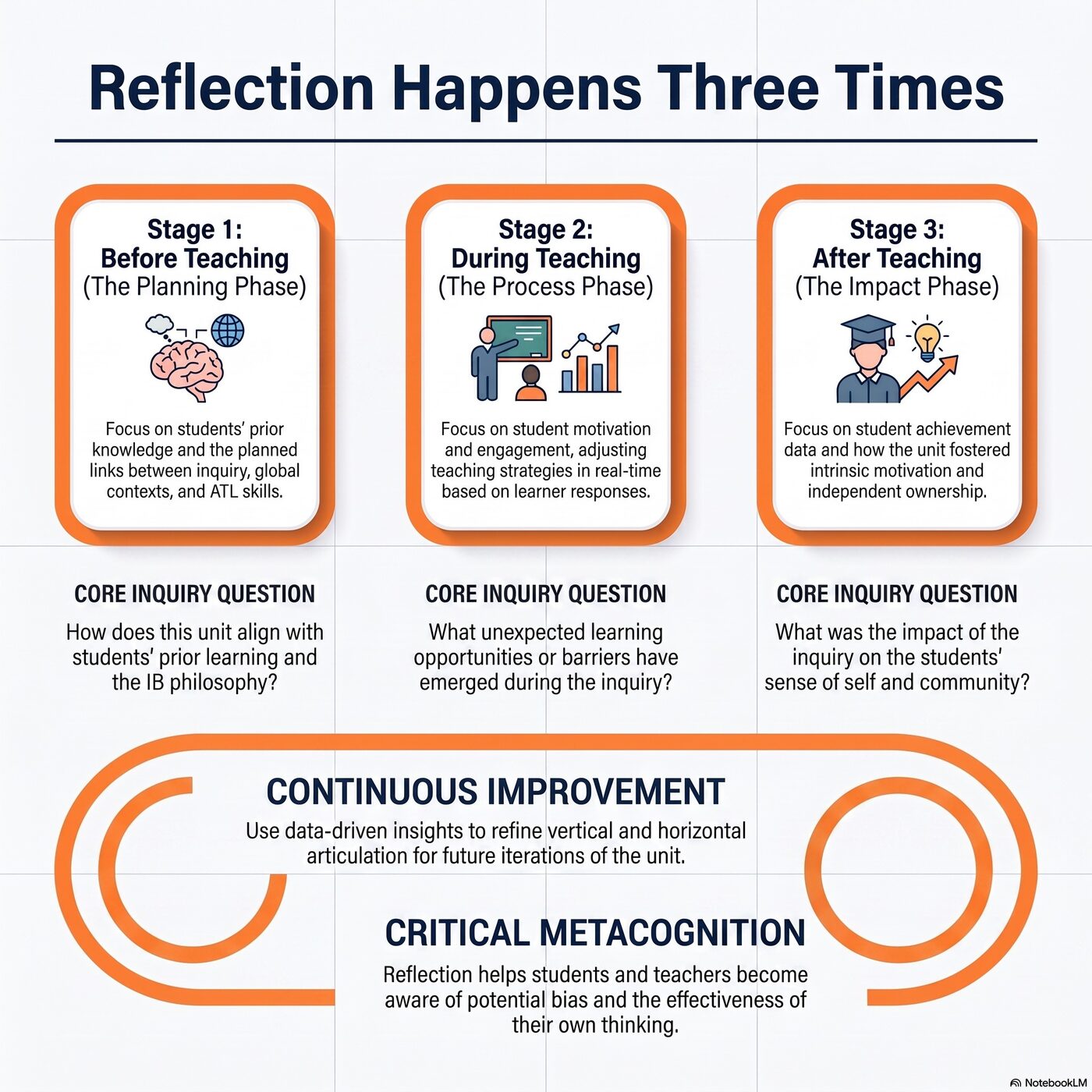
Reflection is a formalized, mandatory process at three stages: prior to teaching (what students already know, potential challenges), during teaching (what's working, whether pacing or ATL practice needs adjusting), and after teaching (whether objectives were achieved, whether the task was authentic and fair, what to change next year).
How they work together: notes captured "after teaching" directly inform "prior to teaching" the following year, ensuring the plan is a living, evolving document.
Common Mistakes
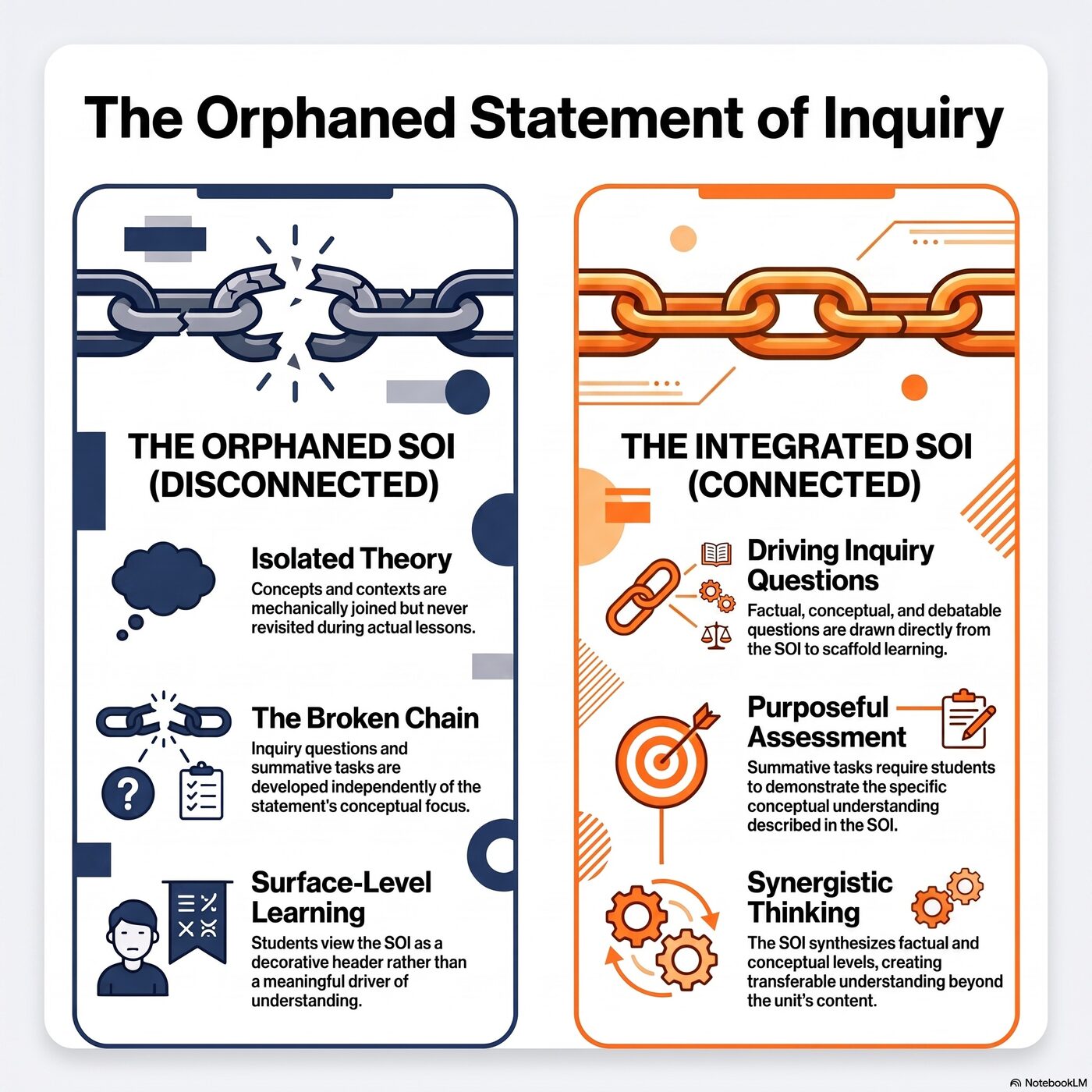
1. The "orphaned" Statement of Inquiry
The mistake: a brilliant Statement of Inquiry is crafted, then never mentioned again — lessons and the summative focus entirely on factual recall.
Why it happens: defaulting to traditional content-coverage habits.
How to avoid: explicitly link the summative task to the Statement of Inquiry; the assessment prompt should require students to use it to justify their findings.
2. Confusing "activities" with "learning experiences"
The mistake: "Students will make a poster about the water cycle."
Why it happens: focusing on the final product rather than the cognitive process.
How to avoid: frame around the inquiry process — "Students will investigate the impact of urbanization on the local water cycle, practicing Research (ATL) skills to gather data, then synthesize it into a visual format."
3. Assessing criteria that weren't taught
The mistake: assessing Criterion C (Producing Text) with no learning experiences dedicated to drafting, organizing, or editing.
Why it happens: assuming students already possess the skills required.
How to avoid: use backward design — sequence formative assessments and teaching strategies that explicitly teach the required skill before assessing it.
4. Generic "Global Context" integration
The mistake: selecting Identities and Relationships for a statistics unit but only using one word problem involving populations to justify it.
Why it happens: treating the Global Context as a mandatory label rather than a lens for learning.
How to avoid: let the Global Context drive the summative task's context — e.g., using statistical models to analyze demographic shifts and their impact on community relationships.
5. The "blank" during-teaching reflection
The mistake: waiting until the end of the semester to fill out all reflection boxes at once.
Why it happens: time pressures and viewing the planner as an administrative chore.
How to avoid: keep the planner accessible and treat "during teaching" as a real-time diary.
Practical Classroom Examples
Example 1: Language Acquisition (Phases 3–4). Key Concept Culture, Related Concept Message, Global Context Personal and Cultural Expression. Statement of Inquiry: "Cultural norms dictate how we express messages of respect and gratitude." Students analyze authentic texts from different target-language cultures, then write two distinct messages of gratitude (to a friend, and to a community elder) applying correct cultural conventions — assessed against Criteria C and D.
Example 2: Sciences. Key Concept Relationships, Related Concept Energy, Global Context Scientific and Technical Innovation. Because students historically struggle with lab report structure, the ATL focus is Information Literacy, explicitly modeled in daily learning experiences. The summative — designing an experiment to test insulating-material efficiency (Criteria B and C) — is fully supported by that explicit teaching.
Example 3: Arts (Visual Arts). Key Concept Aesthetics, Related Concept Audience, Global Context Identities and Relationships. Formative assessments include rough-draft sketches and peer critiques focused on emotional impact; differentiation offers digital design tools for students with fine-motor-skill challenges; the "after teaching" reflection notes the peer-critique protocol should be used earlier next year.
Reflection Questions
- For teachers: if I handed my Action section to a substitute, could they guess my Statement of Inquiry without seeing the Inquiry section?
- For coordinators: when reviewing unit plans vertically, do we see a logical progression of ATL skills, or the same basic skills taught repetitively?
- For the student experience: are students surprised by summative expectations, or did formative tasks and explicit ATL instruction thoroughly prepare them?
Quick Checklist: Ensuring Unit Coherence
- ☐ The SoI-to-assessment link: the summative task requires demonstrating understanding of the Statement of Inquiry.
- ☐ The objectives-to-criteria link: subject-group objectives match the assessment criteria used.
- ☐ The ATL-to-action link: identified ATL skills are supported by planned teaching strategies.
- ☐ The formative-to-summative link: formative tasks provide direct practice for what the summative requires.
- ☐ The reflection loop: "prior to teaching" notes are informed by last year's "after teaching" reflections.
Key Takeaways
- The MYP Unit Planner ensures alignment between the written, taught, and assessed curriculum.
- Planning is iterative, not linear — teachers move constantly between Inquiry, Action, and Reflection.
- The Inquiry section establishes the conceptual and contextual destination.
- The Action section details the daily mechanics of reaching that destination.
- Reflection is a formalized, ongoing requirement driving continuous improvement.