 My IB
My IB In Chapter 1, we established that the MYP Unit Plan is far more than an administrative template; it is the architectural blueprint for your classroom. But a blueprint is only as good as the architectural principles upon which it is founded. In the MYP, those principles are rooted in a distinct, research-backed educational philosophy.
An IB education is the result of a dynamic interaction between the learners, the pedagogical approaches, the global contexts, and the pursuit of significant knowledge. The MYP framework demands that we shift our focus from what we are teaching to how and why students are learning — viewing education not as the transmission of facts, but as the collaborative construction of meaning.
In this chapter, we explore the philosophical pillars that hold up the MYP Unit Planner:
- Concept-based learning: moving beyond rote memorization.
- Inquiry-based teaching: fostering genuine curiosity and investigation.
- Student agency: empowering students to take action and ownership.
- International-mindedness: cultivating a global perspective.
Why This Matters
The educational purpose
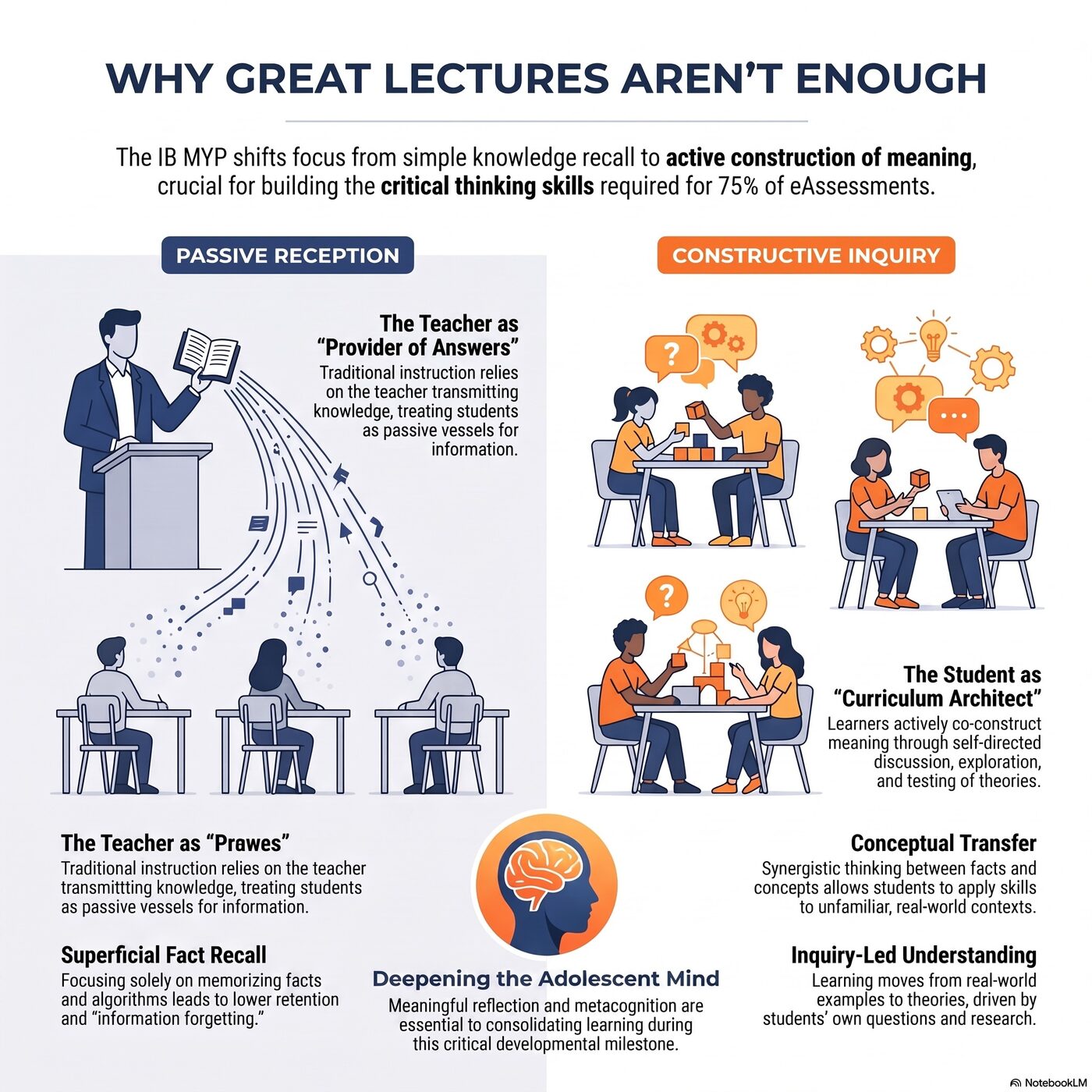
At its core, the MYP embraces a constructivist approach to education: learners do not simply absorb information passively, but actively construct their own understanding by connecting new experiences to prior knowledge.
This is crucial for adolescent learners (ages 11–16), a time of profound physical, emotional, and cognitive change during which students are actively establishing their personal and social identities. Education that relies heavily on "teacher-talk" and memorization fails to engage developing higher-order thinking skills; to motivate middle-level learners, education must be emotionally engaging, intellectually rigorous, and demonstrably relevant to the real world.
The common misconception
New MYP teachers often view the philosophical elements of the planner — the learner profile, the conceptual framework — as "fluff" that takes time away from teaching "real content."
What happens if this is ignored?
If we ignore the philosophy behind the MYP, our teaching defaults to traditional, compliance-driven instruction: students memorize information for a test and promptly forget it; learning remains trapped in subject silos; students lack the cognitive agility to apply knowledge to unfamiliar situations; and students are underprepared for the DP, CP, and MYP eAssessments, which explicitly prioritize inquiry, communication, and critical thinking over simple recall.
Core Concepts
1. Concept-based learning: thinking beyond the facts
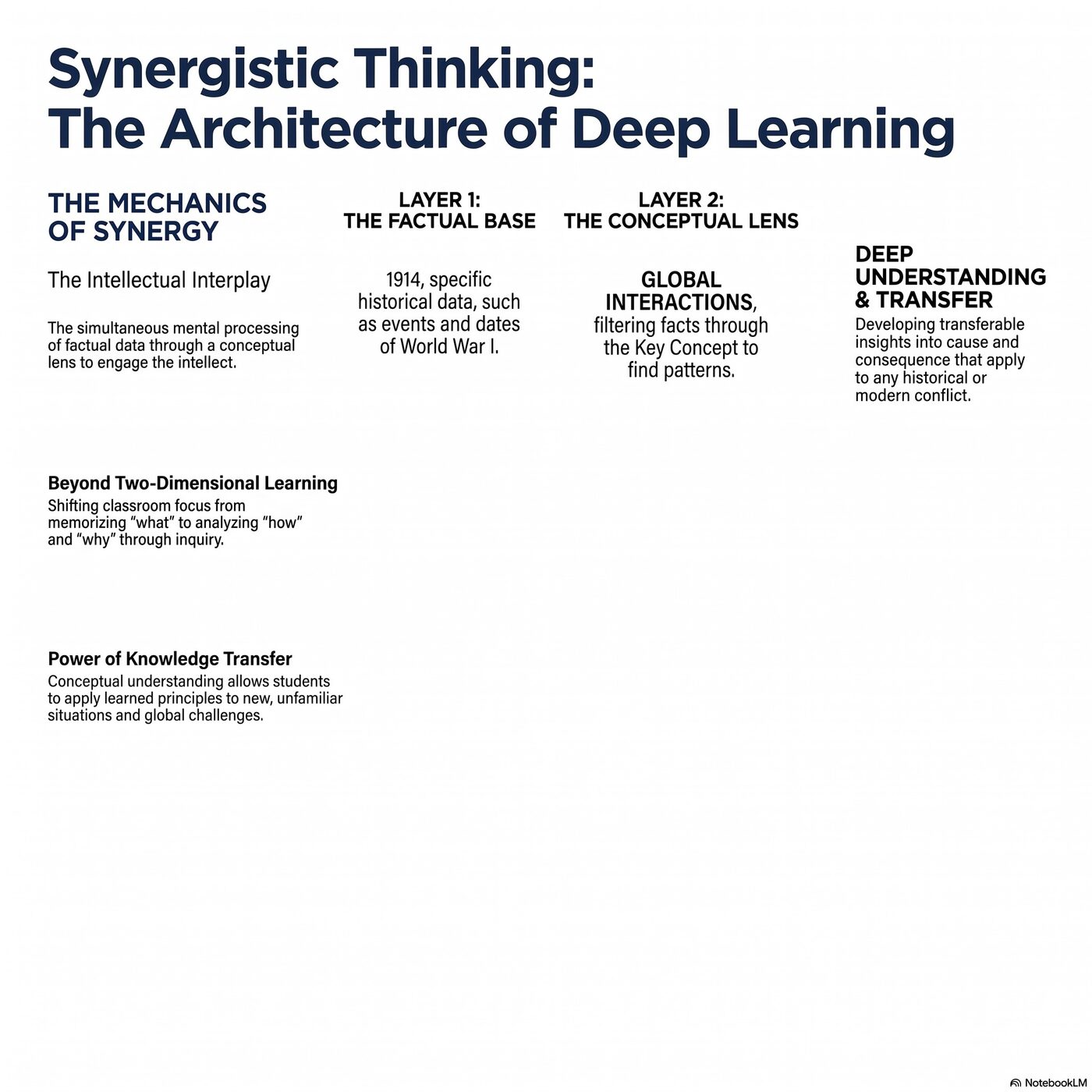
In a world where facts are readily accessible via a quick search, classroom time must shift from covering information to applying and thinking with it. The MYP is a concept-driven curriculum: concepts are powerful, organizing ideas that transcend national and cultural boundaries, and filtering facts through a conceptual lens produces "synergistic thinking" — deeper cognitive processing and greater retention.
In practical planning, this is divided into two layers:
- Key Concepts provide interdisciplinary breadth — 16 overarching ideas (Change, Systems, Relationships, Communication, etc.) shared across all subject groups.
- Related Concepts provide disciplinary depth — specific to your subject group (Equivalence in Math, Adaptation in PHE, Genre in Language and Literature).
Classroom relevance: you do not stop teaching facts — you use facts as the tool to teach the concept. If teaching the causes of World War I, the dates and treaties are the facts, but the enduring understanding comes from analyzing them through the Key Concept of Global Interactions and the Related Concept of Causality.
2. Inquiry-based teaching: the cycle of learning
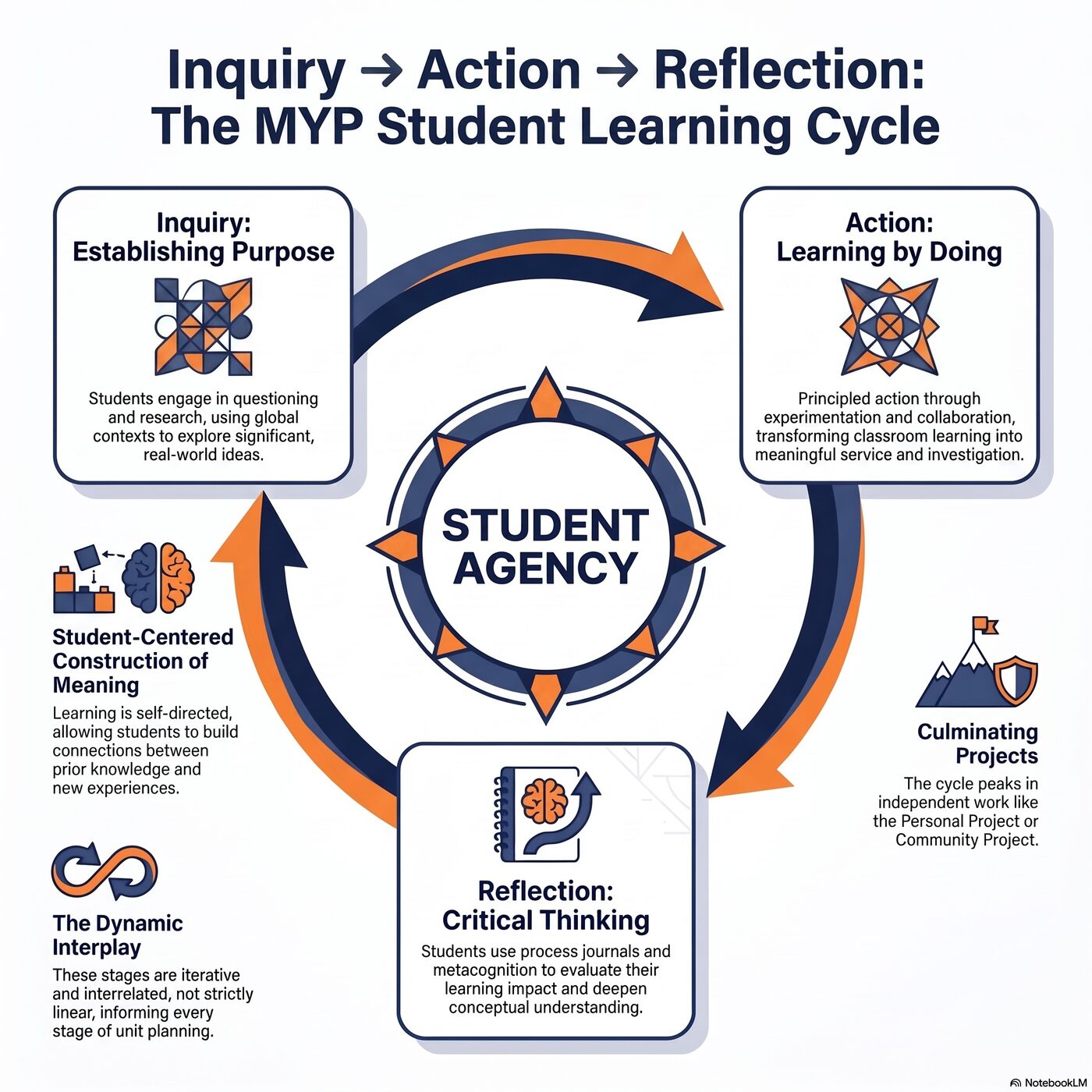
Inquiry is the pedagogical engine of the MYP — the process that moves a student from their current understanding to a deeper one. The MYP relies on structured inquiry: the teacher carefully designs a learning environment that provokes curiosity and sustains exploration, formally represented as the cycle of Inquiry, Action, and Reflection.
- Inquiry (Asking): drawing on prior knowledge, establishing context, formulating compelling questions — where Inquiry Questions (factual, conceptual, debatable) come into play.
- Action (Doing): research, experimentation, collaboration, problem-solving.
- Reflection (Thinking): clarifying ideas, reappraising perceptions, evaluating the learning process.
Classroom relevance: an inquiry-based teacher shifts from "sage on the stage" to facilitator of meaning-making, provoking thought through open-ended questions and formative feedback.
3. Student agency and Approaches to Learning (ATL)
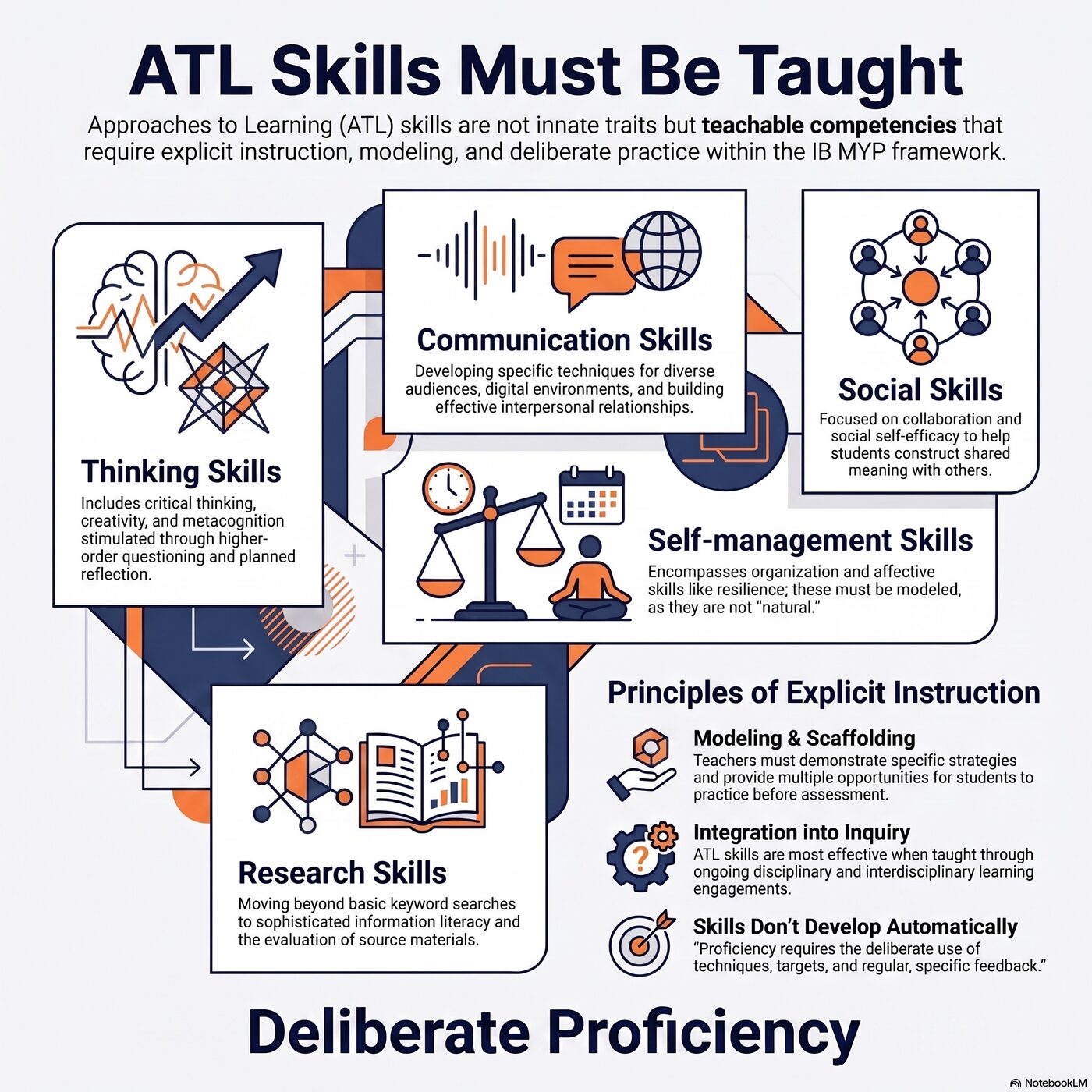
An IB education empowers young people for a lifetime of independent learning; students must be active participants, not passive recipients. This is made practical through explicit teaching of ATL Skills, grouped into five categories: Thinking, Social, Communication, Self-Management, and Research.
We cannot assume middle schoolers know how to study, collaborate respectfully, or evaluate media bias — these skills must be systematically mapped and explicitly taught, developing metacognition and, ultimately, agency. True student agency culminates in Action: the MYP philosophy expects successful inquiry to lead to responsible, student-initiated action, whether an informal shift in behavior or a formal community service project.
4. International-mindedness and contextual learning
The fundamental aim of all IB programmes is to develop internationally-minded people who recognize their common humanity and shared guardianship of the planet. International-mindedness is not flags on a wall or an international food day — it requires understanding multiple perspectives, investigating global challenges, and reflecting on cultural biases.
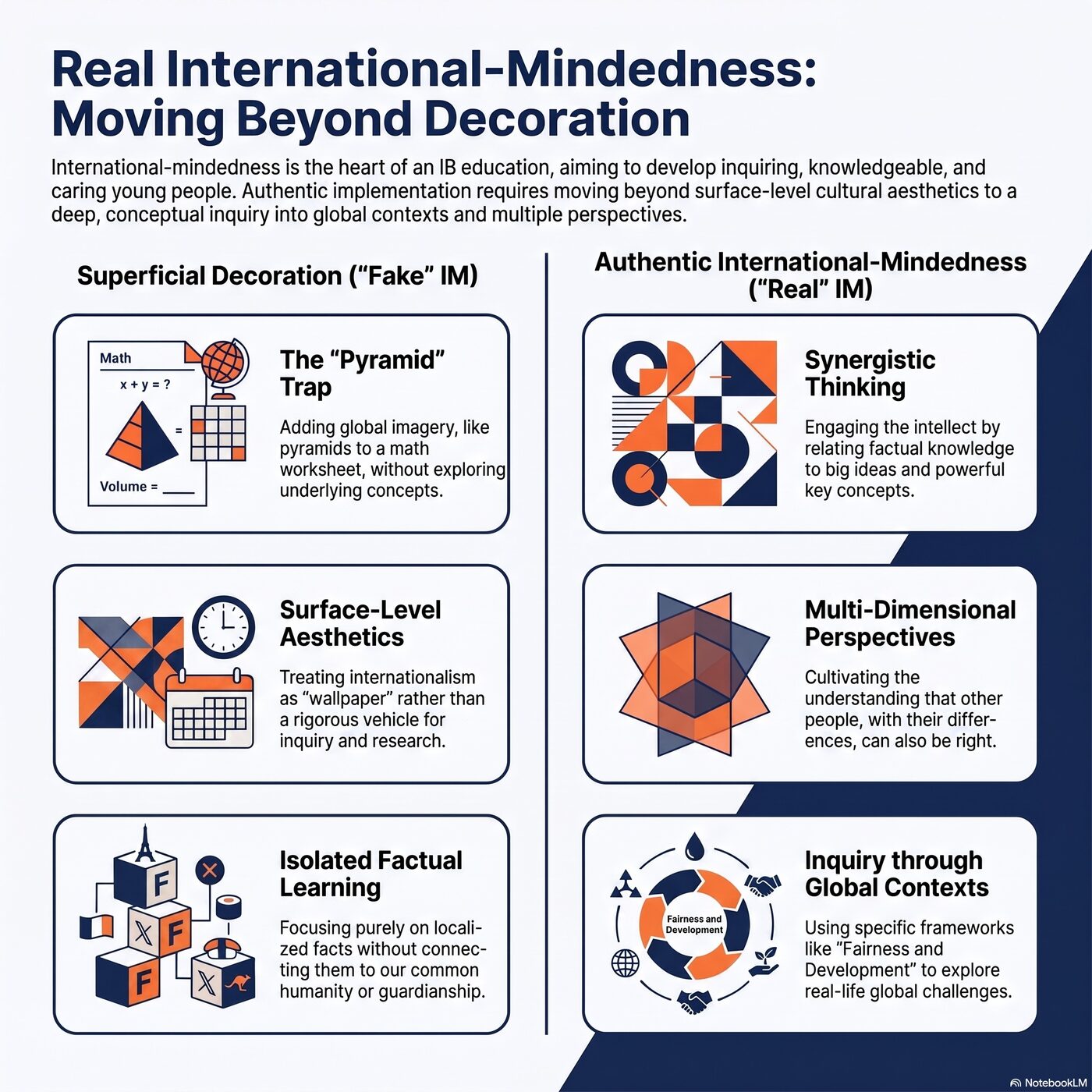
In the Unit Planner, this philosophy is anchored by the Global Context. All learning is contextual; the MYP requires selecting one of six Global Contexts (e.g., Fairness and Development, Identities and Relationships) to frame every unit, answering the student's vital question: "Why are we learning this? Why does this matter to the real world?"
Classroom relevance: a Science unit on water filtration placed in the context of Globalization and Sustainability forces students to look beyond the chemistry, inquiring into how access to clean water impacts global equity.
Common Mistakes
1. The "guess what I'm thinking" inquiry
The mistake: posing an inquiry question but subtly steering the conversation until someone guesses the pre-planned answer.
Why it happens: time pressure and fear of letting the inquiry go "off track."
How to avoid: use the Statement of Inquiry as an anchor, but allow students to construct meaning in varied ways.
2. Treating concepts as vocabulary words
The mistake: writing "Form" on the board, having students copy the definition, and never mentioning it again until the test.
Why it happens: confusing a fact to be memorized with a concept to be utilized.
How to avoid: concepts are lenses, not vocabulary. Ask: "How does changing the 'Form' of this poem alter its meaning?"
3. Forced international-mindedness
The mistake: showing a picture of the Pyramids in a geometry class and declaring the lesson "internationally-minded," then teaching standard formulas.
Why it happens: viewing international-mindedness as a box to tick.
How to avoid: use the Global Context to drive authentic exploration — e.g., Orientation in space and time to investigate how ancient cultures solved geometric problems.
4. The "invisible" ATL skills
The mistake: checking the "Collaboration" box because the summative involves group work, without teaching conflict resolution or delegation.
Why it happens: assuming students naturally possess these skills.
How to avoid: design mini-lessons that explicitly model effective group work.
5. Treating "Action" as an unrelated chore
The mistake: abruptly assigning two hours of unrelated community service at the end of a unit.
Why it happens: misinterpreting Action as a volunteering quota rather than an organic outcome of learning.
How to avoid: let Action arise authentically — e.g., writing advocacy letters after studying persuasive writing.
Practical Classroom Examples
Example 1: Language Acquisition — Connections & Message. Traditional approach: memorize past-tense travel vocabulary. MYP approach: Key Concept Connections, Related Concept Message, Global Context Personal and Cultural Expression. Students analyze travel blogs from different cultures and write a reflective narrative about a personal journey, focusing on intercultural understanding.
Example 2: Arts (Visual Arts) — Identity & Expression. Traditional approach: a step-by-step watercolor tutorial that produces 25 identical paintings. MYP approach: Key Concept Identity, Related Concept Expression. Students formulate their own inquiry questions about identity after viewing diverse self-portraits, then choose their own medium to create a piece communicating personal cultural identity, with a reflective process journal.
Example 3: Physical and Health Education — Relationships & Interaction. Traditional approach: explain basketball rules and grade baskets scored. MYP approach: Key Concept Relationships, Related Concept Interaction, ATL focus Collaboration. Teams design a new invasion game, negotiating rules and team dynamics; assessment covers both physical skill and collaborative negotiation.
Reflection Questions
- Am I genuinely teaching for conceptual transfer, or using concepts as decorative titles for content-heavy lessons?
- Does my classroom tolerate the messiness of student-led inquiry, or do I quickly supply the "correct" answers?
- How often do I explicitly model and teach ATL skills, rather than expecting students to naturally possess them?
- Will students leave my unit with a deeper understanding of shared humanity and the wider world, or only isolated facts?
- Does my MYP Assessment allow students to demonstrate understanding in authentic, real-world contexts?
Quick Checklist: Aligning Philosophy with Planning
- ☐ Concept check: one Key Concept and 1–3 Related Concepts, actively used to analyze the content.
- ☐ Context check: the Global Context provides a meaningful, real-world anchor.
- ☐ Inquiry check: Inquiry Questions are open-ended enough to provoke genuine debate.
- ☐ Agency check: the unit explicitly teaches ATL skills and provides self-reflection opportunities.
- ☐ Action check: look for organic opportunities for responsible, independent student action.
Key Takeaways
- Philosophy drives practice. The Unit Planner enforces a constructivist, concept-driven, inquiry-based approach.
- Concepts over coverage. Facts are used to build enduring, transferable conceptual understanding.
- Inquiry is a cycle of asking questions, taking action, and reflecting on outcomes.
- Agency requires skills — explicitly teaching ATL skills so students "learn how to learn."
- Context provides meaning — Global Contexts foster international-mindedness and real-world relevance.