 My IB
My IB Whether you are a teacher transitioning from a traditional curriculum or a coordinator guiding a new team, you have likely encountered the MYP Unit Planner. At first glance, it can appear daunting — a dense, multi-page document filled with specific IB terminology.
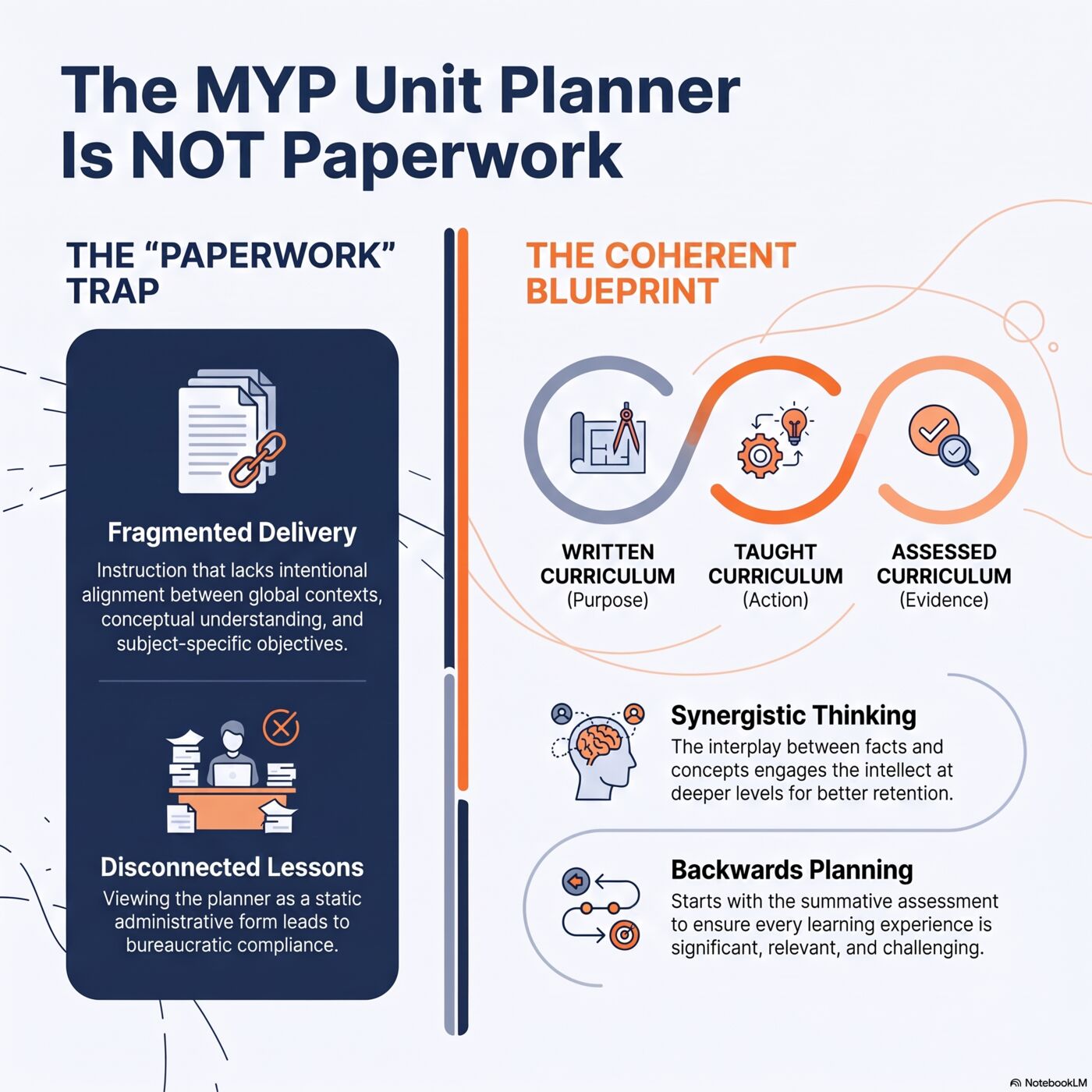
However, understanding the MYP Unit Plan is the key to unlocking the true power of an IB education. Within the MYP framework, a unit is defined as a planned period of study that concludes with a summative assessment. But the planner itself is much more than a mandatory administrative form. It is the architectural blueprint for your classroom — it forces us to move away from isolated, day-to-day lesson planning and instead construct cohesive, concept-driven learning experiences.
In this chapter, we explore:
- Where the MYP Unit Plan fits within the broader IB curriculum framework.
- Why we use "backward design" to construct deep, meaningful inquiries.
- The three dynamic phases of an MYP unit: Inquiry, Action, and Reflection.
- The fundamental differences between traditional teaching and IB MYP Planning.
Why This Matters
Educational purpose: moving beyond "coverage"
In many traditional systems, curriculum planning is driven by content coverage: "What facts do I need to teach by Friday?" The MYP explicitly rejects the idea of education as the mere transmission of knowledge and rote memorization of facts.
Instead, the MYP emphasizes the construction of meaning. The MYP Unit Plan provides a framework that requires students to process factual knowledge through a conceptual lens — "synergistic thinking," an interplay between factual information and conceptual ideas that results in deeper mental processing and greater retention.
The common misconception: "it's just paperwork"
One of the most frequent struggles for new MYP teachers is viewing the unit planner as a compliance document to be filled out after deciding what activities to do in class. When the planner is treated as an administrative hurdle, teaching becomes disjointed.
When teachers understand the why behind the planner, it becomes a dynamic tool. Approaches to Learning (ATL) Skills, Key Concepts, and the Global Context stop being boxes to tick and become the engines driving student curiosity.
What happens if this is ignored?
If the principles of the MYP Unit Plan are ignored, teaching reverts to "siloed" facts. Students might memorize the dates of a historical event or the formula for a physics calculation, but they will lack the cognitive framework to apply that knowledge to unfamiliar, real-world situations — leaving them underprepared for the rigorous, independent demands of the DP or CP.
Core Concepts
The MYP Unit Plan is not just a sequence of lessons; it is a philosophy of education put into practice. To master it, we must break down its three foundational pillars.
1. The curriculum model: written, taught, and assessed
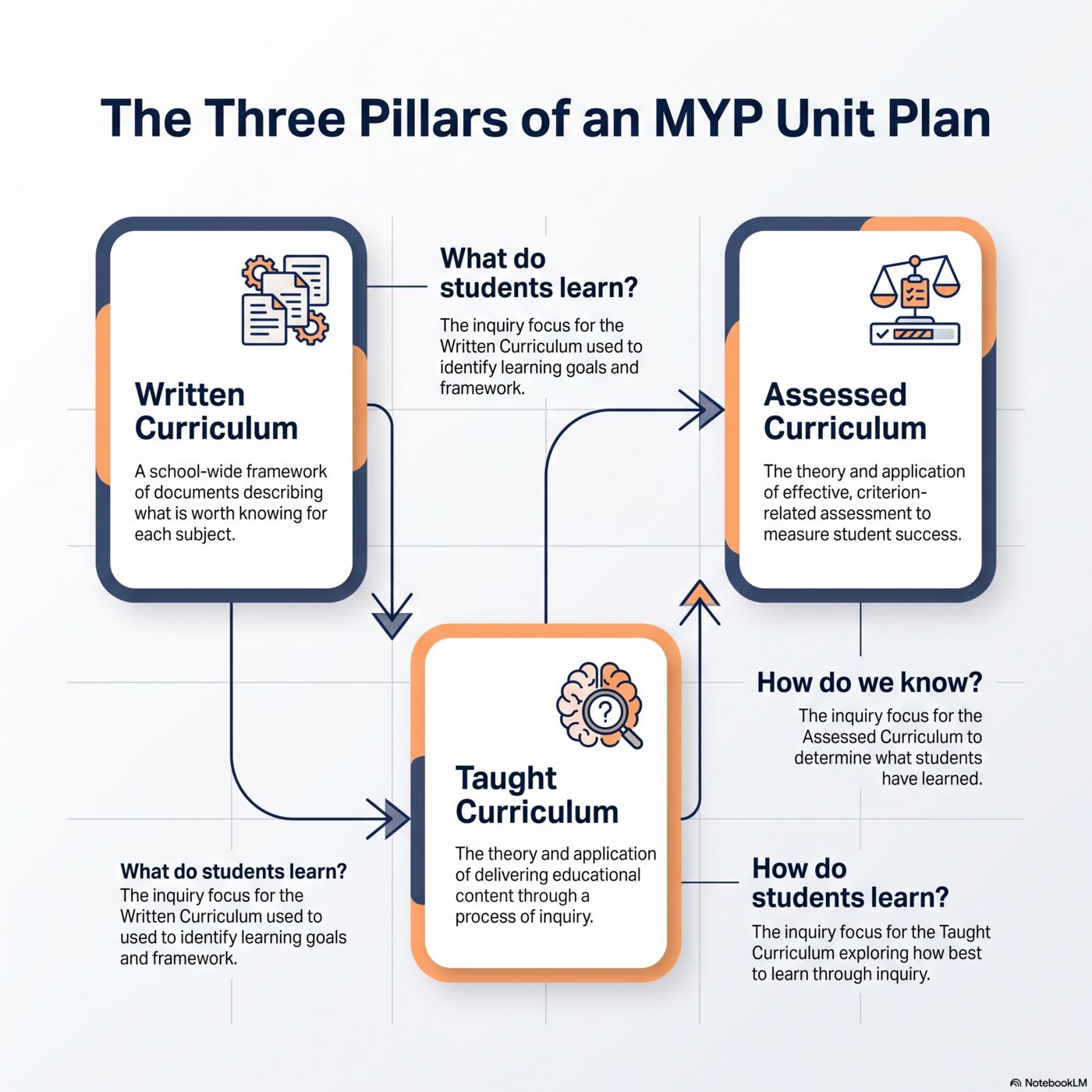
A coherent MYP curriculum relies on the seamless integration of three components, and the unit planner acts as the bridge connecting them all:
- The Designed/Planned Curriculum (Written): the framework of what is worth knowing — what do we want to learn?
- The Delivered Curriculum (Taught): the theory and application of teaching through inquiry — how best will we learn?
- The Assessed Curriculum: evaluating student understanding through authentic performance — how will we know what we have learned?
In traditional planning, these three often exist in isolation. In the MYP, they are an integrated, iterative process mapped directly onto the unit planner.
2. Backward planning
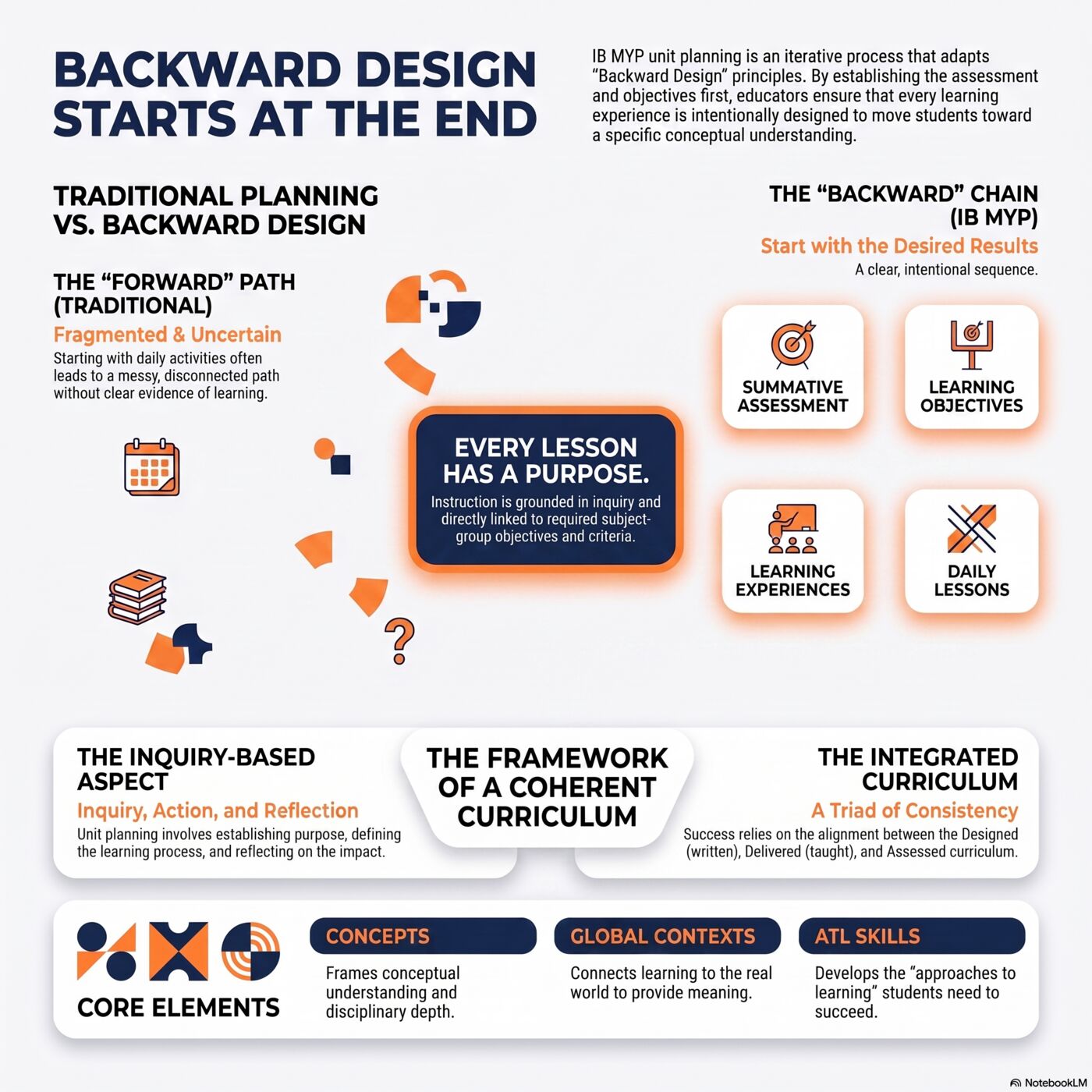
The MYP Unit Plan adopts the principles of "backwards planning" (Wiggins and McTighe). Rather than planning lesson 1, then lesson 2, and finally deciding what the test will be, MYP teachers establish the ultimate purpose of the unit first.
You define the summative assessment and the MYP Assessment criteria before you design your daily learning activities. This ensures every classroom activity directly supports the students' ability to succeed on the final task.
3. The anatomy of the MYP Unit Planner
The planner is divided into three dynamic, interrelated sections.
Part A: Inquiry (establishing the purpose)
This section frames the destination of the unit — what students will understand and why it matters.
- Concepts: one broad Key Concept (e.g., Systems, Change, Relationships) that transcends disciplines, plus 1–3 Related Concepts (e.g., Equivalence in Math, Adaptation in Design) that provide disciplinary depth.
- Global Context: the real-world setting for the unit, answering the student's eternal question, "Why do I need to know this?"
- Statement of Inquiry: a central idea combining the concepts and context into one transferable statement.
- Inquiry Questions: factual, conceptual, and debatable questions guiding exploration of the statement of inquiry.
- Summative Assessment: the authentic task demonstrating achievement against specific MYP subject-group objectives.
- ATL Skills: the explicit thinking, self-management, social, communication, or research skills students need.
Part B: Action (learning and teaching through inquiry)
The "how" — the daily mechanics of the classroom.
- Content: the specific disciplinary knowledge, facts, and local/national curriculum standards to be covered.
- Learning experiences and teaching strategies: the sequence of inquiry-based activities that build knowledge and skills.
- Formative assessment: ongoing, low-stakes checks for understanding.
- Differentiation: how the environment or task adapts to diverse learner needs.
Part C: Reflection (considering the planning, process, and impact)
Reflection is formalized into the planner, occurring prior to, during, and after teaching — what students already know and potential challenges; what's working and whether pacing or formative assessment needs adjusting; and whether objectives were achieved and what changes next year.
Traditional lesson planning vs. IB MYP planning
| Domain | Traditional Lesson Planning | IB MYP Unit Planning |
|---|---|---|
| Starting Point | Content and textbook chapters. | Concepts, real-world contexts, and overarching ideas. |
| Pacing | Day-to-day or week-to-week chronological planning. | Backward design; starting with the summative assessment. |
| Assessment | Often norm-referenced; testing memorized facts at the end of a topic. | Criterion-related; continuous formative assessment leading to an authentic summative performance. |
| Skills | Implicitly taught. | Explicitly mapped and taught via the ATL Skills framework. |
| Collaboration | Mostly isolated to individual teachers. | Highly collaborative, fostering interdisciplinary links and vertical alignment. |
| Purpose | Information transmission. | Meaning-making and conceptual transfer. |
Common Mistakes
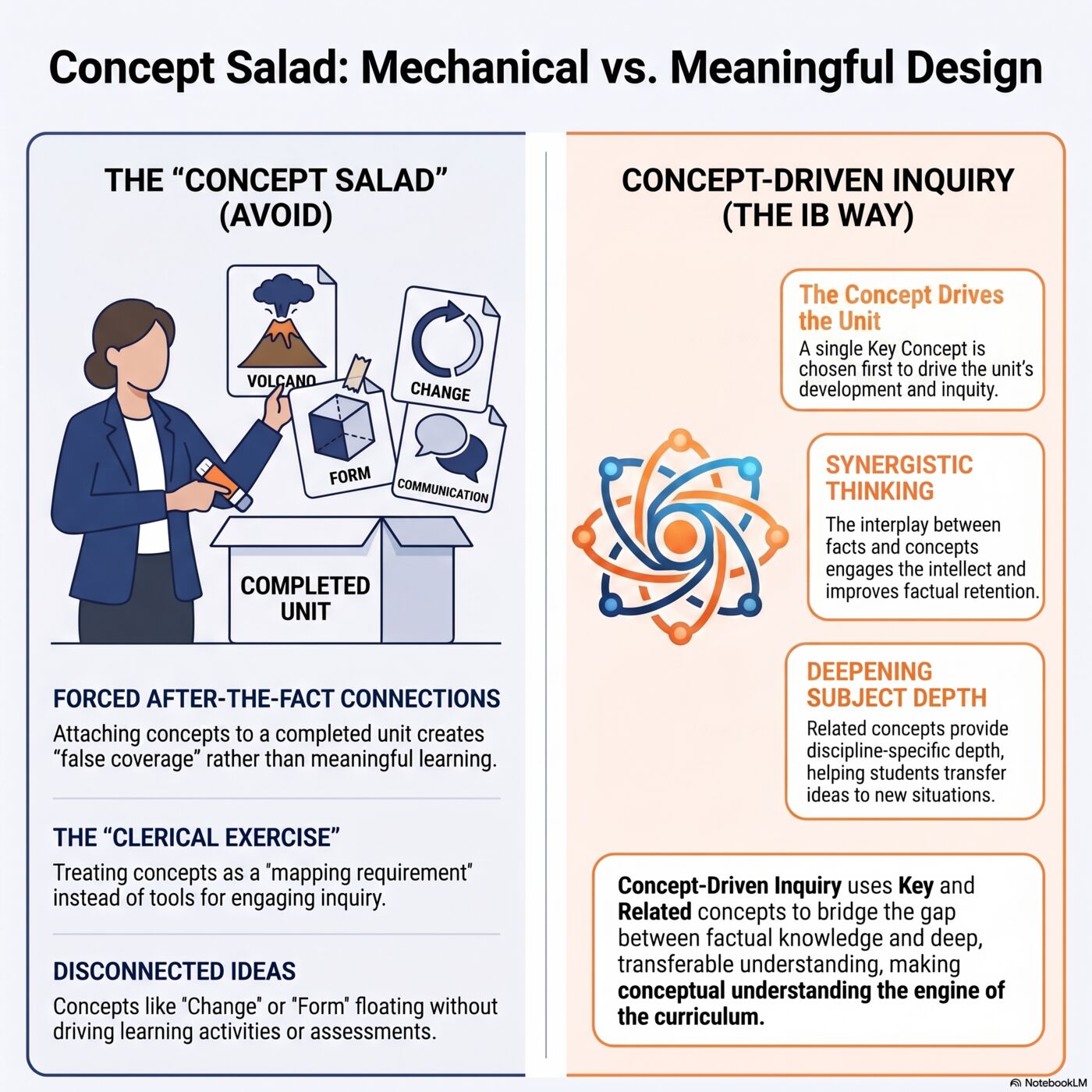
1. The "concept salad" (retrofitting concepts)
The mistake: a teacher builds a unit on "Volcanoes," then at the last minute picks Change and Form randomly to satisfy the planner requirements.
Why it happens: treating the planner as compliance rather than a design tool.
How to avoid: start with the concepts. Build the unit around how "Change" drives geological events — concepts must be the vehicle for inquiry, not a decoration.
2. Treating formative assessment as "mini-summatives"
The mistake: assigning a grade to every piece of practice work, increasing teacher workload and student anxiety.
Why it happens: misunderstanding the purpose of formative assessment.
How to avoid: use formative assessment strictly as a feedback loop — "assessment for learning," not "assessment of learning."
3. Isolating ATL skills from the subject content
The mistake: listing "Communication" in the ATL box, but never explicitly teaching students how to communicate effectively during the unit.
Why it happens: believing that assigning group work automatically teaches collaboration.
How to avoid: ATL skills must be actively taught, modeled, and formatively assessed through the subject content.
4. The "invisible" global context
The mistake: identifying a Global Context in the Inquiry section, but students never explore the real-world connection during the Action phase.
Why it happens: focusing too heavily on factual content.
How to avoid: ensure the summative assessment requires students to apply their knowledge directly to the chosen Global Context.
5. Skipping the "during teaching" reflection
The mistake: only filling out reflection boxes at the very end of the year, right before a curriculum review.
Why it happens: time constraints and pacing pressure.
How to avoid: keep the unit planner open and add bullet points weekly — the "during" reflection is where responsive teaching happens.
Practical Classroom Examples
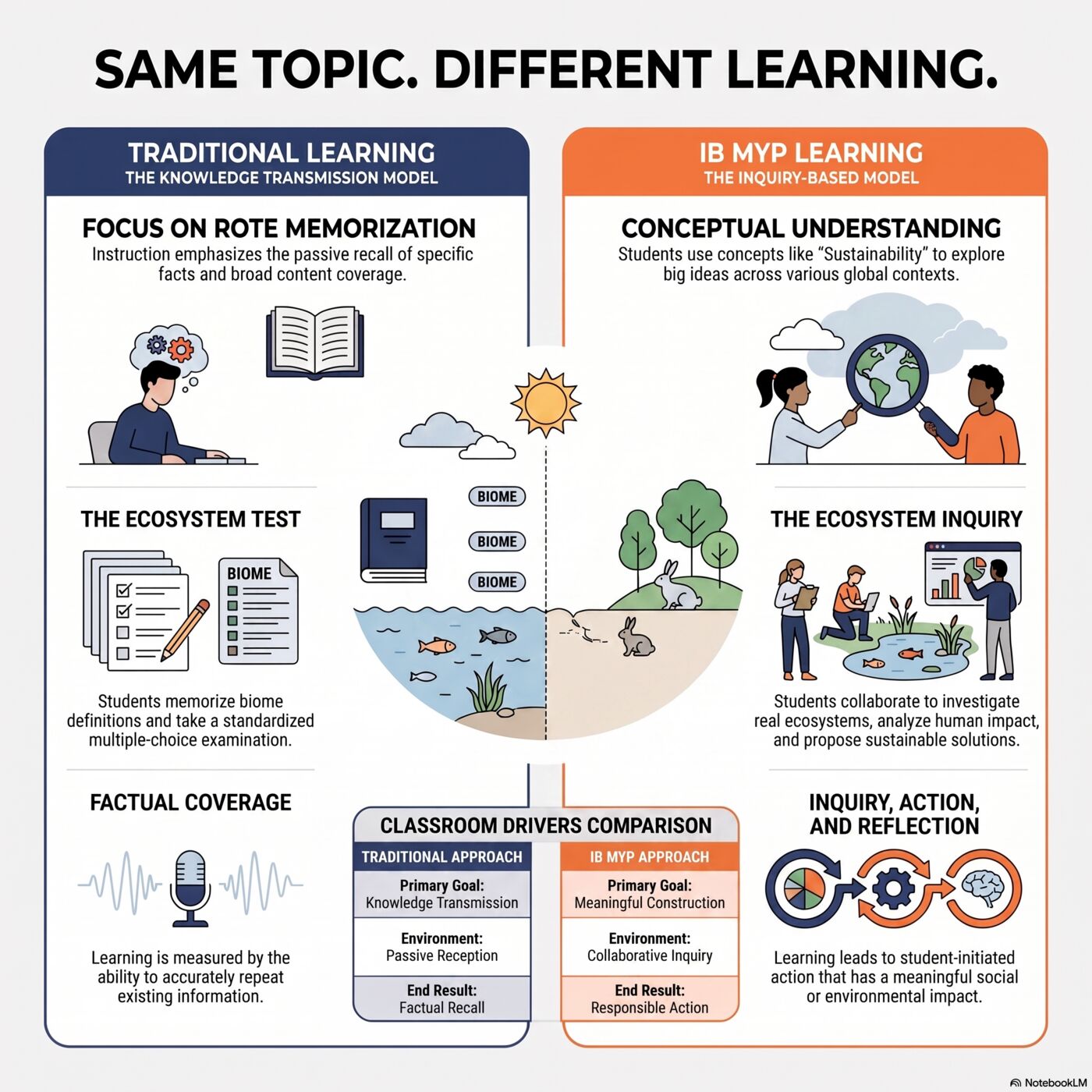
Example 1: Sciences — Ecosystems and Food Webs. Traditional approach: memorize producer/consumer/decomposer definitions for a multiple-choice test. MYP approach: Key Concept Systems, Related Concept Interaction, Global Context Globalization and Sustainability. Statement of Inquiry: "Human interactions with natural systems can disrupt the balance of ecosystems." Students act as ecologists, analyzing the impact of a human intervention (like a dam) on a local food web and proposing a sustainable solution.
Example 2: Design — Furniture. Traditional approach: everyone builds the same birdhouse from instructions. MYP approach: Key Concept Communities, Related Concepts Ergonomics and Adaptation. Statement of Inquiry: "Products must be adapted to fit the ergonomic needs of specific communities." Students research a target audience (e.g., elderly individuals or toddlers), design a custom chair, build a prototype, and evaluate it against that community's needs.
Example 3: Individuals & Societies — The Industrial Revolution. Traditional approach: chronological textbook reading and an essay on dates and inventions. MYP approach: Key Concept Change, Related Concept Causality, Global Context Scientific and Technical Innovation. Statement of Inquiry: "Technological innovations cause irreversible changes to how societies function." Students inquire into historical data and modern parallels (like AI) and defend a position on whether the human costs of rapid industrialization are justified by societal advancement.
Reflection Questions
- Does my current practice reflect backward design? Do I know exactly how my students will be assessed before I plan my daily learning experiences?
- Are my chosen Key and Related Concepts truly driving the inquiry, or are they just labels I added to the top of my lesson plan?
- How would students experience this unit? Would they understand the "why" behind the content through a meaningful Global Context?
- Am I explicitly teaching the ATL skills, or am I just hoping students figure them out on their own?
Quick Checklist: Starting Your MYP Unit Plan
- ☐ Identify the end goal: select the MYP subject-group objectives and design an authentic summative assessment first.
- ☐ Select the concepts: choose one Key Concept and 1–3 Related Concepts that provide genuine depth.
- ☐ Choose a Global Context: anchor the learning in a specific, real-world context.
- ☐ Draft the Statement of Inquiry: combine the concepts and context into one clear, transferable statement.
- ☐ Develop Inquiry Questions: factual, conceptual, and debatable questions to provoke student thought.
- ☐ Target ATL Skills: identify the skills students need and plan explicit lessons to teach them.
Key Takeaways
- The MYP Unit Plan is not a static administrative form; it is a dynamic blueprint guaranteeing alignment between the written, taught, and assessed curriculum.
- MYP planning relies on backward design: identify the summative assessment and objectives before planning daily activities.
- The curriculum is concept-driven: factual content is a vehicle for grasping larger, transferable concepts.
- The planner is divided into Inquiry (Purpose), Action (Process), and Reflection (Impact) — a continuous cycle of educational improvement.
- Reflection is a required, formal part of the planner occurring prior to, during, and after teaching.